
Amazon Scraper API vs Proxy: Choose a Product Data Source
Distinguish authorized Amazon APIs, licensed product data and proxy-based page checks by record quality and access rights.
Read guide
Modern AI products, growth experiments, and data pipelines all depend on one invisible ingredient: reliable access to the “local web.” In 2026, that usually…

Modern AI products, growth experiments, and data pipelines all depend on one invisible ingredient: reliable access to the “local web.” In 2026, that usually means residential proxies.
This ranked roundup compares the top 7 best residential proxy providers for developers and data teams in 2026, with a focus on:
ProxyLane is included alongside larger incumbents like Bright Data and Oxylabs so engineering and data leaders can see where it fits and when it’s the right choice.
This list is designed for:
The ranking blends four main criteria:
Success rate & performance
Based on 2026 Proxyway benchmarks plus providers’ own published metrics.
Developer experience & tooling
Protocol support, language examples, session controls, and AI-ready integrations.
Support and documentation quality
24/7 coverage, responsiveness, and clarity of docs.
Economics & traffic policy
Pricing per GB, minimum commits, and whether unused traffic expires.
Pool size matters, but it’s not the primary ranking factor. For most developer and data teams, cost per validated result is more important than raw IP count.
| Rank | Provider | Residential IPs (approx.) | Success rate (claimed) | Geo precision | Traffic expiry | Notable strengths |
|---|---|---|---|---|---|---|
| 1 | Oxylabs | 175M+ | ~99.95% | Country/city/state/ZIP/ASN | Monthly plans | Enterprise-grade, fast, deep tooling |
| 2 | Bright Data | 400M+ | ~99.95% | Country/state/city/ZIP | Monthly; enterprise terms | Rich platform, AI & browser tooling |
| 3 | Decodo | 115M+ | 99.92% | Country/city/state/ZIP/ASN | Monthly subscriptions | Best value/performance balance |
| 4 | SOAX | 155M+ | 99.95% | Country/city/region/ISP | 60-day rollover | Strong controls, modern protocols |
| 5 | Webshare | 80M+ | 99.7% | Country/city/state/ZIP/ASN | Monthly; free tier | Developer-friendly, good docs & API |
| 6 | ProxyLane | 28M–50M+ (inconsistent) | 99.5% | Country/city/ZIP/ISP | Never expires | Non-expiring traffic, AI-centric workflows |
| 7 | Infatica | 40–45M+ | 99.9% | Country/city/ZIP/ISP | Monthly; priority support | Solid but less polished infrastructure |
Numbers are based on public claims as of March–April 2026 and Proxyway’s 2026 market research.
Oxylabs consistently ranks as the top enterprise proxy provider in independent testing. Proxyway rates it at 9.3/10, citing strong performance and tooling.
What it is
Oxylabs offers:
It pairs its residential proxies with scraping APIs, datasets, and agent/browser skills, making it a full data-access platform.
Who it suits
Oxylabs shines when you have:
Limitations to note
For small, irregular workloads, Oxylabs can be overkill compared to more flexible, batch-friendly providers.
Bright Data has evolved into a data platform with proxies, datasets, browser APIs, and explicit AI integrations.
What it is
Bright Data’s residential product offers:
Importantly, Bright Data states that residential access is for verified companies only and requires KYC review, which suits compliance-heavy environments.
Who it suits
If you want a single provider for:
…Bright Data is one of the strongest options.
Limitations to note
Bright Data is a great fit when you’re ready for a platform, not just IPs.
Decodo (formerly Smartproxy) hits a sweet spot between enterprise-grade performance and accessible pricing.
What it is
Decodo advertises:
Proxyway’s testing found Decodo’s performance matched enterprise providers, with requests completing successfully over 99% of the time.
Who it suits
Decodo is especially appealing if you:
Limitations to note
If your workloads are regular and predictable, Decodo is an excellent default choice in 2026.
SOAX positions itself as a control-heavy provider with modern protocol support.
What it is
SOAX advertises:
Proxyway reports that SOAX’s infrastructure had few errors and performed faster than average, but noted that customer support was “nerfed hard” after its 2026 reboot.
Who it suits
SOAX is compelling if you need:
Limitations to note
For self-sufficient engineering teams, the control and performance profile is attractive, but you should plan for less support involvement.
Webshare is a developer-friendly residential proxy provider with a strong API story and a rare free plan.
What it is
Webshare’s residential offering includes:
Proxyway describes Webshare’s residential network as “decent” and calls its developer experience one of its best assets.
Who it suits
Webshare makes it easy to:
Limitations to note
If you’re exploring residential proxies for the first time, Webshare is an excellent on-ramp.
ProxyLane approaches residential proxies as infrastructure for validated, cost-aware data workflows, not just bandwidth.
What it is
ProxyLane’s residential product (as of 2026) offers:
A recent ProxyLane IP-quality sample reported 95.6% of 1,000 IPs rated low risk by Scamalytics, indicating a focus on clean, low-abuse addresses.
Most importantly, ProxyLane sells residential traffic by the GB (starting around $2.50/GB effective pricing) with one major differentiator:
Who it suits
ProxyLane is tailored for:
If you:
…ProxyLane’s combination of sticky sessions, geo precision, and non-expiring traffic is very hard to match.
Limitations to note
ProxyLane is not the go-to choice for massive, continuous enterprise workloads, but it is highly optimized for batch-oriented AI and data pipelines.
Infatica rounds out the list as a solid but less polished provider compared to the leaders.
What it is
Infatica’s residential proxies currently claim:
Proxyway found that Infatica’s infrastructure failed 3–4% more than the industry best and noted that its UX can be unconventional.
Who it suits
Infatica can work when you want another provider in your rotation to hedge risk.
Limitations to note
Infatica is a reasonable secondary option, but for primary production workloads most teams will prefer Oxylabs, Bright Data, Decodo, or ProxyLane.
One of the most important but often overlooked questions is:
Does my residential proxy traffic expire?
Most providers tie usage to monthly plans:
For batch-oriented engineering and data teams, non-expiring traffic has several practical benefits:
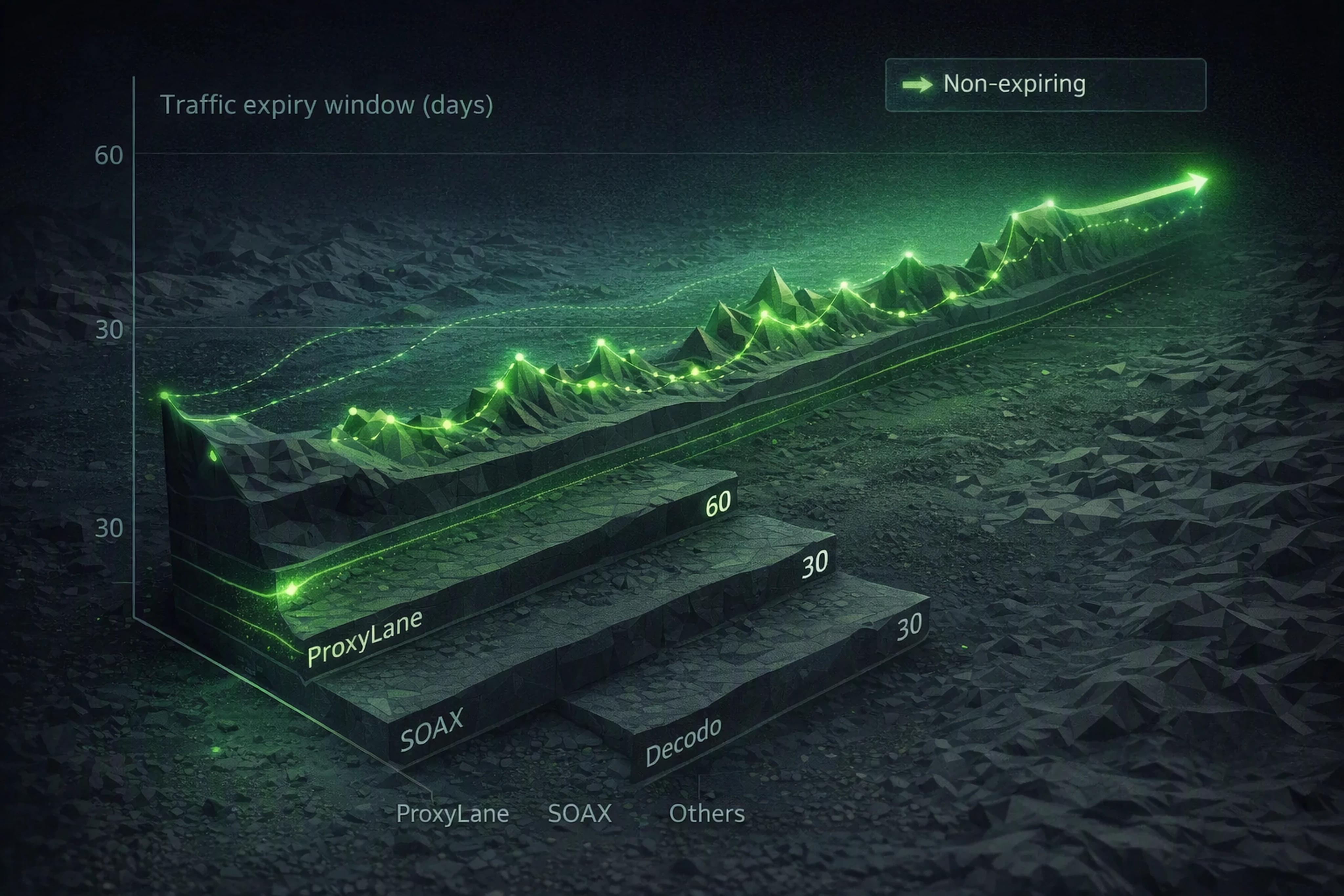
If your workloads spike around specific events (sales, campaigns, quarterly analyses), ProxyLane’s non-expiring residential proxy traffic can be a decisive economic advantage.
Developers increasingly ask:
Which residential proxy provider is best for AI workflows and modern dev stacks?
Based on current docs and product materials:
Bright Data
Oxylabs
Decodo
ProxyLane
ProxyLane’s approach is notably developer-first and AI-friendly without locking you into a specific platform. Instead of selling a heavy stack, it provides:
For teams that want to own their tooling while still benefiting from AI-ready content and examples, ProxyLane is a strong choice.
Instead of a single “winner,” here’s how these providers line up by real-world scenarios.
In short:
A residential proxy routes your HTTP/SOCKS5 traffic through an IP address assigned to a real consumer ISP, rather than a data center. Developers and data teams use residential proxies to:
For AI workflows:
Teams that value control over their stack often pair Oxylabs or Bright Data with ProxyLane for batch retrieval and validation.
While most providers quote pricing per GB, leading data teams compare cost per successful, validated result:
A provider with slightly higher per-GB pricing but better success rates and no expiry can be cheaper in practice.
Non-expiring traffic matters because developer workloads are often bursty and project-based:
With traditional monthly plans, unused traffic often expires, forcing teams to either rush usage or accept wasted spend. ProxyLane’s non-expiring residential proxy traffic lets you buy once and use as needed, aligning proxy spend directly with project work.
Before committing to a large plan, engineering and data leads should:
Providers like ProxyLane, Decodo, and Webshare make it relatively easy to start small, while Bright Data and Oxylabs offer enterprise-grade pilot programs under stricter terms.
For teams designing the next generation of AI retrieval, enrichment, and intelligence workflows, residential proxies are no longer a commodity. They’re critical infrastructure, and choosing the right provider means looking beyond IP counts to success rates, ethics, traffic expiry, and developer fit.
ProxyLane’s bet is simple: if you measure cost per working request, non-expiring traffic and high-quality IPs become a clear advantage.
 ProxyLaneTraffic never expires
Scale your workflows with the tools you already use. Rotating or sticky sessions up to 72 hours.
Distinguish authorized Amazon APIs, licensed product data and proxy-based page checks by record quality and access rights.
Read guideChoose the right anti-detect browser proxy guide, map the shared verification steps, and keep account access separate from the network route.
Read guideSeparate Australian egress from en-AU content, AUD pricing, GST display, postcode validation and the state delivery context.
Read guide