

Amazon Scraper API vs Proxy: Choose a Product Data Source
Compare seller APIs, licensed Amazon product data and proxy page checks by record, access scope and reuse rights.
Read guide
A bounded curl probe separates a proxy CONNECT challenge from origin 401 and 403 responses, with credential-safe checks for Requests and Playwright.

HTTP 407 Proxy Authentication Required means the proxy itself refused the request before the site was ever reached. The fix is in the proxy settings: host, port, username format, password, IP allowlist or account status. A 401 or 403 is different: the proxy let the request through and the site refused it.
For HTTPS through an HTTP proxy, check the CONNECT step separately from the site's answer, and keep proxy secrets out of URLs, command arguments and shared logs.
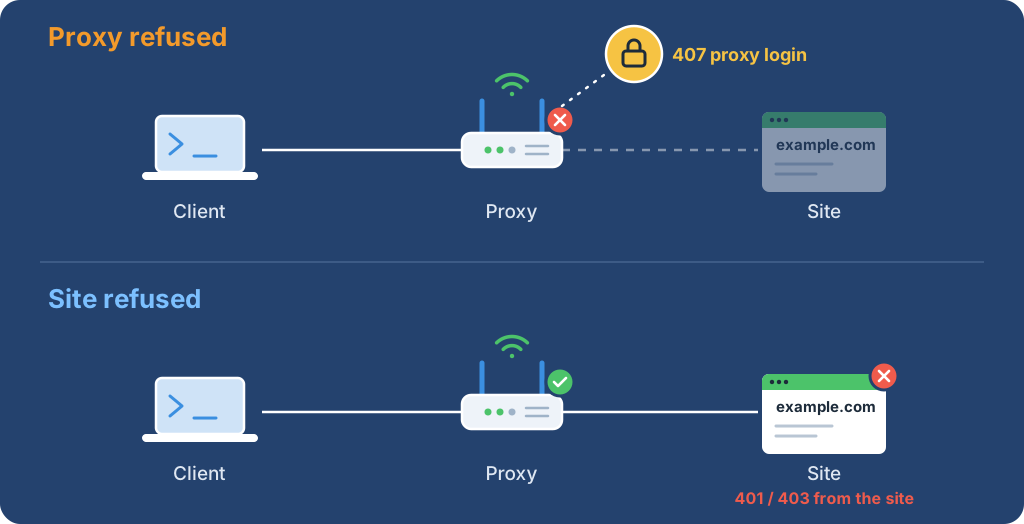
The proxy sends a Proxy-Authenticate challenge, and the client answers with Proxy-Authorization when it has credentials for that proxy. An origin server uses the different 401 and WWW-Authenticate pair; 403 describes a refusal by the responding server.
For an HTTPS target through an HTTP proxy, the client first requests a tunnel with CONNECT. A 407 at that step blocks the tunnel; the destination TLS session has not started. If CONNECT succeeds and the destination later returns 401 or 403, diagnose origin authentication or policy instead.
| Evidence | Responding boundary | Next check |
|---|---|---|
CONNECT returns 407 |
HTTP proxy | Proxy host, port, auth challenge, and account scope |
CONNECT succeeds, target returns 401 |
Destination | Origin login or API credential |
CONNECT succeeds, target returns 403 |
Destination policy | Account permissions, target rules, or source access |
| No HTTP response | DNS, socket, TLS, or protocol | Identify the last completed connection phase |
A corporate chain can contain more than one proxy. A client library can also convert a failed tunnel into an exception instead of exposing a normal target response. Match the failure to the route and endpoint that answered before rotating credentials or changing the target.
Use curl 8.7.1, tested on macOS 26.5.2, and an approved proxy endpoint. Requests and Playwright notes below summarize their official proxy configuration; no provider route is assumed.
Use a fixed HTTPS URL and the approved proxy endpoint. This example assumes a no-auth or Internet Protocol (IP) allowlisted proxy. Set PROXY_URL to http://host:port without credentials; --noproxy '' prevents curl from bypassing that proxy because of a NO_PROXY rule. --disable ignores a local curl configuration file.
The curl --connect-timeout option limits connection setup; --max-time caps the complete transfer. The example values are diagnostic bounds.
: "${PROXY_URL:?Set PROXY_URL to an approved proxy scheme, host, and port}"

curl --disable --proxy "$PROXY_URL" --noproxy '' \
  --connect-timeout 10 --max-time 25 \
  --silent --show-error --output /dev/null \
  --write-out 'target=%{response_code} connect=%{http_connect}\n' \
  'https://example.com/'
target is the final transfer's response code; connect is the last HTTP proxy response to CONNECT, as documented by curl's write-out variables. connect=407 identifies a proxy challenge. connect=200 means that the HTTP proxy accepted the tunnel, after which the target may still return an error. A SOCKS proxy does not use HTTP CONNECT, so this field does not describe SOCKS negotiation.
For a credentialed route, use the provider's documented authentication method through the runtime's secret store or approved credential binding. Do not put a password in --proxy-user, a proxy URL, a shell variable copied into a shared environment, or a diagnostic log. If curl must prompt interactively, first confirm that its prompt behavior matches the installed curl version and that the terminal is private; do not use that method in unattended jobs.
These are configuration checkpoints, not complete client programs. The runnable diagnostic above uses curl; apply each client’s documented setup separately.
In Requests, pass the proxy mapping to the request that needs it, for example {"https": "http://proxy-host:port"}. The scheme in the mapping key describes the destination request; the value describes the proxy URL. Requests documents that environment proxy settings can affect a session, so compare the effective HTTPS_PROXY, ALL_PROXY, and NO_PROXY configuration without printing values that contain credentials.
A rejected CONNECT can surface as requests.exceptions.ProxyError before Requests creates a response object. Record the exception class and route phase, then inspect an approved proxy-side connection record. Avoid logging the raw exception when it may include endpoint details.
Playwright's network documentation supports proxy credentials in browser proxy configuration. Put the username and password in the browser's supported proxy setting, loaded from a secret store at runtime. Do not add Proxy-Authorization through page JavaScript: page code targets the origin request context, while proxy authentication belongs to the intermediary.
Check the proxy's advertised scheme, whether it expects a password or source-IP allowlist, the username format, account status, and endpoint-specific access. A credential accepted by one endpoint does not prove it is authorized on another.
Warning: Proxy credentials can be exposed through shell history, process inspection, traces, or logs. Limit the test to one approved proxy and target, load credentials through the approved secret binding, redact diagnostics, and rotate a credential if it was exposed.
Repeat the same fixed probe after the change. Record the client, proxy scheme, target host, CONNECT status, final target status, and timestamp. If an IP-check endpoint is used, choose a fixed endpoint operated by the team or otherwise explicitly trusted; its response shows only the address observed on that request. It does not prove the target accepts the route or that another destination will behave the same way.
If the status is missing, isolate DNS, TCP, and TLS before changing credentials. The proxy timeout guide separates those phases; the certificate error guide covers trust failures.
 ProxyLaneTraffic never expires
Scale your workflows with the tools you already use. Rotating or sticky sessions up to 72 hours.
Compare seller APIs, licensed Amazon product data and proxy page checks by record, access scope and reuse rights.
Read guideChoose the right anti-detect browser proxy guide, map the shared verification steps, and keep account access separate from the network route.
Read guideOur picks for market research: ProxyLane for small, intermittent projects, plus options for regional tracking, monthly collection and managed extraction.
Read guide