Amazon Scraper API vs Proxy: Choose a Product Data Source
Distinguish authorized Amazon APIs, licensed product data and proxy-based page checks by record quality and access rights.
Read guide
Meta description: Best residential proxy providers for web scraping in 2026 balance ethical sourcing, non-expiring traffic, and 24/7 support.

Meta description: Best residential proxy providers for web scraping in 2026 balance ethical sourcing, non-expiring traffic, and 24/7 support.
The best residential proxies for web scraping in 2026 are the ones that combine ethical sourcing, reliable performance, and strong 24/7 support—not just a big IP pool or a low price per GB.
Cybernews’ 2026 proxy research weights providers by performance (25%), pool size (20%), customer support (15%), reviews (15%), ethics/reputation (15%), and starting price (5%), explicitly moving the market away from “cheapest bandwidth wins” toward “trustworthy, supported infrastructure.” (Cybernews, residential proxy methodology, https://cybernews.com/best-proxy/residential-proxies/, retrieved 2026-10-14; self-reported methodology by Cybernews.)
This article breaks down what “best” really means for residential proxies in 2026, why ethics and support now matter as much as success rate, and how ProxyLane’s compliance stance and 24/7 live chat compare with typical industry practice.
In 2026, web scraping teams buying residential proxies care about:
Imperva’s 2025 Bad Bot Report found that automated traffic reached 51% of all web traffic in 2024, and malicious bots accounted for 37% of total internet traffic (Imperva, 2025 Bad Bot Report, https://www.imperva.com/resources/wp-content/uploads/sites/6/reports/2025-Bad-Bot-Report.pdf, retrieved 2026-10-14; independently researched stats).
With bots now generating more traffic than humans, sites have tightened defenses. That shift makes the quality, reputation, and support behind a residential proxy provider far more important than just pool size or nominal success rate.
When you ask “What are the best residential proxy providers for web scraping in 2026?”, you’re really asking:
For modern scraping, the best residential proxies share a common baseline.
Most top providers in 2026 advertise similar headline features:
Large residential IP pools
Geo‑targeting down to city/ZIP/ASN
Protocol support
Rotating vs sticky sessions
Beyond basic connectivity, web scraping teams now look for:
These criteria map closely to the Cybernews weighting, where performance and ethics/support together account for 55% of the score (25% performance + 15% support + 15% ethics; Cybernews, methodology page, retrieved 2026-10-14).
“Ethical residential proxies” in 2026 is not just marketing language. Buyers increasingly expect, and review sites increasingly score, providers on how they source traffic and treat participants.
Leading providers publish ethics or trust pages with variations on these themes:
Informed participation
Compliance alignment
Abuse mitigation and monitoring
For scraping and data teams, ethics are not only a moral question—they are a risk management question:
A poorly sourced residential network can:
Strong ethical sourcing and compliance claims—especially when backed by audits, clear documentation, and KYC for sensitive targets—can:
When comparing residential proxy providers, ask to see specific evidence, not just the phrase “ethically sourced.” Look for:
In 2026, support has become a primary buying criterion, not a footnote.
Provider pages increasingly advertise:
For scraping teams, support quality directly impacts:
Useful support signals include:
Among residential proxy providers, ProxyLane positions itself squarely in the ethical, support‑focused camp.
According to ProxyLane’s residential proxy documentation (self-reported; ProxyLane, residential proxies, https://proxylane.dev/residential-proxies, retrieved 2026-10-14):
ProxyLane’s feature set aligns with the expectations set by top competitors, while emphasizing session control and fine-grained geo/ISP targeting as first‑class concepts rather than hidden toggles.
ProxyLane’s pricing page (self-reported; ProxyLane pricing, https://proxylane.dev/pricing, retrieved 2026-10-14, UTC) lists:
Crucially, ProxyLane states that unused traffic never expires (self-reported; pricing and product pages, retrieved 2026-10-14). That policy is still relatively rare:
For teams running irregular scraping batches or experimental AI workflows, non‑expiring GBs make it easier to buy bandwidth for specific jobs without worrying about waste.
ProxyLane’s public messaging explicitly references:
These claims appear across ProxyLane’s residential proxy pages and buying guides (self-reported; https://proxylane.dev/residential-proxies and https://proxylane.dev/blog/residential-proxy-buying-guide, retrieved 2026-10-14).
ProxyLane’s own buying guidance urges teams to:
This evidence‑based framing fits with the wider trend toward measurable, compliant, and ethical scraping infrastructure.
ProxyLane’s residential proxies page highlights:
Integration examples in ProxyLane docs (self-reported; https://docs.proxylane.dev/connection-settings, retrieved 2026-10-14) include:
Support that understands these tools and patterns can materially reduce time-to-first-successful-scrape for development teams.
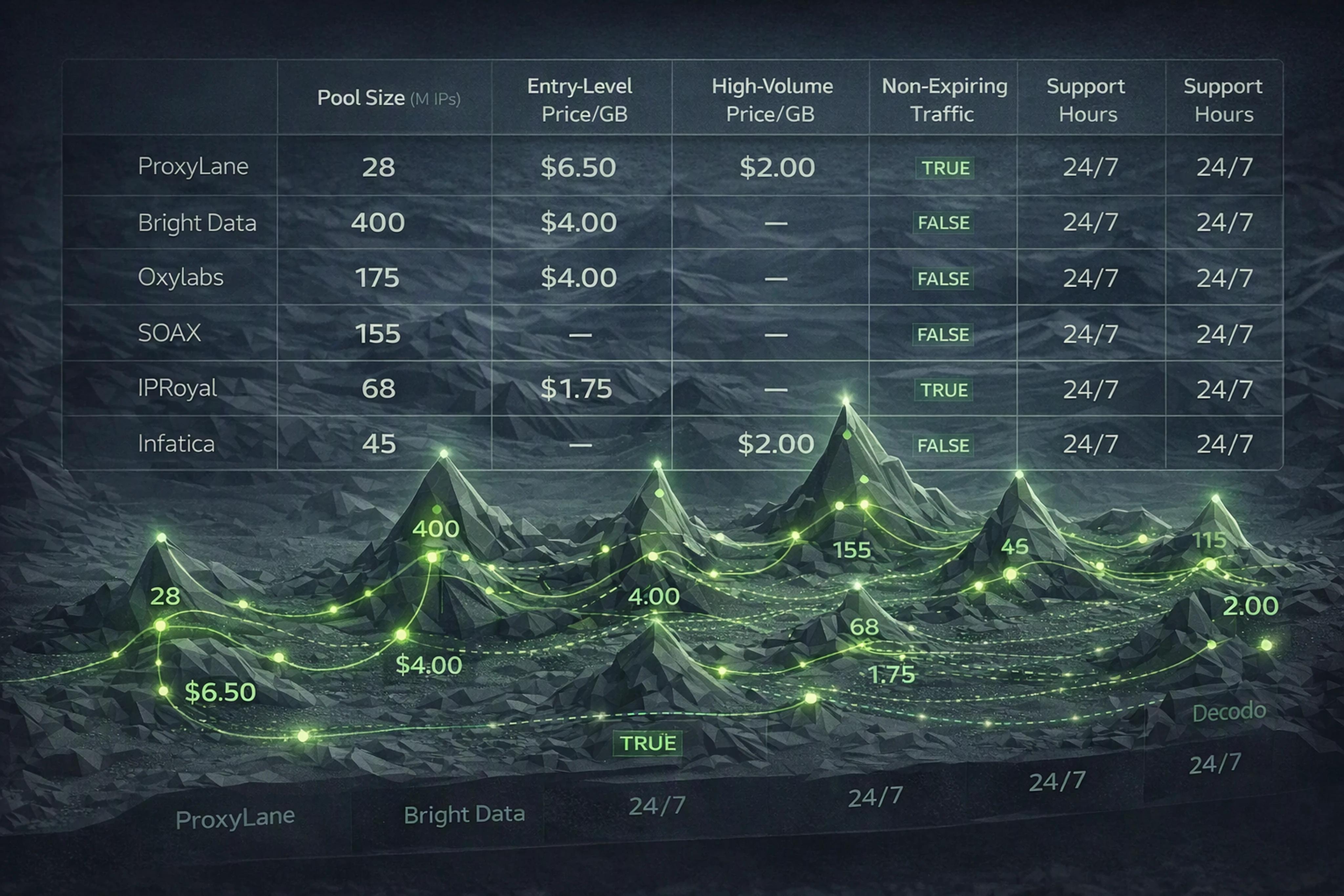
To put ProxyLane in context, here is a simplified comparison against typical industry offerings using self‑reported data as of 2026‑10‑14 (UTC).
<table>
  <thead>
    <tr>
      <th>Provider</th>
      <th>Residential IP Pool (self-reported)</th>
      <th>Indicative Pricing per GB (entry / high volume)</th>
      <th>Traffic Expiration Policy</th>
      <th>Support Hours</th>
      <th>Ethics / Compliance Highlights</th>
    </tr>
  </thead>
  <tbody>
    <tr>
      <td>ProxyLane</td>
      <td>28M+ IPs</td>
      <td>$6.50/GB (1 GB); from $2.00/GB (5 TB+)</td>
      <td>Unused traffic never expires</td>
      <td>24/7 premium support, live chat</td>
      <td>Ethically sourced residential; GDPR & CCPA alignment</td>
    </tr>
    <tr>
      <td>Bright Data</td>
      <td>400M+ IPs</td>
      <td>$4.00/GB pay-as-you-go; lower at monthly volume</td>
      <td>Time-bound plans, monthly/commitment-based</td>
      <td>24/7 support</td>
      <td>Trust center with sourcing ethics, privacy compliance</td>
    </tr>
    <tr>
      <td>Oxylabs</td>
      <td>175M+ IPs</td>
      <td>From $4.00/GB</td>
      <td>Monthly plans / commitments</td>
      <td>24/7 live chat</td>
      <td>KYC for restricted targets; ethical acquisition best practices</td>
    </tr>
    <tr>
      <td>SOAX</td>
      <td>155M+ IPs</td>
      <td>Tiered plans; high-volume pricing around top-market rates</td>
      <td>Monthly/plan-based</td>
      <td>24/7 multilingual support</td>
      <td>Trust page with monitoring, abuse mitigation, ethical use cases</td>
    </tr>
    <tr>
      <td>IPRoyal</td>
      <td>68M+ IPs</td>
      <td>From $1.75/GB for rotating residential</td>
      <td>Residential traffic advertised as never expiring</td>
      <td>24/7 support, avg. 58s response</td>
      <td>Ethical sourcing claims; compliance references</td>
    </tr>
    <tr>
      <td>Infatica</td>
      <td>45M+ IPs</td>
      <td>Tiered plans; high-volume rates near premium segment</td>
      <td>Monthly/commitment-based</td>
      <td>24/7 priority support</td>
      <td>4× ISO-certified infra; ethically sourced proxies</td>
    </tr>
    <tr>
      <td>Decodo (Smartproxy)</td>
      <td>115M+ IPs</td>
      <td>From ~$2.00/GB at high volume</td>
      <td>Monthly plans / volume tiers</td>
      <td>24/7 tech support</td>
      <td>Ethically sourced; compliance-focused messaging</td>
    </tr>
  </tbody>
</table>
Notes:
From this matrix, you can see where ProxyLane differentiates:
Given this landscape, here’s a practical checklist for selecting a provider.
Proxyway’s 2026 market research splits providers into entry-level, mid-market, and enterprise segments (Proxyway, Proxy Market Research 2026, https://proxyway.com/research/proxy-market-research-2026, retrieved 2026-10-14; independent research):
Choose a provider whose positioning and support model matches your scale and risk profile.
Before you look at pricing:
Use a structured test:
Many providers publish high success-rate figures:
Treat these numbers as starting points, then validate them against your workload.
Given the prevalence of CAPTCHAs, blocks, and bot filters:
Providers like ProxyLane explicitly advocate this metric in their buying guides (self-reported; ProxyLane residential proxy buying guide, https://proxylane.dev/blog/residential-proxy-buying-guide, retrieved 2026-10-14).
Finally, make sure the provider fits your stack:
For teams that want developer‑first integration, non-expiring traffic, and ethical sourcing, ProxyLane is one of the providers that explicitly targets these needs (see https://proxylane.dev for current details and documentation, retrieved 2026-10-14).
An ethical residential proxy provider in 2026:
Bright Data’s trust center and Oxylabs’ best-practices article are two public examples of these principles (Bright Data, Trust Center; Oxylabs blog; retrieved 2026-10-14).
Because scraping workloads often run overnight, across time zones, and at high volume:
Providers such as Oxylabs, SOAX, Infatica, IPRoyal, and ProxyLane all advertise 24/7 support as a core product feature (self-reported on their sites, retrieved 2026-10-14).
Not usually, if “cheap” implies:
Given Imperva’s finding that 37% of internet traffic is now malicious bots (Imperva, 2025 Bad Bot Report, retrieved 2026-10-14), sites are more defensive than ever. Saving a few dollars per GB can quickly be outweighed by increased blocks and operational overhead.
A simple way:
You can then compare providers not only on per-GB list price, but on effective cost per usable row, which incorporates success rate, retries, and support quality.
It depends on your workflow:
Rotating proxies work best for:
Sticky sessions work best for:
The best providers in 2026—including ProxyLane, IPRoyal, Decodo, SOAX, and others—offer both modes so you can align session strategy with each scraping job (self-reported; retrieved 2026-10-14).
Choosing the best residential proxy provider for web scraping in 2026 means balancing ethics, compliance, support, performance, and economics. Pool size and list price still matter—but in a world where bots generate more than half of web traffic, trustworthy, well-supported connections are the real differentiator.
 ProxyLaneTraffic never expires
Scale your workflows with the tools you already use. Rotating or sticky sessions up to 72 hours.
Distinguish authorized Amazon APIs, licensed product data and proxy-based page checks by record quality and access rights.
Read guideChoose the right anti-detect browser proxy guide, map the shared verification steps, and keep account access separate from the network route.
Read guideSeparate Australian egress from en-AU content, AUD pricing, GST display, postcode validation and the state delivery context.
Read guide