
This ProxyLane residential proxy service review covers pricing, pay‑per‑GB plans, city/ISP targeting, and how AI agents and data teams use residential proxies for web scraping, LLM evaluation, and production model monitoring across the "local web."
Quick take: ProxyLane proxy service review & best residential proxies for web scraping 2026
If you need residential proxies for AI agents, data teams, and LLM evaluation, ProxyLane is a strong 2026 choice when you care about:
- Non‑expiring bandwidth for batch runs and irregular workloads
- City, ISP, and ZIP‑level targeting for "local web" evaluation datasets
- Sticky sessions up to 72 hours for multi‑step, logged‑in agent workflows
- Simple HTTP/SOCKS5 integration with existing tools (Playwright, Python, cURL, n8n)
As of October 2026, ProxyLane reports 28M+ real P2P residential IPs in 195 countries with traffic starting around $2–2.50/GB effective at scale and never expiring source: ProxyLane product pages, Oct 2026.
This article explains how AI agents and data teams actually use residential proxies for:
- Gathering fresh, contamination‑resistant LLM evaluation datasets
- Monitoring models via trace‑based, web‑native workflows
- Triggering and validating multi‑step agents across region‑specific local webs
And then compares ProxyLane’s pricing & features with other residential proxy providers for web scraping in 2026.
Why AI agents and data teams need residential proxies
AI agents are now a production workload, not just a demo.
Anthropic’s 2026 State of AI Agents report surveyed 500+ technical leaders and found:
- 57% of organizations already use agents for multi‑stage workflows
- 16% use agents across cross‑functional processes
- 81% plan to tackle more complex agent use cases in 2026
- 80% report measurable ROI from agent investments
Source: Anthropic, "The 2026 State of AI Agents" foreword Oct 2026.
As agents move from simple pilots to cross‑functional systems, three proxy‑related needs show up:
- Reliable local‑web access: Sites change content, language, and pricing by user location, and many now block AI bots and datacenter traffic.
- Session continuity: Multi‑step, logged‑in agents need sticky sessions that behave like a real browser user.
- Traceable evaluation and monitoring: Teams want reproducible traces, clean inputs, and known geo locations when grading workflows.
Residential proxies sit at the routing layer of these workflows.
The "local web" problem for AI agents
Geonode notes that many sites return different content, language, prices, or search results depending on IP location and ASN (ISP) Geonode docs, Oct 2026.
At the same time, Cloudflare now lets site owners block AI crawlers and training bots with a single click, identifying top AI crawlers like Bytespider, Amazonbot, ClaudeBot, and GPTBot by request volume Cloudflare blog, Oct 2026.
This combination means:
- Datacenter IPs and obvious AI bots get filtered or served CAPTCHAs.
- Logged‑in agents need to look like stable home users.
- Evaluation datasets must reflect what a local user actually sees.
High‑quality residential proxies, with city/ISP targeting and good fraud scores, are the practical way to route agent traffic through the "local web" without tripping every anti‑bot control.
Residential proxies for LLM evaluation datasets
LLM evaluation is moving away from static, globally visible benchmarks toward fresh, region‑specific, web‑native datasets:
- Anthropic’s BrowseComp work found 9 contamination examples in 1,266 problems, and 11 total items where answers were pulled from benchmark materials instead of original research Anthropic engineering blog, Oct 2026.
- A 2026 systematic review synthesized 55 studies on benchmark contamination up to late 2025 ACL Anthology GEM 2026 paper.
This pushes teams to collect evaluation datasets that are:
- Fresh in time (recently scraped)
- Local in space (city/ISP‑specific)
- Hard to memorize (dynamic inventories, regional offers, rotating content)
How data teams use residential proxies for eval dataset collection
Common patterns:
- Local price and inventory tests: Comparing how an e‑commerce site prices products or shows availability across cities or ISPs.
- Language and content variants: Capturing how the same query surfaces different content in Germany vs the U.S.
- Region‑specific compliance and policy pages: Building eval sets from localized privacy pages, terms, or product notices.
Residential proxies with granular geo controls let teams:
- Route each scraping job through specific country, city, ZIP, and ISP.
- Validate IP geography via IP intelligence APIs before collecting data.
- Maintain sticky sessions for multi‑step browsing and logged‑in state.
ProxyLane, as of Oct 2026, offers:
- 28M+ real P2P residential IPs, 195 countries, city/ISP/ZIP targeting ProxyLane docs, Oct 2026
- Sticky sessions up to 72 hours plus rotating proxies for single‑shot requests
- HTTP(S) and SOCKS5 endpoints that work with standard tools (no SDK)
This combination is well‑aligned with dataset collection for LLM evaluation across diverse local webs.
Residential proxies for AI agents & workflow automation
OpenAI’s evaluation documentation defines an agent evaluation stack around:
- Traces: End‑to‑end logs of model calls, tool calls, guardrails, and handoffs
- Trace grading: Scoring traces to identify workflow‑level issues and regressions
- Datasets and eval runs: Turning graded traces into reproducible test suites
Source: OpenAI, "Agent evals" and "Trace grading" guides Oct 2026 and trace grading docs.
For agents that touch the web, residential proxies affect:
- What pages they see (geo, ISP, fraud score)
- Whether they get CAPTCHAs or errors instead of real content
- Session continuity across navigation, forms, and logins
Cloudflare’s description of browser‑style agents highlights the need to:
- Navigate between pages
- Fill forms and extract data
- Take screenshots
- Support observability and human‑in‑the‑loop handoffs when things break
Source: Cloudflare "Browser Run" announcement Oct 2026.
Where ProxyLane’s session model fits AI agents
For AI agents and automation:
By aligning agent routing with ProxyLane’s session controls, teams can:
- Keep traces reproducible by fixing geo and ISP for a given scenario
- Reduce failure rates from unexpected logouts or IP changes
- Optimize cost per validated result, not just cost per GB
Residential proxies for model monitoring & chain‑of‑thought evals
OpenAI’s 2025 monitorability research introduces a framework with 13 evaluations across 24 environments, arguing that monitoring a model’s internal reasoning can be more effective than monitoring only actions or final outputs OpenAI monitorability paper, 2025.
In practice, model monitoring often involves:
- Running scheduled or triggered web‑based probes (e.g., search + extract + compare)
- Logging traces plus web responses for later review
- Evaluating agents under different regional conditions and site behaviors
Residential proxies enable monitoring setups that are:
- Geo‑aware: The same trace can be tested across multiple cities/ISPs.
- Resilient: Residential IPs typically carry lower fraud scores and see fewer CAPTCHAs.
- Cost‑aware: Pay‑per‑GB models with non‑expiring bandwidth suit low‑frequency monitoring.
SOAX explicitly notes that fraud scores influence whether websites serve content, trigger CAPTCHAs, or block requests, and that residential IPs usually score best because they look like genuine home traffic SOAX troubleshooting docs, Oct 2026.
Geonode warns that if fetchers get a CAPTCHA or error page, that bad page can contaminate downstream LLM grounding datasets Geonode LLM grounding use case, Oct 2026.
For monitoring pipelines, that means:
- Proxies with better IP quality and routing reduce noise in eval traces.
- City/ISP targeting helps simulate real user conditions at scale.
ProxyLane pricing & pay‑per‑GB model vs competitors (web scraping proxies)
Residential proxies pay‑per‑GB pricing explained
Most residential proxy providers use pay‑per‑GB pricing:
- You pay for the volume of data transferred (inbound + outbound) via their proxy.
- Some providers offer roll‑over or non‑expiring bandwidth; others expire monthly.
To compare providers, data teams often convert cost per GB into cost per validated result:
- Validated result: A successful trace or scraping task where:
- The request returns the expected content (no CAPTCHA/error page)
- The IP geography is correct for the scenario
- The agent or script completes the workflow without unhandled failures
A simple example:
- You buy 10 GB of residential traffic.
- Your monitoring pipeline uses 0.01 GB per trace (10 MB).
- The provider’s pool yields a 95% success rate (95 of 100 traces validate).
Then:
- Maximum traces from 10 GB = 10 GB / 0.01 GB = 1,000 traces.
- Successful traces = 1,000 × 0.95 = 950 validated results.
- If pricing is $2.50/GB, total cost = 10 × $2.50 = $25.
- Cost per validated result ≈ $25 / 950 ≈ $0.026 per trace.
This is more informative than cost per GB alone because pool quality, geo accuracy, and session stability directly affect how many of your traces succeed.
ProxyLane residential proxies for web scraping: pricing & features (Oct 2026)
Key specs and pricing snapshots as of October 2026 (sources linked for verification):
-
ProxyLane
- Pool size: 28M+ real P2P residential IPs
- Countries: 195
- Targeting: Country, city, ISP, ZIP
- Sessions: Rotating + sticky, up to 72h
- Pricing: from ≈$2–2.50/GB at effective tiers, minimum packs around $6.50 for 1 GB, traffic never expires
- Protocols: HTTP(S), SOCKS5
- Source: ProxyLane product pages, Oct 2026 proxylane.dev
-
Decodo / Smartproxy
- Pool size: 115M+ IPs
- Countries: 195+
- Targeting: Country/state/city/ZIP/ASN
- Sessions: Rotating + sticky (duration depends on plan), 99.92% success rate, 99.99% uptime
- Pricing: residential from ≈$2/GB at higher tiers, structured in monthly bundles
- Protocols: HTTP(S), SOCKS5
- Source: Decodo residential proxies pricing page, Oct 2026 decodo.com
-
SOAX
- Pool size: 155M+ residential IPs
- Countries: 195+
- Targeting: Country, city
- Sessions: Rotating + sticky; 60‑second session expiration on inactivity
- Pricing: tiered GB packages; residential priced per GB in monthly subscriptions
- Protocols: HTTP(S), SOCKS5
- Source: SOAX developer docs, Oct 2026 developers.soax.com
-
Geonode
- Pool size: 7.5M+ active monthly residential IPs
- Countries: 150+
- Targeting: Country/state/city/ASN
- Sessions: Rotating + sticky; bandwidth roll‑over until cancellation
- Pricing: residential from ≈$0.27/GB at high volume
- Protocols: HTTP(S), SOCKS5
- Source: Geonode residential proxies info, Oct 2026 geonode.com
-
Infatica
- Pool size: 20M+ proxy IPs
- Countries: 195
- Targeting: Country/city/ZIP
- Sessions: Rotating + sticky; KYC required on purchase
- Pricing: residential ≈$0.30/GB depending on plan
- Protocols: HTTP(S), SOCKS5
- Source: Infatica global proxy product page, Oct 2026 go.infatica.io
Residential proxies for web scraping pricing comparison (CSV‑friendly)
Here is a compact comparison table you can lift directly into CSV or spreadsheets.
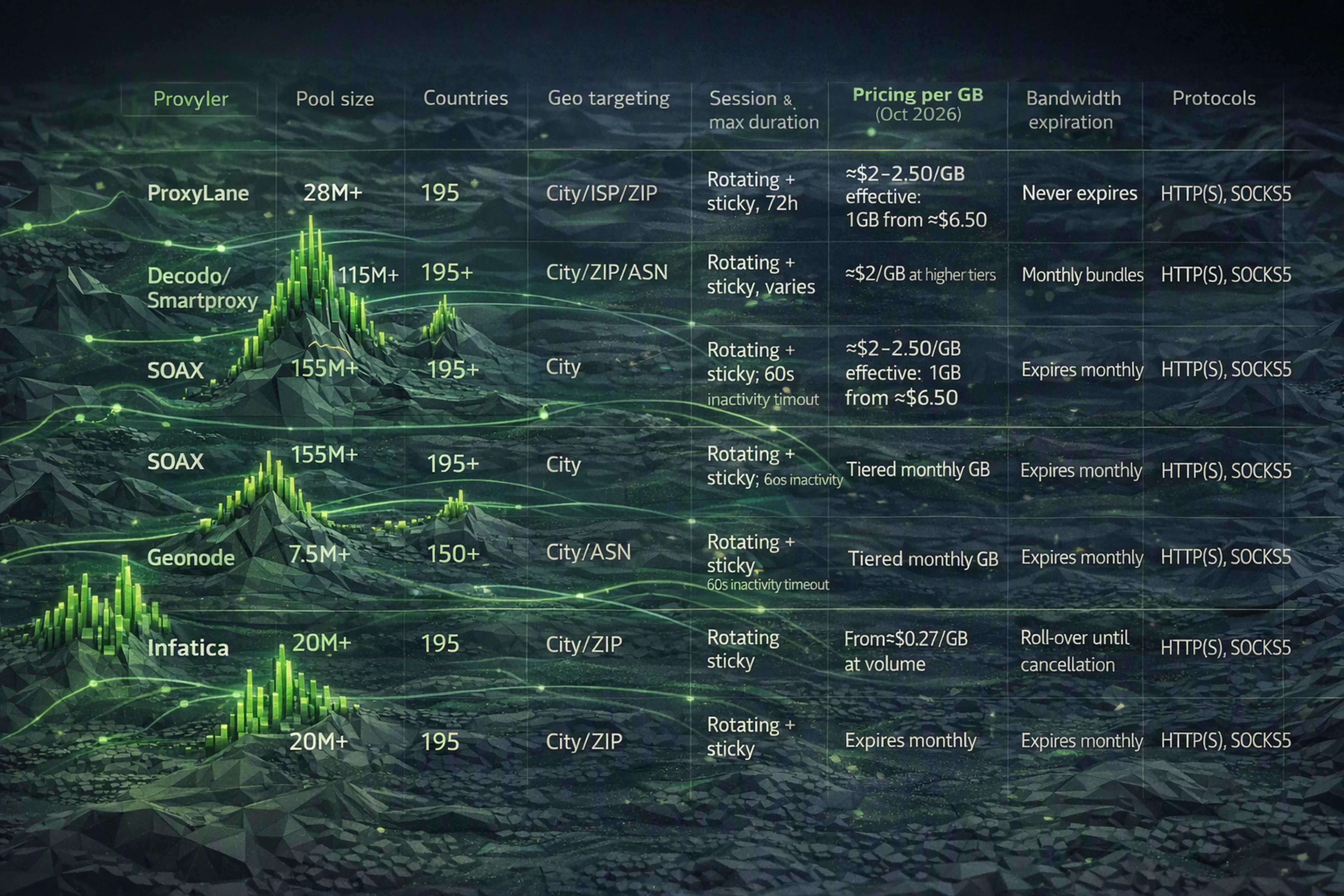
Provider,Pool size (IPs),Countries,City/ISP targeting,Session types & max duration,Pricing per GB (indicative, Oct 2026),Bandwidth expiration,Protocols,Source URL
ProxyLane,28M+,195,City/ISP/ZIP,Rotating + sticky up to 72h,"≈$2–2.50/GB effective; 1GB from ≈$6.50",Never expires,"HTTP(S), SOCKS5",https://proxylane.dev/
Decodo/Smartproxy,115M+,195+,City/ZIP/ASN,Rotating + sticky (varies by plan),"≈$2/GB at higher tiers",Monthly bundles,"HTTP(S), SOCKS5",https://decodo.com/proxies/residential-proxies/pricing
SOAX,155M+,195+,City,Rotating + sticky; 60s inactivity timeout,Tiered monthly GB,"Expires monthly (subscription)","HTTP(S), SOCKS5",https://developers.soax.com/proxies/residential
Geonode,7.5M+ active,150+,City/ASN,Rotating + sticky,Bulk from ≈$0.27/GB,"Roll-over until cancellation","HTTP(S), SOCKS5",https://geonode.com/products/residential-proxies
Infatica,20M+,195,City/ZIP,Rotating + sticky,≈$0.30/GB,"Expires monthly (subscription)","HTTP(S), SOCKS5",https://go.infatica.io/global-proxy
From an AI agents and evaluation perspective, the key differentiators are:
- Bandwidth expiration (ProxyLane, Geonode roll‑over vs monthly expiry)
- Session duration (ProxyLane’s 72h sticky vs shorter timeouts)
- Granular geo/ISP controls (city/ISP/ZIP essential for local‑web scrapes)
If you run irregular batches or low‑frequency monitoring, non‑expiring traffic can materially lower your effective cost per validated result.
Residential proxies for AI agents, data teams, and LLM evaluation datasets: testing checklist
Before you scale, you should treat proxies like any other critical infrastructure.
Here’s a reproducible testing checklist for residential proxies for AI agents, data teams, and LLM evaluation.
1) Validate IP geo and ISP
Use public tools like ipinfo.io or ip-api.com:
- Confirm country, region, and city match your targeting.
- Check ISP/ASN to ensure it looks like residential traffic.
cURL example (HTTP proxy):
curl -x http://USERNAME:PASSWORD@RESIDENTIAL_PROXY_HOST:PORT \
https://ipinfo.io/json
Check the JSON fields ip, city, region, country, and org.
2) Confirm headers and basic request behavior
Inspect request headers from your agent framework or scraper:
- User‑Agent string (browser‑like or tool‑specific)
- Accept‑Language for regional tests
- Any custom headers you use for trace correlation
Playwright example (ProxyLane‑style HTTP proxy):
from playwright.sync_api import sync_playwright
proxy_server = "http://USERNAME:PASSWORD@RESIDENTIAL_PROXY_HOST:PORT"
with sync_playwright() as p:
browser = p.chromium.launch(proxy={"server": proxy_server})
page = browser.new_page()
page.goto("https://httpbin.org/headers")
print(page.text_content("pre"))
browser.close()
Verify that requests actually pass through your residential proxy and carry the headers you expect.
3) Test session continuity (sticky vs rotating)
For logged‑in agents and multi‑step flows:
- Acquire a sticky session (e.g., session token or dedicated endpoint).
- Perform a sequence: login → navigate → form submit → logout.
- Confirm IP address and cookies remain consistent throughout.
cURL sticky session example:
# Step 1: login with sticky session
curl -x http://USERNAME:PASSWORD@STICKY_PROXY_HOST:PORT \
-c cookies.txt \
https://target-site.example/login
# Step 2: authenticated action on same sticky session
curl -x http://USERNAME:PASSWORD@STICKY_PROXY_HOST:PORT \
-b cookies.txt \
https://target-site.example/account
If the site treats the second request as logged‑out or shows a new IP, your session stickiness is not behaving as required.
4) Measure CAPTCHA and error rates
Run a small pilot batch per provider and per region:
- Count total requests vs successful responses (no CAPTCHA, 2xx/3xx status, correct content type).
- Compute success rate: successful responses / total requests.
- Use the earlier cost per validated result formula to compare providers.
This lets you choose the residential proxy provider that minimizes noise in your evaluation datasets and agent traces.
ProxyLane vs competitors: best residential proxy providers 2026
For AI agents and LLM evaluation, the "best residential proxies" in 2026 are less about raw pool size and more about:
- Verified geo and ISP behavior under test
- Session stability for agents
- Transparent economics (non‑expiring bandwidth, clear GB rates)
- Ethical residential sourcing (consent, withdrawal controls, abuse response)
ProxyLane’s differentiators in that context:
- Non‑expiring traffic: Buy GBs for a specific evaluation or monitoring batch, keep unused bandwidth for future runs instead of racing against monthly expiry.
- Granular city/ISP/ZIP targeting: Reach specific local webs to build region‑aware evaluation datasets and simulate realistic conditions.
- Session control as a first‑class concept: Explicit guidance on rotating vs sticky sessions and up to 72h stickiness for multi‑step agent flows.
- Developer‑first integration: Standard HTTP/SOCKS5 endpoints that work with Python, Playwright, cURL, and automation tools without proprietary SDK lock‑in.
Combined with a 28M+ P2P IP pool and 195 countries Oct 2026, ProxyLane docs, those traits make ProxyLane one of the more evaluation‑friendly residential proxy providers for AI agents, data teams, and LLM monitoring.
Using ProxyLane residential proxies for AI agents & data workflows
To connect the dots:
ProxyLane also maintains open‑source "skills" on GitHub that teach AI agents how to set up and verify residential proxies using Python and cURL in a provider‑agnostic way ProxyLane skills repository, Oct 2026. That aligns with the brand’s emphasis on evidence‑based buying and real, working connections rather than lock‑in.
If you want to experiment with these patterns, bandwidth packages and technical docs are available at ProxyLane’s site: proxylane.dev.
FAQ: residential proxies for AI agents, data teams, and LLM evaluation
1. Why use residential proxies instead of datacenter proxies for LLM evaluation?
Residential IPs typically:
- Look like real home users with better fraud scores, so they face fewer CAPTCHAs and blocks SOAX fraud score docs, Oct 2026.
- Capture realistic local‑web behavior (language, prices, inventory) that datacenter IPs may not see.
For LLM evaluation and monitoring, that means cleaner inputs and more representative traces.
2. How do I measure "cost per validated result" with residential proxies?
You can define:
- Validated result as a successful trace or scraping job where the response is correct, geo is accurate, and the workflow completes.
Then compute:
- Traces per GB = (GB purchased) ÷ (GB per trace).
- Successful traces = traces per GB × success rate.
- Cost per validated result = (total spend) ÷ (successful traces).
This lets you compare providers and configurations based on actual outcomes, not just headline pricing.
3. What makes ProxyLane suitable for AI agents and model monitoring?
As of Oct 2026, ProxyLane offers:
- 28M+ P2P residential IPs in 195 countries
- City/ISP/ZIP geo targeting
- Sticky sessions up to 72h
- Non‑expiring pay‑per‑GB traffic
Those traits support multi‑step agents, irregular monitoring pipelines, and region‑specific evaluation datasets.
4. How do I avoid benchmark contamination when using web data?
You can:
- Prefer dynamic, region‑specific datasets collected through residential proxies.
- Cross‑check eval items against known benchmarks (e.g., Anthropic’s BrowseComp contamination analysis Oct 2026).
- Periodically refresh datasets to reduce overlap with training corpora.
Residential proxies help by giving you access to fresh, local content that is harder for general‑purpose models to memorize.
5. Do residential proxies raise compliance or ethical concerns?
Yes, and they should.
Best practice is to:
- Use providers that document informed participation, withdrawal controls, and abuse response.
- Align use cases with legal and platform policies.
- Treat residential traffic as a shared resource that must be used responsibly.
ProxyLane’s buying guides and ethics content encourage teams to seek evidence of responsible residential sourcing, not just low prices.

ProxyLaneTraffic never expires
Scale your workflows with the tools you already use. Rotating or sticky sessions up to 72 hours.