Modern data teams don’t just need “a proxy.” They need residential proxies that can survive rising bot pressure, work with AI agents, and deliver reliable, local web data at a predictable cost.
This ranked roundup compares the top 5 ProxyLane competitors for residential proxies and data collection. It’s written for:
- Data engineers and scientists building scraping or enrichment workflows
- AI teams deploying agents for retrieval and research
- Growth and product leaders running pricing, SERP, and ecommerce intelligence
We rank each provider on four core dimensions:
- Residential proxy quality (pool size, success rate, geo precision)
- Pricing (per-GB cost, billing flexibility, non-expiring vs credits)
- Tooling (scrapers, AI/agent integrations, proxy managers)
- Support & usability (setup experience, documentation, live help)
Throughout, you’ll see where ProxyLane stands out—especially its non-expiring traffic and AI-friendly reliability focused on cost per successful result.
For a deeper dive into ProxyLane itself, including success rates and workflow examples, see this in-depth guide: ProxyLane reviews 2026: features, pricing, and real-world success rates.
Summary: Best Residential Proxy Providers for Data-Intensive Workflows (2026)
Before we go provider by provider, here’s a side-by-side comparison of the main stats and traits that matter for data collection.
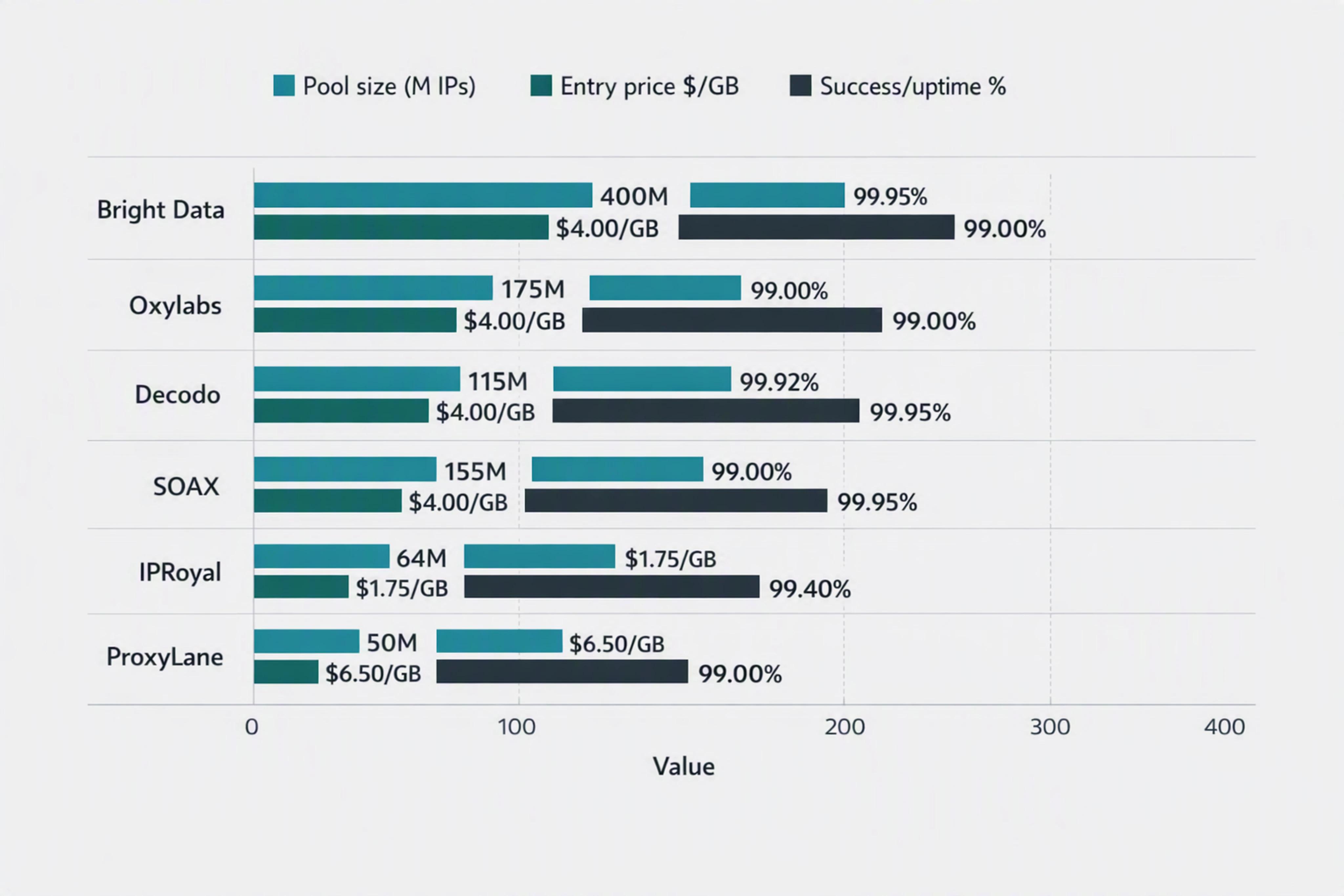
Quick comparison table
| Provider |
Residential IPs (approx.) |
Countries |
Published success / uptime |
Pricing (public, residential) |
Billing flexibility |
Notable differentiator |
| Bright Data |
400M+ |
195 |
99.95% success, 99.99% uptime |
From $4/GB PAYG; ~$2.50/GB at 1TB |
PAYG + high-volume tiers |
Enterprise-grade stack, strict KYC |
| Oxylabs |
175M+ |
195 |
~0.41s response |
From $4/GB; plans from $99/month |
Subscriptions + usage-based |
AI workflows, strong support |
| Decodo (Smartproxy) |
115M+ |
195+ |
99.92% success, 99.99% uptime |
From $2/GB; PAYG $4/GB |
Monthly plans + PAYG |
Mid-market value, broad tooling |
| SOAX |
155M+ |
195 |
99.95% success |
60-day credit rollover; test $1.99 |
Monthly credits + rollover |
Fine-grained geo + session control |
| IPRoyal |
64M+ |
195+ |
99.4% success, ~0.5s resp. |
From $1.75/GB at scale |
Non-expiring traffic |
Budget-friendly, non-expiring bandwidth |
| ProxyLane |
50M+ |
Global |
Focus on verifiable results |
1GB from $6.50; effective from $2.50/GB |
Non-expiring traffic |
Developer-first, quality-focused, AI-ready |
1. Bright Data – Best Overall Enterprise Benchmark
Bright Data is the strongest enterprise benchmark for residential proxies today. If you’re comparing ProxyLane against the most feature-complete, compliance-heavy player, this is it.
What Bright Data offers
-
Pool & coverage
- 400M+ monthly residential IPs
- 195 countries, broad city-level coverage
- 99.95% success rate and 99.99% uptime (public claims)
-
Pricing & billing
- Pay-as-you-go from $4/GB for residential
- Drops to around $2.50/GB at 1TB scale
- Enterprise contracts and custom plans for very large data operations
-
Tooling for data teams
- Scraping APIs and browser automation tools
- MCP server and AI-ready datasets
- Free proxy manager and strong analytics
-
Compliance & ethics
- Human-reviewed KYC for residential access
- Heavy emphasis on legal and responsible usage
This combination makes Bright Data attractive to organizations where legal review, audit trails, and global IT governance are central requirements.
Who Bright Data is best for
Choose Bright Data when:
- You’re an enterprise with dedicated compliance teams and complex approval flows
- You want a full web-data platform (APIs + datasets), not just proxies
- Your workloads warrant high-volume commitments and long-term contracts
Where Bright Data falls short versus ProxyLane
Compared to ProxyLane:
- Billing flexibility is more rigid:
- You get PAYG and tiers, but no non-expiring traffic. Credits are tied to plans and time.
- Setup friction is higher:
- KYC review for residential access adds steps and delays before your first request.
- Cost per experiment can be steep:
- For teams running irregular batches or proofs-of-concept, Bright Data economics can feel heavy versus ProxyLane’s buy-small, keep-forever GBs.
If you measure spend as cost per validated result, Bright Data excels at scale—but ProxyLane often gives smaller teams more room to experiment without wasted traffic.
2. Oxylabs – Enterprise Reliability and AI Workflows
Oxylabs is a close competitor to Bright Data in the enterprise reliability + AI workflows space, pairing a large pool with sophisticated filtering and tooling.
What Oxylabs offers
-
Pool & performance
- 175M+ residential IPs
- 195 countries
- 0.41s average response time (public claim)
- Advanced IP filtering by latency, bandwidth, and quality
-
Pricing & plans
- Residential proxies from $4/GB
- Starter plans from $99/month
- Focus on subscriptions and planned usage rather than casual PAYG
-
Tooling & AI focus
- MCP / AI Studio and AI-oriented workflows
- Browser and proxy manager tools
- Unlimited concurrent sessions, which matters for high-throughput scraping
-
Support & sentiment
- 24/7 live chat and strong reputation for support
- G2 rating around 4.5/5 on 400+ reviews, with users praising reliability
Who Oxylabs is best for
Oxylabs fits data teams that:
- Need high concurrency and consistent low latency
- Want built-in AI scraping workflows without building everything in-house
- Are comfortable with monthly plans and predictable volume
Where Oxylabs falls short versus ProxyLane
Key differences compared to ProxyLane:
Decodo, formerly known as Smartproxy, is a strong mid-market value provider: big enough to be serious, but priced and packaged for developers who don’t need enterprise overhead.
What Decodo offers
-
Pool & reliability
- 115M+ residential IPs
- 195+ locations
- 99.92% success rate
- 99.99% uptime
- <0.5s average response time
-
Pricing
- Residential from $2/GB on larger plans
- $4/GB pay-as-you-go for smaller usage
-
Tooling
- Browser extensions for Chrome/Firefox
- MCP and agent skills for AI workflows
- SDKs and no-code integrations
-
User sentiment
- G2 rating around 4.6/5 with 700+ reviews
- Often praised for support and simplicity
Who Decodo is best for
Decodo is a great fit when:
- You’re a developer or small data team needing a solid proxy pool with quick setup
- You value built-in helpers like extensions and managed tooling
- You want pricing that lands between budget providers and enterprise stacks
Where Decodo falls short versus ProxyLane
Compared to ProxyLane:
4. SOAX – Geo Precision and Structured Workflows
SOAX has carved out a niche for geo-precision and structured proxy workflows, making it compelling for teams that care deeply about location, ASN, and session control.
What SOAX offers
-
Pool & specifics
- 155M+ residential IPs
- 195 countries
- City/region/ASN targeting
- 99.95% success rate
- ~0.55s response time
-
Session & rotation
- Sticky and rotating sessions
- Smart rotation and session preservation aimed at multi-step flows
-
Pricing & rollover
- Monthly credits with 60-day rollover policy
- Test package at $1.99 (400MB for 3 days)
-
Tooling & support
- AI-powered scraping tools
- Managed data acquisition options
- Smaller, but positive review base (e.g., ~66 G2 reviews with high scores)
Who SOAX is best for
Pick SOAX when:
- You need fine-grained geo and ASN control for:
- Localized pricing checks
- Region-sensitive SERP monitoring
- ISP-specific QA and testing
- You want structured session policies baked in
- You’re comfortable with monthly credits and occasional rollover
Where SOAX falls short versus ProxyLane
Relative to ProxyLane:
5. IPRoyal – Budget-Friendly Non-Expiring Traffic
IPRoyal is the closest direct competitor to ProxyLane on billing model: it also offers non-expiring residential traffic, making it a natural comparison for teams who care about not losing unused GBs.
What IPRoyal offers
-
Pool & performance
- 64M+ residential IPs
- 195+ countries
- 99.4% success rate
- ~0.5s average response time
-
Pricing & billing
- Residential from $1.75/GB at scale
- Publicly marketed as non-expiring traffic
- Strong draw for price-sensitive users
-
Tooling & support
- AI-focused Web Unblocker messaging
- 24/7 support
- ~58-second average response time claim
- G2 rating ~4.7/5 on nearly 1,000 reviews, with users highlighting setup ease and support
Who IPRoyal is best for
IPRoyal is a good fit when:
- Budget is the primary constraint, and you still want a serious proxy provider
- You run irregular scraping batches and want to avoid expiring credits
- You value fast, responsive support for troubleshooting
Where IPRoyal falls short versus ProxyLane
Even with similar “never expiring” language, there are differences:
Where ProxyLane Fits in This Landscape
ProxyLane isn’t trying to be the biggest pool or most feature-bloated platform. It’s positioned as premium residential proxies for your next working request, emphasizing:
- 50M+ residential IPs with precise country, city, and ISP targeting
- HTTP and SOCKS5 support with rotating or sticky sessions
- Non-expiring traffic starting at 1GB from $6.50 (effective from $2.50/GB at scale)
- Integration with Playwright, Python, cURL, n8n, and other tools without proprietary SDKs
- A content ecosystem focused on buying guides, sourcing checklists, and workflow examples for AI, enrichment, ecommerce intelligence, and people sourcing
If you care most about:
- Cost per successful result, not just cost per GB
- The ability to validate IP location and behavior before scaling
- Avoiding traffic expiration for irregular data work
- Keeping your stack open and developer-first
ProxyLane sits in a sweet spot between budget providers and enterprise platforms.
Recommendations by Use Case
There’s no single “best residential proxy provider” for every scenario. Instead, match the provider to your workflow and constraints.
For compliance-heavy enterprises
- Bright Data or Oxylabs
- You get full web-data platforms, strict compliance posture, and deep tooling.
For mid-market teams needing balance
- Decodo (Smartproxy)
- Strong pool, solid success rates, and accessible tooling at reasonable mid-market pricing.
For geo-sensitive testing and localized intelligence
- SOAX or ProxyLane
- SOAX for hyper-precise ASN/city targeting within a structured subscription model.
- ProxyLane if you want city/ISP targeting plus non-expiring traffic and provider-agnostic integration.
For budget-focused, irregular scraping
- IPRoyal or ProxyLane
- IPRoyal when lowest headline per-GB pricing dominates the decision.
- ProxyLane when you want non-expiring traffic plus a stronger emphasis on verifiable quality and AI-ready reliability.
For AI agents and experimental data workflows
- ProxyLane
- Open-source skills, standard HTTP/SOCKS5, and content focused on cost per validated result make it especially suited to AI-driven workflows that need real, working connections rather than a complex platform.
FAQ: Choosing Residential Proxies for Data Collection
1. What matters most when comparing residential proxy providers?
For data-intensive workflows, focus on:
- Success rate and uptime (99%+ is now common among top providers)
- Geo targeting precision (country, city, ISP, ASN if needed)
- Session behavior (rotating vs sticky, and how well sessions persist)
- Pricing and billing (per-GB cost, non-expiring vs monthly credits)
- Tooling compatibility (HTTP/SOCKS5, support for Playwright, Python, cURL)
- Ethical and legal posture (clear sourcing, informed participation, KYC where appropriate)
2. Why is non-expiring traffic a big deal for data teams?
Residential proxies traditionally use monthly credits or subscriptions. If your workload is irregular—seasonal scraping, periodic audits, or experimental AI agents—unused traffic can expire unused, turning into sunk cost.
Providers like ProxyLane and IPRoyal offer non-expiring bandwidth, letting you:
- Buy GBs for specific projects or sprints
- Pause and resume without losing traffic
- Treat bandwidth as a durable resource instead of a ticking clock
This often improves cost per successful result, especially for smaller teams.
3. How does ProxyLane differ from typical budget providers?
ProxyLane and budget providers like IPRoyal both market non-expiring traffic, but ProxyLane’s focus is different:
- Emphasis on validated outputs: verifying IP locations, target responses, and session continuity
- Granular targeting: country, city, and ISP selection for local-web access
- Developer-first integration: HTTP/SOCKS5, no proprietary SDK required, and clear session controls
- Educational content around buying proxies based on cost per validated result, not just cheap bandwidth
If you’re optimizing for quality and reliability under AI workflows, ProxyLane aims squarely at that target.
4. Are all these providers suitable for AI agents and LLM workflows?
Most leading residential proxy providers now market AI readiness:
- Bright Data, Oxylabs, Decodo, and SOAX offer MCP, AI studios, agent skills, or managed AI scraping tools.
- IPRoyal pushes AI-focused Web Unblocker features.
- ProxyLane maintains open-source skills that teach AI agents provider-agnostic proxy setup and verification.
The key is to choose a provider that:
- Supports standard protocols (HTTP/SOCKS5)
- Allows you to validate sessions and locations programmatically
- Fits your cost and governance model (non-expiring vs subscription, KYC vs self-serve)
5. How should I run a practical proxy bake-off?
When evaluating ProxyLane and its competitors:
- Define a test workflow (e.g., SERP scraping in 10 cities, ecommerce price checks, or company enrichment).
- Measure success rate and retry behavior per provider.
- Track latency and throughput under realistic concurrency.
- Validate geo accuracy (city/ISP) using independent IP intel.
- Compare effective cost per successful result, not just per-GB headline pricing.
ProxyLane’s buying guides and checklists are designed around this kind of evidence-based proxy buying, helping teams go beyond marketing claims to real-world performance.
If you’re designing data or AI workflows that depend on residential proxies, treat them as core infrastructure. Whether you choose a large enterprise platform like Bright Data or an evidence-focused provider like ProxyLane, the goal is the same: reliable, ethical, and cost-aware access to the local web your requests actually need.
 ProxyLaneFrom $2/GB at 5 TB+
Your next connection
Starts here
Non-expiring traffic, location targeting and rotating or sticky sessions for your existing tools.