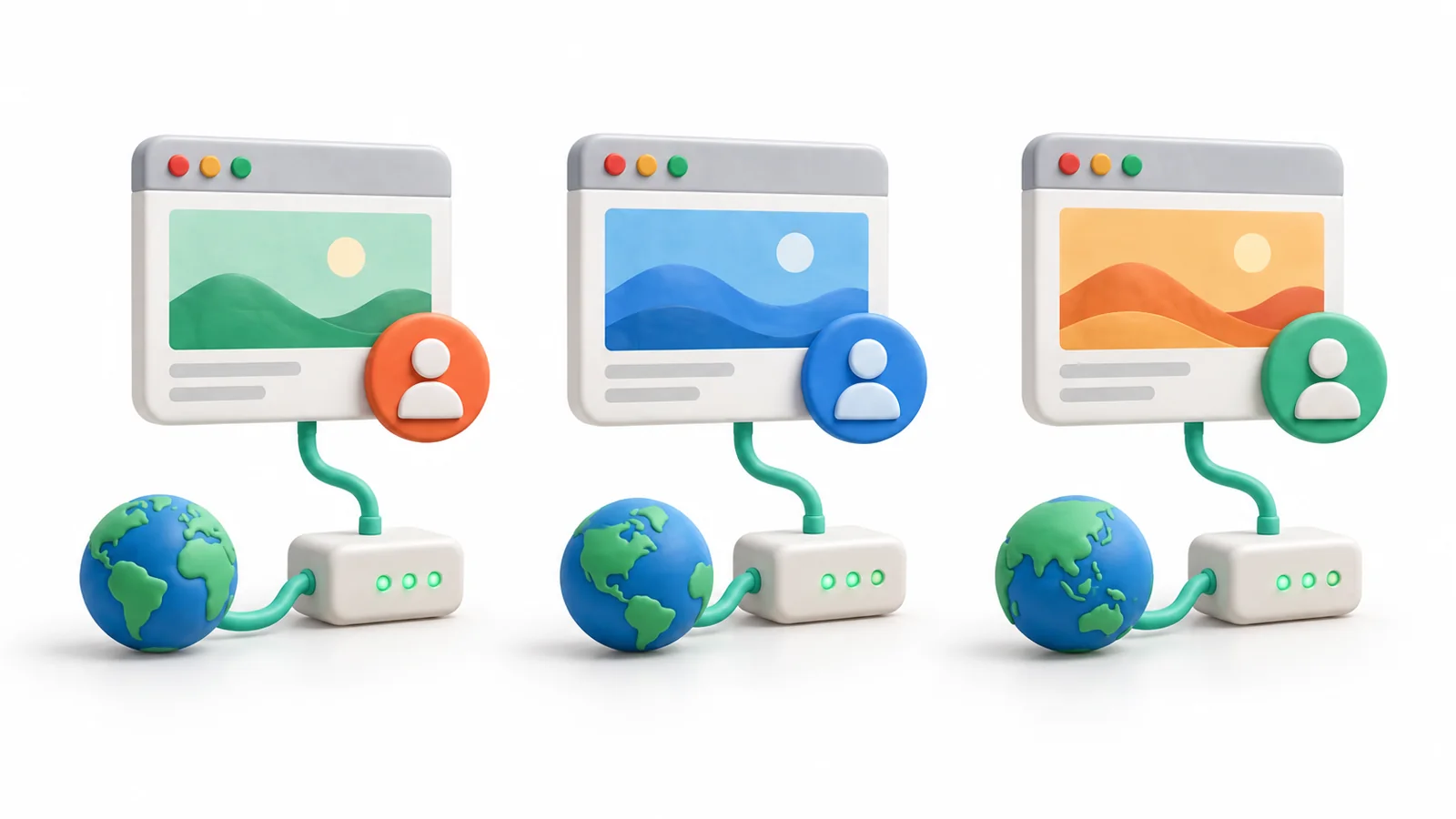

Amazon Scraper API vs Proxy: Choose a Product Data Source
Distinguish authorized Amazon APIs, licensed product data and proxy-based page checks by record quality and access rights.
Read guide
When you’re comparing tools for web data collection, the bottom line is simple: for scraping, enrichment, and AI retrieval that require many concurrent…

When you’re comparing tools for web data collection, the bottom line is simple: for scraping, enrichment, and AI retrieval that require many concurrent, localized requests, residential proxies beat VPNs almost every time. This ProxyLane proxy service review explains why, and shows how modern residential pools outperform VPN tunnels on IP diversity, success rates, and compliance.
Before we get into web scraping and AI workflows, it helps to clarify the primitives.
A residential proxy routes your traffic through IP addresses assigned to real consumer internet connections.
Key characteristics:
Providers like ZenRows (legacy docs) describe residential proxies as a way to route requests through chosen countries to reach geo-restricted content and local search results, with pools such as 55M+ IPs across 190+ countries and ~0.35s average response time (vendor-advertised, as of Oct 2026).
A VPN (Virtual Private Network) creates an encrypted tunnel from your device to a VPN server, then sends traffic out to the internet from that server.
According to OpenVPN’s documentation, a typical setup:
Where VPNs excel:
Where they fall short for data teams:
From a data-team perspective, the key difference is scale and locality.
For scraping, enrichment, and AI retrieval, your workflows often need:
VPNs generally cannot provide all four at once. Residential proxies are built to.
According to OpenVPN guidance, traffic exits through a single VPN server location; residential networks, by contrast, can rotate IPs per request and target country, city, ZIP, ISP, or ASN (retrieved Oct 2026). That’s decisive for:
For most web data tasks, the critical constraints are:
VPNs give you encryption but concentrate traffic on a small set of IPs.
Residential networks:
When Imperva reports that automated traffic surpassed human traffic in 2024 at 51% of all web traffic and bad bots reached 37% of internet traffic (2025 Bad Bot Report, retrieved Oct 2026), it’s clear that anti-bot systems are tuned to spot concentrated, non-human patterns. Residential IP diversity is one way to avoid looking like that.
This section focuses on ProxyLane residential proxies pricing, features, and performance, based on vendor-advertised data (retrieved from proxylane.dev in Oct 2026).
ProxyLane positions itself as premium residential proxies for working requests, emphasizing:
Technical integration is developer-first:
ProxyLane sells traffic by the GB, with non-expiring bandwidth.
Vendor-advertised pricing (proxylane.dev/pricing, retrieved Oct 2026):
Here’s a compact pricing table based on those ranges:
| Plan size (example) | Advertised rate (USD/GB) | Notes |
|---|---|---|
| 1 GB | $6.50 | Non-expiring, small batch tests |
| 50 GB | ~$3.50–$4.00* | Illustrative mid-range estimate* |
| 1 TB (1000 GB) | $2.50 | Approximate scale tier |
*Mid-range pricing often sits between entry and max-discount tiers; check the live pricing page for exact brackets.
ProxyLane’s own positioning stresses cost per successful result, not just cost per GB.
Their messaging includes:
This aligns with broader market trends, where providers like Bright Data bill products such as Web Unlocker per successful request (brightdata.com, retrieved Oct 2026).
Let’s break down the comparison specifically for data workflows.
For 2026 web scraping workloads, data teams usually need:
Residential proxies offer:
VPNs, even when used from multiple endpoints, generally provide:
The outcome for scraping:
Enrichment workflows (company enrichment, people sourcing, ecommerce intelligence) often call third-party sites with stringent anti-bot controls.
Residential proxies help by:
VPNs generally:
AI retrieval (especially RAG on public web data) magnifies all these constraints.
Industry data:
ProxyLane’s own RAG framing is useful here:
So for RAG workflows you need both:
VPNs can secure traffic from your retrieval agents, but they cannot provide the IP diversity and locality that modern AI retrieval must have.
Compliance and sourcing transparency are now first-order buying criteria, especially for enterprises.
Major providers emphasize sourcing practices:
Practical checklist when reviewing residential proxy providers:
VPNs typically focus on:
They rarely provide detailed information on the ethics of IP sourcing, because their infrastructure is data-center or corporate-focused rather than distributed residential nodes.
For brands with legal, compliance, or PR exposure, residential proxies must come with documented sourcing and auditable practices. ProxyLane’s own messaging emphasizes ethical residential networks with informed participation and withdrawal controls (vendor content, proxylane.dev, retrieved Oct 2026).
Here’s a compact, vendor-advertised feature matrix for several residential proxy providers and how they differ from VPN-style access. All figures are based on each vendor’s site as of Oct 2026.

ProxyLane (proxylane.dev, vendor content, retrieved Oct 2026)
Bright Data (brightdata.com, vendor content, retrieved Oct 2026)
Oxylabs (developers.oxylabs.io, vendor content, retrieved Oct 2026)
SOAX (soax.com, vendor content, retrieved Oct 2026)
Budget competitors (e.g., Geonode) (geonode.com, vendor content, retrieved Oct 2026)
Typical VPN service (generalized from OpenVPN and common providers, retrieved Oct 2026)
Note: All numbers above are vendor-advertised and should be verified in live docs before procurement.
From a usage perspective, how does ProxyLane stack up against competitors and VPNs?
Strengths of ProxyLane (vendor-advertised, proxylane.dev, Oct 2026):
Trade-offs compared to large incumbents:
For AI and data teams who want flexible, pay-as-you-go residential proxies with high geo precision and strong session controls, ProxyLane is positioned as a practical alternative without lock-in.
If you currently run scraping or enrichment purely via VPN:
ProxyLane-style residential proxies provide:
For teams ready to test, a practical starting point is a small GB package and a controlled A/B test (see next section).
To experiment with these behaviors in your own stack, you can configure a residential proxy endpoint in Playwright, Python, or cURL using standard HTTP/SOCKS5 settings as documented on proxylane.dev (vendor docs, retrieved Oct 2026).
To evaluate whether residential proxies outperform VPNs for your workflow, run a reproducible A/B test.
For each request, log:
Aggregate metrics:
Suppose over 10,000 requests:
VPN:
Residential proxy:
Here the per-success cost is higher, but if the business value per validated result (e.g., per enriched lead) is $5–$50, the higher cost for more reliable data can be justified. The right answer depends on your use case, but this framework lets you measure it explicitly.
Use residential proxies when you need many concurrent, localized requests with high success rates and diverse IPs. Use a VPN when you need a secure tunnel for a single user or small set of devices, but don’t require large-scale IP rotation or city-level targeting.
Residential proxies usually expose an HTTP or SOCKS5 endpoint like res.proxy-provider.com:port plus credentials. In Python, you configure proxies in requests or set environment variables; in Playwright, you pass a proxy configuration when launching the browser. Providers publish specific Playwright proxy configuration guides and Python residential proxy setup tutorials in their docs.
Residential proxies themselves are a neutral technology. Legality depends on what you access and how you use the data. You should:
Choose providers that emphasize ethical sourcing and informed consent to reduce risk.
Yes. Many residential proxy providers work with no-code automation tools (e.g., n8n, Make, Zapier-like platforms) via standard HTTP or SOCKS5 settings. You typically configure the proxy in a global HTTP client or per-request module, allowing no-code workflows to route traffic through residential IPs without custom code.
Log each request’s outcome (success/fail/block), then compute:
Pair these with cost data (per GB or per month) to calculate cost per validated result. This helps you compare a residential proxy provider and a VPN tunnel based on actual business value, not just headline bandwidth.
By treating residential proxies as web data infrastructure instead of just bandwidth, and testing them against your existing VPN tunnels, data teams can align their scraping, enrichment, and AI retrieval workflows with reliable, ethical, and measurable request success.
 ProxyLaneTraffic never expires
Scale your workflows with the tools you already use. Rotating or sticky sessions up to 72 hours.
Distinguish authorized Amazon APIs, licensed product data and proxy-based page checks by record quality and access rights.
Read guideChoose the right anti-detect browser proxy guide, map the shared verification steps, and keep account access separate from the network route.
Read guideSeparate Australian egress from en-AU content, AUD pricing, GST display, postcode validation and the state delivery context.
Read guide