
Amazon Scraper API vs Proxy: Choose a Product Data Source
Compare seller APIs, licensed Amazon product data and proxy page checks by record, access scope and reuse rights.
Read guide
Choose between Search Console, SERP services, and proxy-based checks. Record location and result context for useful SEO observations.
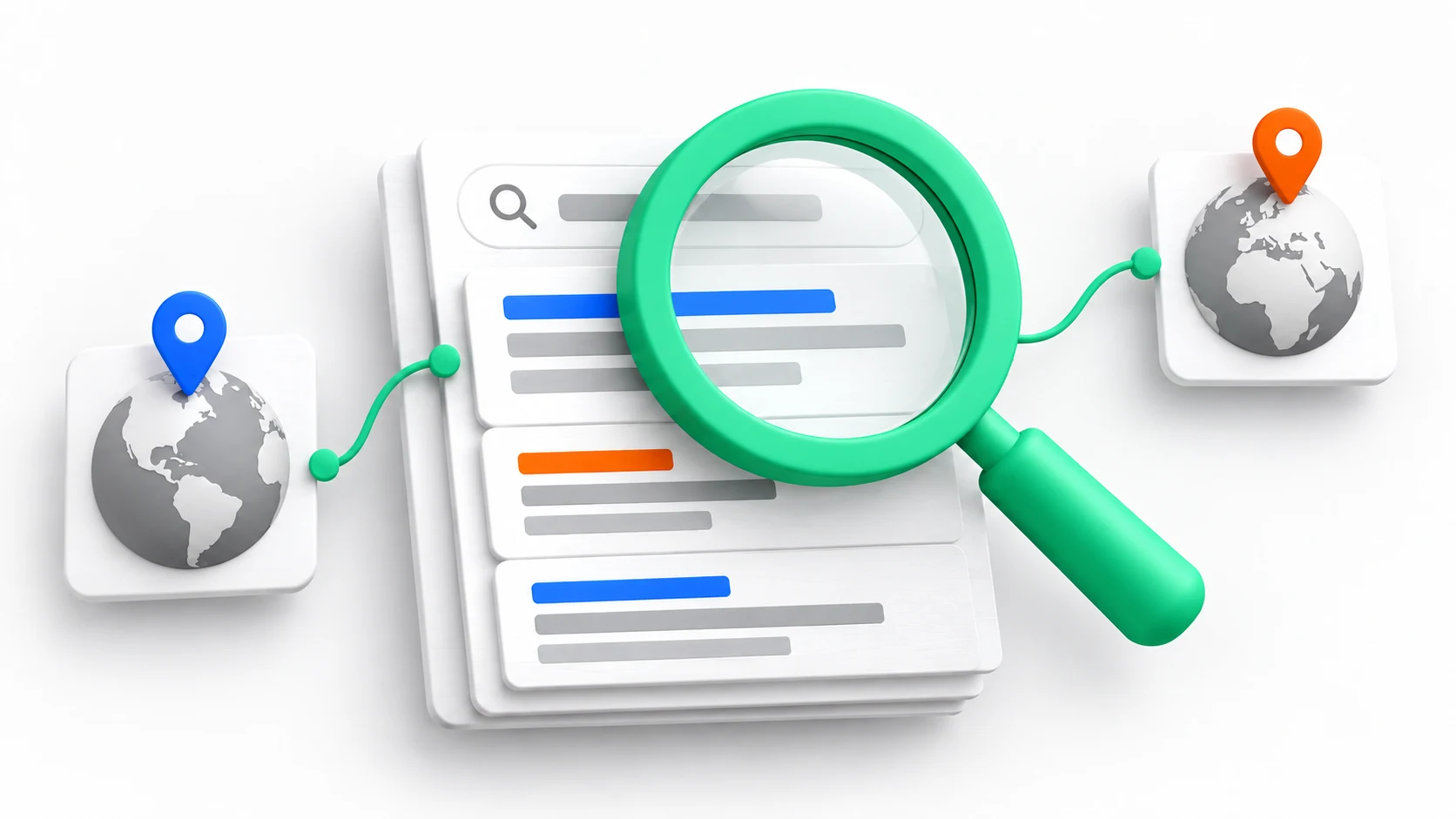
A proxy helps SEO monitoring where location changes the answer: checking what a page looks like from a specific place, such as a Berlin exit for a German landing page, and routing an authorized SERP collector. Clicks and impressions for a verified site come from Search Console with no proxy. Repeatable rank records come from a licensed SERP service or another explicitly authorized collection.
Automated Google Search queries need express permission under Google's machine-generated traffic policy; a residential IP does not change that. Robots.txt is not access authorization either.
This guide is for SEO and data teams choosing a source for performance reporting, a local SERP sample, or a localized page check.
| Question | Suitable evidence | Proxy's role |
|---|---|---|
| Which queries and pages earned impressions or clicks? | Search Console Performance report | None |
| What result appeared for a query in a defined place and time? | Licensed SERP service or explicitly authorized collection | Routes traffic for the permitted collector |
| Did a localized landing page show the intended offer or redirect? | Browser capture of URL, language, and displayed content | Supplies the network exit for that market |
| Did organic acquisition improve? | Comparable Search Console and on-site outcomes over time | None |
Google separates Search Console activity before a visit from Analytics behavior after it. The Search Console Performance report shows impressions, clicks, click-through rate, and average position by query, page, country, and device. Average position is an aggregate, not a fixed rank every searcher sees.
A local SERP sample answers a narrower question: what one collection returned under recorded conditions. It cannot establish clicks, conversions, or a universal rank. Google's third-party SEO guidance also notes that using a service or tool "doesn't guarantee ranking success".
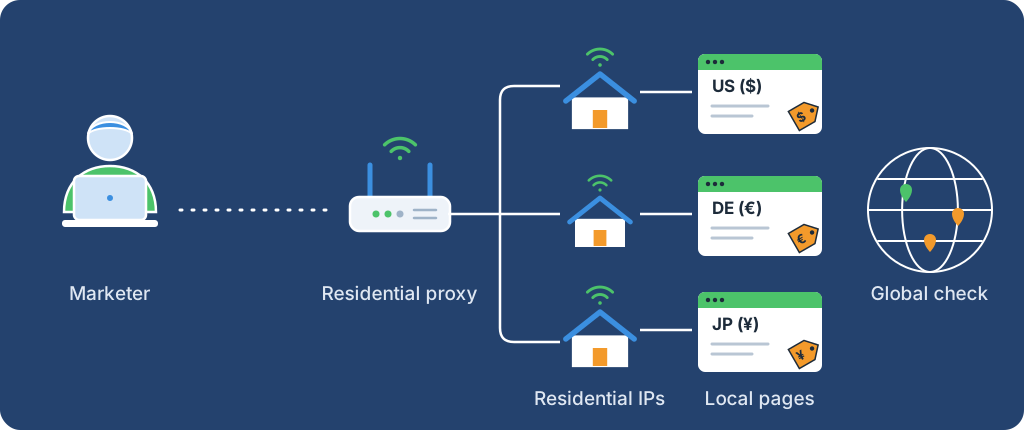
Here the proxy is the tool itself. A team launches a German page and needs to know what visitors in Germany see: the right language, the euro price, the regional offer, and no redirect to the global page.
Caution: Each check uses paid proxy traffic and saves screenshots of a third-party page. Start with a few pages on a small allocation, stop if usage grows faster than planned, and delete captures the retention policy does not allow.
A successful load confirms that one request returned content. It does not establish search visibility or business impact.
When a licensed service or an authorized collector produces rank data, record the conditions with every row:
| Field | Example value | Why it matters |
|---|---|---|
| Query and engine | running shoes, one named engine |
Defines what was asked |
| Requested location | Berlin |
What the collector asked for |
| Observed exit | Germany |
What the network used |
| Language and device | de, mobile profile |
Changes the result set |
| Scope and depth | Organic only, top 20 | Defines how positions are counted |
| Outcome | Accepted, partial, challenge, empty, or failed | Keeps a broken page out of rank data |
Add a rank field only after an authorized, parseable result has been reviewed; the example values above describe a schema, not a measured result. Keep the requested location separate from the observed exit and from any location shown in the result.
Accept a record only when the result set is parseable at the required depth and matches the declared scope. HTTP success alone proves nothing about content. Treat HTTP 429 as a rate limit and follow the source's access policy instead of counting it as an observation.
A city selected in a proxy dashboard does not prove the engine rendered a city-specific result. Keep a city label only when the page context supports it.
| Field | Record for each run | Why it matters |
|---|---|---|
| Collection scope | Query set, engine, location, language, device, depth | Defines which observations compare |
| Outcome | Accepted, partial, challenge, empty, or failed | Stops an incomplete parse counting as success |
| Cost | Provider charge, traffic, retries, accepted records | Gives cost per accepted observation |
| Reproduction | Client, parser version, timestamp, evidence reference | Separates a route change from a parser change |
Compare total cost per accepted observation for the same workload, including retries and parser or browser maintenance. Keep raw proxy traffic separate from a managed SERP product that returns parsed records. If nothing passes the acceptance rule, report trial cost and failure categories instead of a unit cost.
The pricing page lists ProxyLane package terms; a public per-GB rate does not predict cost per accepted result. A proxy changes the network exit, but it does not reproduce a person's search history, account state, or every device signal.
The trade-off between a managed data source and a self-run collector is covered in SERP API vs proxy. The proxy geotargeting guide covers location controls, and the proxy monitoring playbook covers route health.
 CSV + Python
Record location, depth and cost. Run the local validator to separate accepted observations from challenges and mismatches.
Open source · MIT license · Runs locally
Clone the repository and follow the README to connect your proxy. Then run:
python3 evaluate-seo.py seo-example.csv --output seo-demo.jsonDemonstration data, not a provider performance benchmark.
 ProxyLaneTraffic never expires
Scale your workflows with the tools you already use. Rotating or sticky sessions up to 72 hours.
Compare seller APIs, licensed Amazon product data and proxy page checks by record, access scope and reuse rights.
Read guideChoose the right anti-detect browser proxy guide, map the shared verification steps, and keep account access separate from the network route.
Read guideOur picks for market research: ProxyLane for small, intermittent projects, plus options for regional tracking, monthly collection and managed extraction.
Read guide