In 2026, "best residential proxies" no longer just means the largest IP pool or the lowest $/GB. With automated traffic now accounting for 53% of all web traffic in 2025 according to Imperva, web scraping teams are judged on:
- IP reputation and success rate
- Compliance and ethical sourcing
- Session stability and observability
- Cost model and waste (expiring vs non-expiring traffic)
This ranked roundup of the best 6 residential proxy services for web scraping in 2026 focuses on those dimensions, not hype. It’s written for:
- Data and AI teams building scraping and retrieval pipelines
- Growth and product teams doing localized testing, pricing intel, and lead enrichment
- Small businesses and enterprises who care about ethical, measurable web data
If you want a deeper dive into provider ethics and support practices, see this companion guide: best residential proxies web scraping 2026 ethical and support-focused.
How this 2026 ranking was made
This list compares residential proxy providers on four primary axes:
- IP quality & technical capabilities
- Pool size and coverage (countries, cities, ASN/ISP targeting)
- Success rates, typical response times, session controls (rotating vs sticky)
- Compliance & ethical stance
- Trust centers, KYC flows, restricted-use lists, abuse handling
- Evidence of responsible residential IP sourcing
- Support & operational maturity
- 24/7 support, SLAs, account management
- Documentation quality and developer-first integration
- Cost model & pricing transparency
- Pay-as-you-go vs bundles, non-expiring traffic, rollover
- Effective price per GB at realistic volumes
Within that framework, we rank the best residential proxy providers for web scraping in 2026 as:
- Bright Data
- Oxylabs
- SOAX
- ProxyLane
- IPRoyal
- Proxy-Cheap
1. Bright Data – Best overall enterprise stack
Bright Data is the 2026 benchmark for enterprise-grade residential proxies and broader web data infrastructure. It combines a huge residential pool with strict compliance and deep tooling.
What Bright Data offers
- 400M+ monthly residential IPs in 195 countries
- Fine-grained geo: city/state/ZIP/ASN targeting at no extra cost
- HTTP(S) access with browser tools, unlockers, and data collection APIs
- Residential pricing: $4/GB pay-as-you-go, down to $2.50/GB at ~798 GB/month
- Trust center + human-reviewed KYC for residential access
- 24/7 support with SLA-backed options
Bright Data has also extended into datasets, browser automation, and agent/MCP-style products, making it more of a web data platform than just a proxy vendor.
Who Bright Data suits best
- Large enterprises with strict compliance requirements
- Teams needing city-level or ASN-level targeting at global scale
- Organizations deploying multi-region scraping with internal audit requirements
If your legal and security teams are heavily involved in proxy procurement, Bright Data’s trust center and KYC flow can be a strong plus—especially when regulators or partners ask how your residential traffic is governed.
Honest limitation
- Complex and more expensive at small scale.
For small teams or bursty workloads, the combination of KYC onboarding and pricing optimized for hundreds of GB/month can feel heavyweight. You’re paying both for the IPs and the extensive platform/enterprise overhead.
Oxylabs ranks just behind Bright Data as a top-tier provider that emphasizes ethical compliance, high performance, and strong support.
What Oxylabs offers
- 175M+ residential IPs across 195 locations
- Free geo-targeting, HTTP(S)/HTTP3/SOCKS5 support
- Sticky sessions and unlimited concurrent sessions
- Pricing from $6/GB down to $2.50/GB at 1 TB
- 24/7 support with dedicated account managers
- Trust center quoting ISO 27001, SOC 2 Type 2, GDPR, CCPA
- Restricted-target docs to avoid abusive or unclear use cases
Oxylabs positions ethics and governance as product features, not just legal boilerplate. For 2026-era scraping where bad bot behavior is under scrutiny, this matters.
Who Oxylabs suits best
- Mid-market and enterprise teams that need fast, reliable residential traffic
- Buyers who want formal certifications (ISO/SOC2) and clear restricted-use lists
- Operations scaling into hundreds of GB or TB per month, where dedicated support pays off
For AI-driven scraping workflows, Oxylabs’ support for HTTP3 and modern protocols, plus unlimited concurrency, helps when you are pushing high parallelism.
Honest limitation
- Pricing is tuned to volume buyers.
While Oxylabs can work for smaller teams, its sweet spot is clearly high-usage customers. If you only need a few GB per month and care about non-expiring traffic, other providers may be more cost-efficient.
3. SOAX – Best rotation, geo/session control, and docs
SOAX stands out in 2026 for its combination of smart rotation, granular geo targeting, and strong documentation. It explicitly frames residential proxies as “real home internet connections” optimized for both anti-bot resilience and stateful browsing.
What SOAX offers
- 155M+ residential IPs in 195+ countries
- City-level targeting and filters by region, city, and ASN
- HTTP(S), SOCKS5, and support for UDP/QUIC
- Claims 99.95% success rate on proxies
- Published pricing around $5.00/GB (Tier 1) and $3.75/GB (Tier 2)
- 24/7 AI support plus defined human support hours
- Premium SLA tier with 99.9% uptime
SOAX’s mesh-based proxy architecture and rotation options are well-documented, which helps teams designing flows that mix single-request hits with multi-step logged-in sessions.
Who SOAX suits best
- Teams that prioritize rotation intelligence and session controls
- Scraping projects needing fine-grained city/ASN targeting but not full enterprise overhead
- Developers who value clear, modern docs when integrating proxies into Playwright, Python, or headless browsers
Honest limitation
- Pricing and model can be more complex to optimize.
SOAX’s credit-based and tiered structure rewards consistent usage. If you have sporadic or highly bursty workloads, you need to model how credits, tiers, and SLAs line up with your real job schedule to avoid unused capacity.
4. ProxyLane – Best premium niche for cost-aware, non-expiring traffic
ProxyLane is a focused premium residential proxy provider built for developers, data teams, and AI workflows that care about cost per successful result, not just cost per GB. It ranks fourth overall, but first for non-expiring traffic in a high-quality residential pool.
What ProxyLane offers
- 50M+ residential IPs with country, city, and ISP targeting
- HTTP and SOCKS5 support
- Choice of rotating proxies or sticky sessions for logged-in flows
- Traffic sold by the GB starting at 1 GB for $6.50, with effective pricing from $2.50/GB
- Unused traffic never expires — a major differentiator
- Integrations that work with existing stacks: Playwright, Python, cURL, n8n, etc. (no proprietary SDK required)
- Educational ecosystem: buying guides, sourcing checklists, workflow examples for AI retrieval, enrichment, ecommerce intelligence, and people sourcing
- Open-source skills on GitHub that teach AI agents to set up and verify residential proxies provider-agnostically
ProxyLane’s point of view is clear: residential proxies are critical infrastructure for working requests, and you should measure spend by validated results rather than raw traffic.
Why ProxyLane is compelling in 2026
Imperva’s data shows automated traffic is now over half of all web traffic. That makes IP quality, session continuity, and ethical sourcing more important than ever. ProxyLane leans into that reality:
- Emphasizes quality before volume – stable sessions and verifiable locations
- Promotes evidence-based buying with checklists for validating IP geography and target responses
- Advocates for ethical residential networks (informed participation, withdrawal controls, abuse response)
Who ProxyLane suits best
ProxyLane is particularly strong for:
- Small and mid-size teams with irregular scraping or retrieval workloads
- AI and data workflows where each successful, validated result matters more than bandwidth volume
- Buyers who want non-expiring traffic so they can pre-purchase GB for upcoming projects and use leftover bandwidth later
- Teams that prefer developer-first integration (standard HTTP/SOCKS5 clients, no vendor lock-in)
For example, a growth team running monthly ecommerce price checks plus ad-hoc QA can buy a 10 GB bundle, run several batches over months, and keep unused GB for future experiments without worrying about expiry.
Honest limitation
- Smaller pool and ecosystem than the biggest enterprise platforms.
ProxyLane doesn’t try to be a full data platform with datasets, unlockers, or managed scraping services. If you need a very broad set of web data tools under one vendor, Bright Data or Oxylabs may be a better fit. But for cost-aware teams focused on residential proxies with non-expiring traffic, ProxyLane is a strong choice.
5. IPRoyal – Best value/support blend with non-expiring traffic
IPRoyal combines solid IP quality, aggressive pricing at scale, and strong support metrics. It’s one of the few major providers, alongside ProxyLane, that emphasizes traffic that never expires.
What IPRoyal offers
- 64M+ residential IPs in 195+ countries
- Country/state/city targeting
- Rotating or sticky sessions
- Claimed 99.4% success rate and ~0.5s response time
- 24/7 support with average response time around 58 seconds
- Non-expiring traffic; scale pricing down to $1.75/GB at 10 TB
- PAYG around $1.84/GB from the same threshold
- Trust center referencing SOC 2 / ISO 27001 status
IPRoyal’s value proposition is clear: fast support, high success rate, and aggressive per-GB pricing at higher tiers, especially attractive for teams that want non-expiring traffic.
Who IPRoyal suits best
- Budget-conscious teams that still care about support quality and response time
- Operations planning to grow into hundreds of GB or multiple TB of residential traffic
- Buyers who want a mix of rotating and sticky options with non-expiring bandwidth
Honest limitation
- Best pricing appears at high volumes.
While non-expiring traffic is attractive, the lowest per-GB prices kick in at multi-TB levels. Very small teams might not hit those thresholds, so modeling your usage beforehand is important.
6. Proxy-Cheap – Best budget entry point (with caveats)
Proxy-Cheap is often the cheapest way to get started with residential proxies, thanks to very low per-GB prices and pay-as-you-go billing. It rounds out this 2026 ranking as the value-first option.
What Proxy-Cheap offers
- Officially advertises 155M+ IPs across 180+ countries
- Pay-as-you-go residential proxies with no monthly commitment
- Pricing from $0.49/GB, much lower than most competitors
- Policy pages detailing an AUP, abuse-response process, and unsupported destinations/use cases
This makes Proxy-Cheap appealing for early-stage experimentation, small scraping scripts, and teams that simply need to validate a concept before committing to a larger provider.
Who Proxy-Cheap suits best
- Freelancers and small projects needing very low-cost entry
- Experimental or non-critical scraping workloads where occasional friction is acceptable
- Teams that want to test workflows before migrating to a more premium provider
Honest limitation
- Compatibility and inventory caveats.
Proxy-Cheap’s own docs note that some destinations/use cases are unsupported and inventory/locations can vary. For mission-critical, compliance-sensitive, or high-volume 2026 web scraping, you may prefer providers with more explicit governance and consistency.
Comparison: Best residential proxy providers for web scraping in 2026
Here’s a high-level comparison of the best 6 residential proxy services discussed above.
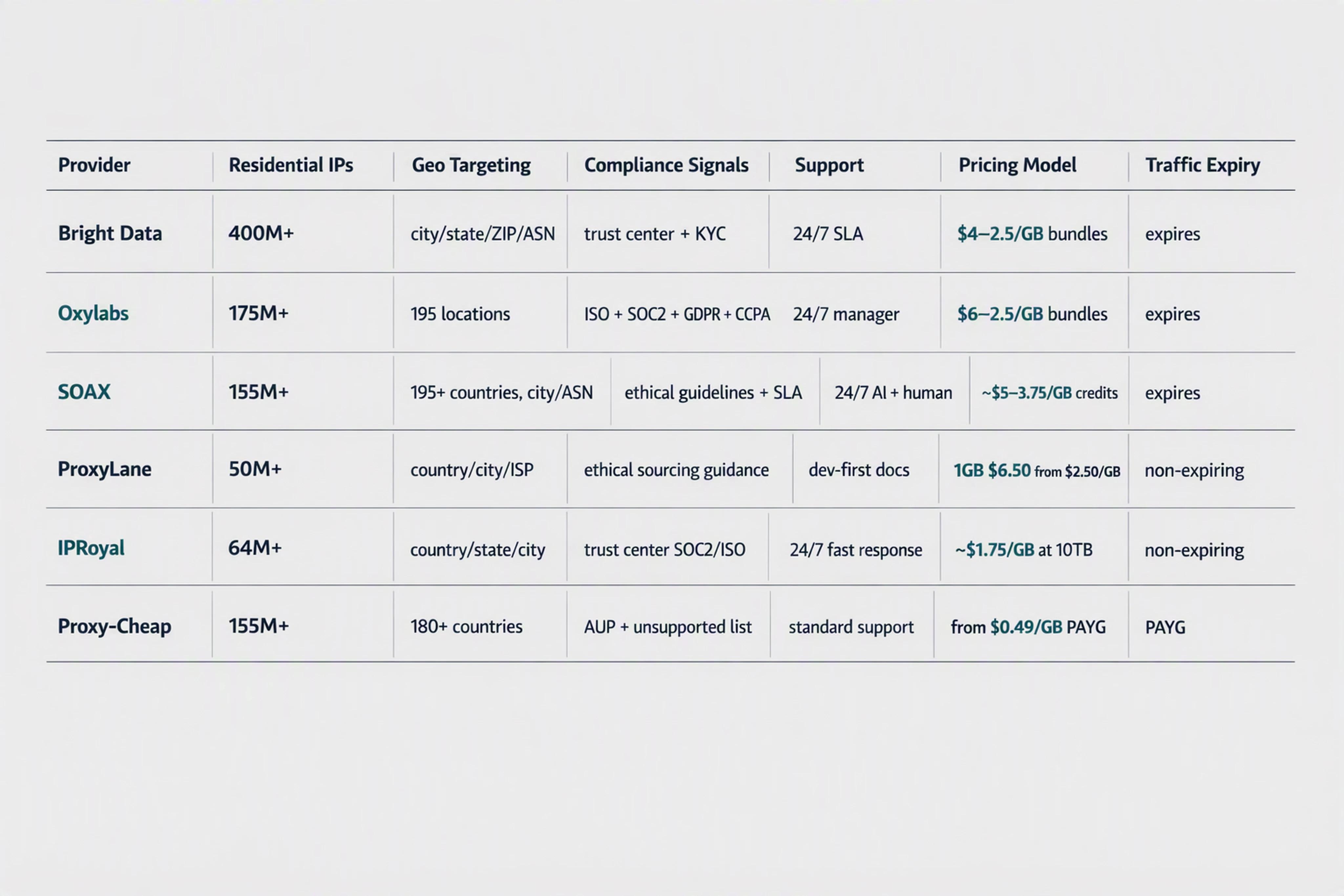
This overview table compares pool size, compliance signals, support, and cost characteristics across the six leading residential proxy providers for 2026 web scraping.
- Bright Data — Residential IPs (approx): 400M+ monthly; Geo Targeting: Country, city, state, ZIP, ASN; Compliance / Trust Signals: Trust center, strict KYC, 24/7 monitoring; Support / SLA: 24/7, enterprise SLAs; Pricing Model & Approx Rates: $4/GB PAYG, down to ~$2.50/GB at 798 GB/month; Traffic Expiry: Standard bundles
- Oxylabs — Residential IPs (approx): 175M+; Geo Targeting: 195 locations, free geo; Compliance / Trust Signals: Trust center, ISO 27001, SOC 2, GDPR, CCPA; Support / SLA: 24/7, account manager; Pricing Model & Approx Rates: $6/GB base, down to ~$2.50/GB at 1 TB; Traffic Expiry: Standard bundles
- SOAX — Residential IPs (approx): 155M+; Geo Targeting: 195+ countries, city/ASN; Compliance / Trust Signals: Ethical guidelines, SLA up to 99.9%; Support / SLA: 24/7 AI + human support; Pricing Model & Approx Rates: ~$5.00/GB Tier 1, ~$3.75/GB Tier 2; Traffic Expiry: Credit/rollover model
- ProxyLane — Residential IPs (approx): 50M+; Geo Targeting: Country, city, ISP; Compliance / Trust Signals: Ethical stance, sourcing guidance; Support / SLA: Dev-first, docs + skills; Pricing Model & Approx Rates: 1 GB from $6.50; effective pricing from ~$2.50/GB; Traffic Expiry: Never expires
- IPRoyal — Residential IPs (approx): 64M+; Geo Targeting: Country, state, city; Compliance / Trust Signals: Trust center, SOC 2 / ISO references; Support / SLA: 24/7, ~58s average response; Pricing Model & Approx Rates: Down to ~$1.75/GB at 10 TB; PAYG ~1.84/GB at threshold; Traffic Expiry: Never expires
- Proxy-Cheap — Residential IPs (approx): 155M+; Geo Targeting: 180+ countries; Compliance / Trust Signals: AUP, abuse response, unsupported target list; Support / SLA: Standard support; Pricing Model & Approx Rates: From ~$0.49/GB, PAYG, no monthly commitment; Traffic Expiry: PAYG, usage-based
Recommendations by use case (not just a single winner)
Rather than picking a single "best residential proxy provider" for 2026, it’s more useful to match vendors to workflows.
For compliance-heavy enterprises
Choose:
- Bright Data if human-reviewed KYC and extensive governance are mandatory
- Oxylabs if you want audited certifications (ISO/SOC2) plus strong ethical controls
Why:
- Both have robust trust centers, restricted-use lists, and enterprise SLAs.
- They’re built to handle internal audits, third-party risk reviews, and regulatory scrutiny.
For high-volume web scraping at scale
Choose:
- Oxylabs or SOAX for high performance and modern protocol support
- IPRoyal if non-expiring traffic plus aggressive per-GB pricing at TB scale is attractive
Why:
- Unlimited concurrency (Oxylabs) and high success rate (SOAX, IPRoyal) matter when you’re running continuous jobs.
- At TB scale, small per-GB differences add up quickly.
For cost-aware, bursty AI and data workflows
Choose:
- ProxyLane as a primary option
- IPRoyal as an alternative when volume is larger and you can hit the best tiers
Why ProxyLane stands out:
- Non-expiring traffic avoids wasted budget on infrequent or experimental jobs.
- Granular country/city/ISP targeting supports localized AI retrieval, testing, and enrichment.
- Developer-first integration (HTTP/SOCKS5, no SDK) keeps you in control of tools.
- Educational guides and open-source skills help design pipelines around cost per successful result, not just bandwidth.
For budget-conscious experiments and early-stage projects
Choose:
- Proxy-Cheap for lowest upfront cost
- Consider ProxyLane or IPRoyal once you start caring about session continuity and validated outcomes
Why:
- Proxy-Cheap’s $0.49/GB starting price is hard to beat for simple trials.
- As soon as your scraping workflows become business-critical, you may want more transparent, verifiable IP behavior.
FAQ: Residential proxies for web scraping in 2026
1. What matters most when choosing residential proxies for web scraping in 2026?
Four factors matter more than headline pool size:
- IP quality and reputation – success rates, response times, and how targets treat the traffic.
- Compliance and ethics – trust centers, KYC, restricted targets, and sourcing transparency.
- Session control – ability to choose between rotating proxies and sticky sessions for logged-in flows.
- Cost model – whether traffic expires, how pricing scales, and how well it aligns with your actual workloads.
The rise of bots to 53% of web traffic means targets are more aggressive about filtering low-quality or obvious automation, so buying purely on cheap bandwidth is risky.
2. Why is non-expiring traffic such a big advantage?
Non-expiring traffic, offered by providers like ProxyLane and IPRoyal, helps in several ways:
- You can pre-buy GB for specific projects and keep unused traffic for future runs.
- Irregular or bursty jobs (monthly price checks, quarterly audits, ad-hoc QA) don’t waste bandwidth.
- It becomes easier to measure cost per successful result, because billing isn’t distorted by expiry.
This is particularly useful for AI and data teams that run experiments and pilots alongside production jobs.
3. When should I use rotating proxies vs sticky sessions?
Use rotating proxies when:
- You’re sending independent, single-step requests to a target (e.g., product pages, public profiles).
- You want to spread traffic across many IPs for resilience and rate-limit avoidance.
Use sticky sessions when:
- You have multi-step flows, like logging in and navigating an account.
- The target maintains state across requests (cookies, session IDs) that must stay consistent.
Providers like ProxyLane, SOAX, Oxylabs, and IPRoyal all support both modes, but ProxyLane specifically emphasizes matching session policy to workflow in its guides.
4. How should I compare proxy providers beyond $/GB?
Look at:
- Cost per successful, validated result, not just cost per GB used.
- Ability to verify IP location and ISP from the target’s perspective.
- Session continuity and recovery – what happens when a request fails or a session breaks?
- Ethical sourcing evidence – informed participation, opt-out controls, and abuse responses.
ProxyLane’s procurement guidance is a good model: test the response your target returns, check session stability, and only then scale up traffic.
5. Do I need a proprietary SDK to use residential proxies?
Generally, no. Most providers, including ProxyLane, SOAX, Oxylabs, and IPRoyal, work via standard HTTP/SOCKS5 credentials. You can plug them into:
- Python scripts (e.g.,
requests, aiohttp)
- Browser automation tools like Playwright or Puppeteer
- cURL, n8n, and other automation platforms
ProxyLane specifically avoids SDK lock-in and even publishes provider-agnostic skills on GitHub that teach AI agents to configure and validate proxies via Python or cURL.
Residential proxies in 2026 are no longer a generic commodity. Whether you’re an enterprise with compliance mandates or a small team optimizing AI workflows, the right provider is the one that gives you working, ethical connections at a predictable cost per validated result. Use this ranking as a starting point, then run small validation batches—particularly with premium, non-expiring providers like ProxyLane—before you scale.
 ProxyLaneFrom $2/GB at 5 TB+
Your next connection
Starts here
Non-expiring traffic, location targeting and rotating or sticky sessions for your existing tools.