Amazon Scraper API vs Proxy: Choose a Product Data Source
Distinguish authorized Amazon APIs, licensed product data and proxy-based page checks by record quality and access rights.
Read guide
Understand what an HTTP connection pool reuses, when clients reconnect through a proxy, and why transport reuse does not rotate an exit IP.
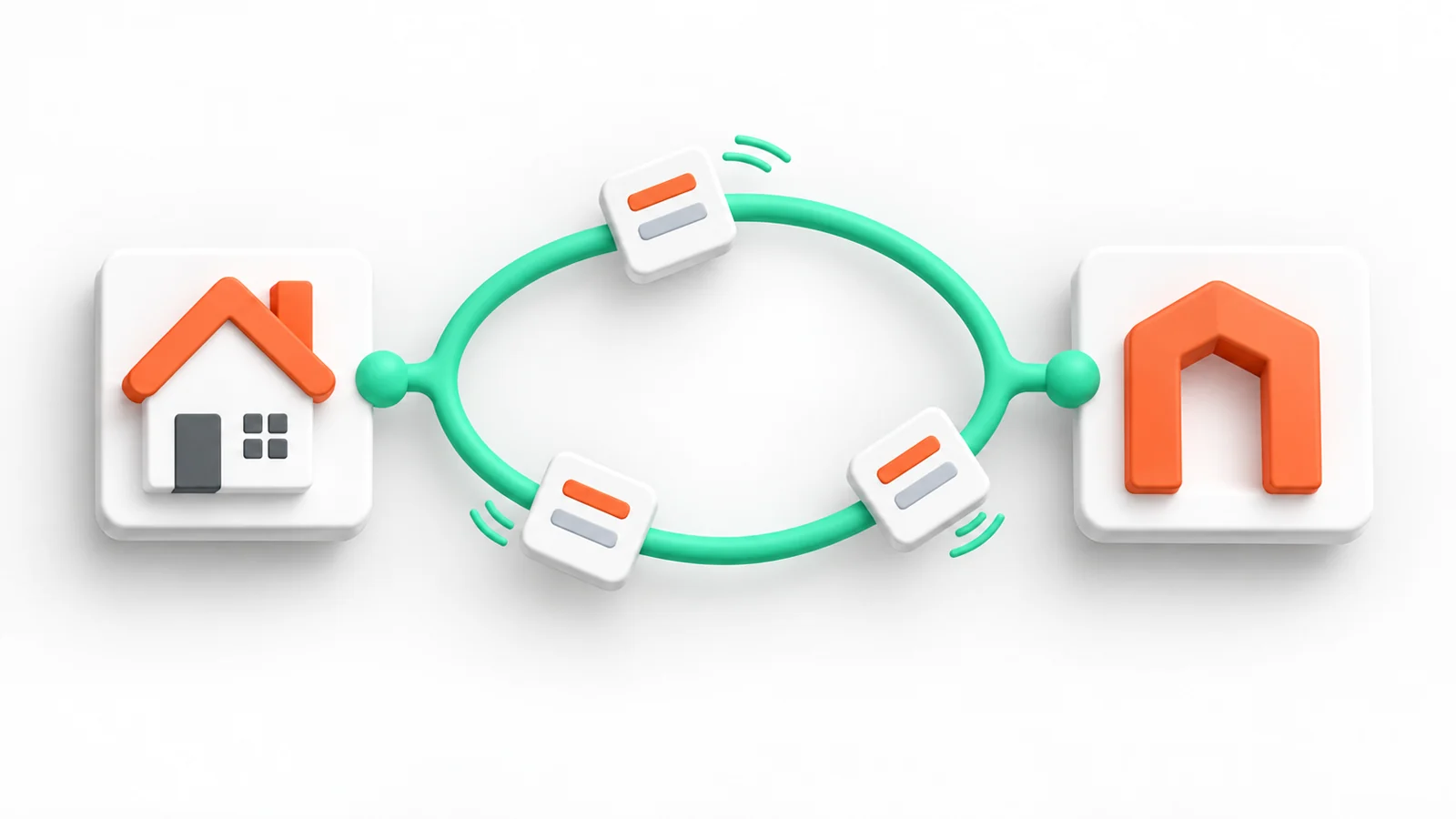
Connection pooling reuses eligible open transport connections across HTTP requests, reducing setup work. It does not set request rate or rotate the proxy exit IP. Check client reuse separately from the provider’s session policy.
An HTTP request asks for a resource or performs an operation. A connection is the transport channel carrying one or more requests. A proxy is a forwarding hop between the client and destination. These objects have different lifetimes: one connection may carry multiple requests, and one application session may use more than one connection.
HTTP/1.1 allows persistent connections unless either side closes them, subject to the protocol’s rules (RFC 9112). A client library decides whether an open connection is eligible for another transfer.
For example, libcurl attempts to reuse persistent connections when conditions allow, and retains its cache on the easy or multi handle (libcurl API overview). This behavior belongs to the client implementation; it is not a promise from every proxy or protocol.
| Layer | What may be reused | What controls its lifetime |
|---|---|---|
| HTTP operation | No; each request is a new operation | Application logic and target response |
| Client connection pool | An eligible open transport connection | Client library, handle/session lifetime, protocol and server conditions |
| Proxy route | A connection through a configured proxy endpoint | Proxy configuration and network availability |
| Exit IP or sticky session | Provider-defined route identity | Provider policy, session identifier, expiry, and product terms |
A keep-alive connection and a sticky proxy session can overlap, but they are not synonyms. A client might open a second connection while retaining the same provider session, or reuse one connection while the provider assigns an exit according to its own policy. Confirm those behaviors with provider documentation and a bounded route check.
Suppose a collector requests many pages from one authorized host through the same proxy endpoint.
Keeping a client session alive may avoid repeated TCP and TLS setup, reducing connection churn. If the client creates and destroys its pool for every page, it loses the opportunity to reuse eligible connections. Reuse still depends on response framing, connection health, server policy, and the client library.
A different workload sends requests to unrelated hosts or needs distinct task identities. A shared pool can retain open sockets longer than a task needs and complicate ownership if sessions or credentials differ.
Set pool limits and client lifetimes at the scope of the task, then measure queueing, open connections, errors, and target responses. Avoid inferring a worker limit from the number of pooled sockets alone; one task can use several connections.
For HTTPS through an HTTP proxy, the client connects to the proxy and requests a tunnel to the destination with CONNECT (RFC 9110). A reusable tunnel is still a transport path. It does not mean the target server treats several requests as one application-level operation, and it does not grant a new target rate limit.
When a connection fails, the client may reconnect. That is a transport recovery action; it is not automatically a request retry, and it does not mean the remote operation failed.
For a write request, a timeout can leave the outcome unknown. Check whether the operation completed before replaying it, or use an idempotency mechanism provided by the target.
A 429 Too Many Requests response signals rate limiting by the responding service, which may be the destination or a proxy. Honor its Retry-After instruction and reduce request pressure; switching proxy exits to continue the same work can evade the target’s limit.
For bounded handling, follow the Retry-After value and stop when a job deadline would require an earlier retry. For worker capacity, the browser concurrency guide covers task and resource ownership.
To verify the layer that changed, keep the client handle alive for a small fixed sequence and record the connection-reuse signal available from that library. Separately query a trusted endpoint through the same proxy to observe the exit IP before and after.
The client signal reports transport reuse. The endpoint reports the exit address it observed at each check. Neither proves that every request used a particular route or that another target will accept it.
 ProxyLaneFrom $2/GB at 5 TB+
Non-expiring traffic, location targeting and rotating or sticky sessions for your existing tools.
Distinguish authorized Amazon APIs, licensed product data and proxy-based page checks by record quality and access rights.
Read guideConnect a buyer-owned proxy to an Apify Actor, keep the session boundary clear, and validate records instead of counting requests.
Read guideSeparate Australian egress from en-AU content, AUD pricing, GST display, postcode validation and the state delivery context.
Read guide