SERP API vs building your own scraper: what’s best in 2026?
If you’re choosing between a managed SERP API and building your own proxy-powered Google scraper, the core trade-off is control vs convenience. Managed SERP APIs handle proxies, browsers, CAPTCHAs, and parsing for a per-search fee, while a DIY stack with residential proxies gives deeper control over location, sessions, and cost per validated result but pushes reliability and compliance back onto your team.
This guide compares the best SERP API options vs building your own proxy-powered search scrapers, with practical math on cost, definitions of key billing terms, and a reproducible way to benchmark both paths.
Disclosure: This article is written from ProxyLane’s perspective. ProxyLane provides residential proxies but does not sell a SERP API. Treat all vendor comparisons as informational, not endorsements.
Key definitions for SERP scraping and billing
Before comparing SERP APIs vs residential proxy stacks, it helps to pin down a few terms.
What is a SERP API?
A SERP API is a managed service that:
- Sends search queries to Google (and often other engines) on your behalf
- Manages proxy rotation, browser or headless mode, and CAPTCHA solving
- Parses the response and returns structured SERP data as JSON
- Bills per search or per 1,000 successful requests
Examples include SerpApi, DataForSEO, Zenserp, and Bright Data’s SERP API.
What is a proxy-powered search scraper?
A proxy-powered scraper is a stack you build and run yourself:
- You call Google directly over residential proxies
- You manage retries, headers, and browser automation
- You parse HTML (or DOM) into structured data
- You pay per GB of traffic and sometimes per IP
Proxy providers like ProxyLane, ProxyEmpire, SOAX, and Bright Data offer the residential networks that underpin these DIY stacks.
Successful request
A successful request is a search query that returns usable SERP data, not an error page or a blocked response.
Practically, that means:
- HTTP 200 from Google (or equivalent)
- The page is not a CAPTCHA or “unusual traffic” interstitial
- Your scraper can parse the content into the fields you expect
Many SERP APIs (e.g., Bright Data and Zenserp) explicitly bill only for successful requests as of 2026-11-16, but always confirm current terms.
Validated result
A validated result is stricter than a successful request.
A search is validated when:
- The response matches the right geography (e.g., user in Berlin sees Berlin SERP)
- The SERP structure passes your schema checks (e.g., organic listings, AI overview, ads are all parseable)
- Downstream quality checks (deduping, content filters, rank checks) accept the record
Most teams care about cost per validated result, not just cost per request or per GB.
Non-expiring traffic
Non-expiring traffic means bandwidth you buy does not disappear on a calendar schedule.
- ProxyLane advertises residential proxy traffic that never expires as of 2026-11-16 (ProxyLane pricing).
- You can buy GB for a batch project and keep unused balance for later.
This matters when your scraping is irregular or experiment-driven.
Sticky session vs rotating proxies
- A sticky session keeps the same residential IP across multiple requests for a period (often minutes to hours). ProxyLane documents sticky sessions up to 72 hours as of 2026-11-16 (ProxyLane features).
- Rotating proxies assign a new IP per request or per short time slice.
Sticky sessions help:
- Multi-step flows (login → search → paginate)
- Consistent personalization and cookies
Rotating proxies help:
- High-volume one-off SERP pulls
- Minimizing per-IP load and obvious automation patterns
Per-GB billing vs per-search billing
- Per-GB billing (proxy providers): you pay for outbound traffic volume measured in gigabytes.
- Per-search billing (SERP APIs): you pay per query, or per 1,000 queries, regardless of bytes.
Implications:
- Per-GB favors careful engineering and HTML-only fetches.
- Per-search favors simple usage and predictable unit economics.
Prices in this article are snapshots as of 2026-11-16 and may change; always check the vendor’s current pricing.
Managed SERP APIs in 2026: major options and pricing
SerpApi pricing & strengths
SerpApi positions itself as a full-browser SERP extraction service.
- Pricing (as of 2026-11-16, from SerpApi pricing):
- Starter: $25/month for 1,000 searches
- Developer: $75/month for 5,000 searches
- Production: $150/month for 15,000 searches
- Big Data: $275/month for 30,000 searches
- Enterprise: from $3,750/month plus usage
- Effective unit price at plan sizes:
- Starter ≈ $25 per 1,000 searches
- Developer ≈ $15 per 1,000
- Production ≈ $10 per 1,000
Strengths:
- Runs searches in a full browser, which SerpApi says better reflects what real users see
- Handles CAPTCHAs and complex SERP surfaces (maps, images, news)
- Simple per-search pricing for Google and other engines
Trade-offs:
- Less control over exact proxy behavior and headers
- Fixed plans can be overkill for small or irregular usage
DataForSEO pricing & strengths
DataForSEO offers granular SERP APIs with pay-as-you-go pricing.
- Google SERP API pricing (as of 2026-11-16, from DataForSEO SERP pricing):
- From $0.0006 per SERP for Google Organic, Maps, AI Mode, News, Images, Jobs, Ads, etc.
- Minimum top-up $50, balance never expires (their wording)
- Effective unit price:
- $0.60 per 1,000 SERPs at list price
Strengths:
- Very low per-search entry price for at-scale scraping
- Coverage for AI Overview / AI Mode surfaces
- Balance that does not expire, which matches batch-style work
Trade-offs:
- Requires more API integration effort
- You still rely on their abstraction for location and session behavior
Zenserp pricing & strengths
Zenserp focuses on Google SERP extraction with only successful requests billed.
- Pricing (as of 2026-11-16, from Zenserp pricing):
- 50 free searches/month
- Small: $49.99/month for 25,000 searches
- Medium: $149.99/month for 100,000
- Large: $299.99/month for 250,000
- Premium: $499.99/month for 500,000
- Enterprise: $899/month for 1,000,000
- Unit price examples:
- Small ≈ $2.00 per 1,000 searches
- Enterprise ≈ $0.90 per 1,000 searches
Strengths:
- Bills only for successful requests as of 2026-11-16
- High-volume plans with relatively low per-search cost
- Covers AI Search / AI Overview surfaces
Trade-offs:
- Monthly commitments rather than pay-per-event
- Less explicit control over geo at the IP level
Bright Data SERP API pricing & strengths
Bright Data SERP API treats SERPs as a specialized product.
- Billing (as of 2026-11-16, from Bright Data SERP API docs):
- Billed per 1,000 successful requests
- Parsing, proxy management, unlocking/CAPTCHA handling, retries included
- Failed requests generally not billed; no bandwidth fee
- Advertises a free tier of 5,000 requests and unlimited concurrency on paid
Strengths:
- Designed specifically for SERP extraction and “unblocking”
- Success-based billing aligns with cost per successful request
- Strong infrastructure and scale
Trade-offs:
- You buy into their full stack; limited control at the proxy/agent level
- Requires KYC and business verification for residential network access (Bright Data residential intro, checked 2026-11-16)
Google Custom Search JSON API (and its sunset)
Google’s own programmable search option is shrinking.
- Pricing for existing users (as of 2026-11-16, from Custom Search JSON API docs):
- 100 free queries/day
- $5 per 1,000 queries, up to 10,000/day
- Roadmap:
- Closed to new customers
- Existing customers must transition by 2027-01-01
- Google now points some use cases toward Vertex AI Search with limited domain scope
Implication: new projects cannot rely on Google’s official web search API and must choose between third-party SERP APIs or DIY scraping.
Residential proxies for Google scraping: options and pricing
Proxy-only stacks are attractive when you need local web visibility, session control, and fine-grained geo targeting.
Below are some residential proxy providers as of 2026-11-16.
ProxyLane residential proxies: pricing and features
As of 2026-11-16, ProxyLane advertises (ProxyLane homepage):
- 28M+ real residential IPs across 190+ countries
- City and ISP targeting for location-sensitive SERP work
- Sticky sessions up to 72 hours and rotating proxies
- Traffic from $2/GB (effective pricing from $2.50/GB in some materials)
- Non-expiring traffic — unused GB never expire
Key traits for SERP scraping:
- Granular geo: country, city, and ISP controls
- Sticky sessions for logged-in and multi-step flows
- Non-expiring traffic suits batch SERP audits and experiments
ProxyEmpire residential proxies
As of 2026-11-16, ProxyEmpire lists (ProxyEmpire pricing):
- Rotating residential proxies from $1.50/GB
- Static residential from $2/IP
- Bandwidth that rolls over (similar to non-expiring traffic)
- 30M+ residential IPs
- Targeting down to country, region, city, ISP, ASN, OS/TCP, and ZIP
SOAX residential proxies
As of 2026-11-16, SOAX advertises (SOAX residential proxies):
- Residential pool with 155M+ IPs across 195+ countries
- Example pricing: $3.00/GB for a 100 GB monthly tier
Bright Data residential proxies
Bright Data’s residential network (separate from its SERP API) shows (Bright Data residential intro, checked 2026-11-16):
- 400M+ monthly residential IPs across 195+ countries
- Residential proxies require KYC-verified business accounts
- Pricing examples from $5.88/GB
Side-by-side: SERP APIs vs proxy-powered scrapers
Here’s a high-level comparison across key dimensions.
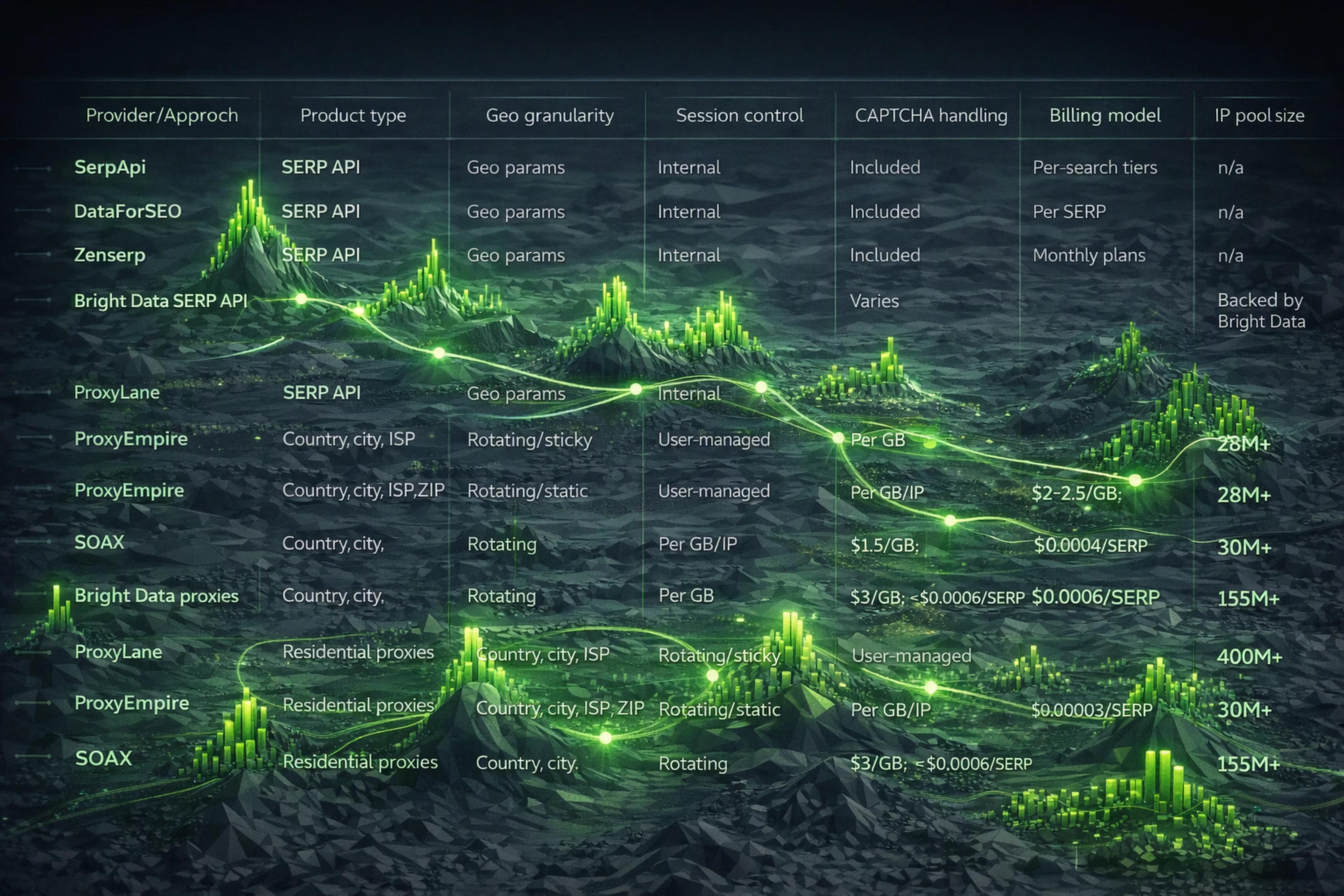
| Provider / Approach |
Product type |
Geo granularity |
Session control |
CAPTCHA/unlock handling |
Billing model |
Sample unit price (2026-11-16) |
IP pool size (2026-11-16) |
Source |
| SerpApi |
Managed SERP API |
Location via API params, not ISP/city |
Hidden (handled internally) |
Included (full browser + solving) |
Per-search plan tiers |
Starter ≈ $25/1,000; Production ≈ $10/1,000 |
Not prominently advertised |
SerpApi pricing |
| DataForSEO |
Managed SERP API |
Geo params, engine-specific |
Hidden |
Included in SERP API |
Pay-as-you-go per SERP |
$0.0006 per SERP (≈ $0.60/1,000) |
Not prominently advertised |
DataForSEO SERP pricing |
| Zenserp |
Managed SERP API |
Geo params |
Hidden |
Included; bills successful only |
Monthly plans, only successful billed |
Small ≈ $2.00/1,000; Enterprise ≈ $0.90/1,000 |
Not prominently advertised |
Zenserp pricing |
| Bright Data SERP API |
Managed SERP API |
Geo params |
Hidden |
Included; success-based billing |
Per 1,000 successful requests |
Exact numbers vary; no bandwidth fee |
Backed by Bright Data network |
Bright Data SERP docs |
| ProxyLane |
Residential proxies |
Country, city, ISP |
Rotating or sticky (up to 72h) |
You manage via your stack |
Per-GB, non-expiring traffic |
From $2/GB (effective ≈ $2–2.5/GB) |
28M+ IPs in 190+ countries |
ProxyLane site |
| ProxyEmpire |
Residential proxies |
Country, region, city, ISP, ASN, ZIP |
Rotating or static |
You manage via your stack |
Per-GB (rotating), per-IP (static) |
From $1.50/GB (rotating), $2/IP (static) |
30M+ residential IPs |
ProxyEmpire pricing |
| SOAX |
Residential proxies |
Country, region, city |
Rotating, configurable |
You manage via your stack |
Per-GB tiers |
Example ≈ $3.00/GB at 100 GB tier |
155M+ IPs across 195+ countries |
SOAX residential |
| Bright Data proxies |
Residential proxies |
Country, city, more via proxy manager |
Session options via config |
You manage; tools available |
Per-GB (residential), KYC required |
From ≈ $5.88/GB |
400M+ monthly residential IPs |
Bright Data residential |
Note: IP counts and prices are snapshots, not guarantees. Always verify current docs.
Cost-per-validated-result: a reproducible benchmarking method
To decide between a SERP API vs building your own scraper, you need a way to measure cost per validated SERP result.
Here’s a simple methodology you can replicate.
Step 1: Estimate bytes per SERP
Your bytes-per-search depend on the fetch mode.
- HTML-only (no assets):
- Typical Google SERP HTML: 50–300 KB compressed
- Safe planning estimate: 200 KB per SERP
- Full headless browser (HTML + assets):
- One SERP page can easily reach 1–5 MB or more
- Safe planning estimate: 2 MB per SERP
For per-GB billing, convert:
- 1 GB = 1,024 MB
- 1 MB ≈ 1,024 KB
Approximate SERPs per GB:
- HTML-only at 200 KB:
- 1 GB ≈ 1,024,000 KB
- 1,024,000 / 200 ≈ 5,120 SERPs per GB
- Full browser at 2 MB (≈ 2,048 KB):
- 1,024,000 / 2,048 ≈ 500 SERPs per GB
Step 2: Translate proxy cost to per-search
Using per-GB list prices as of 2026-11-16:
- ProxyLane from $2/GB:
- HTML-only: 5,120 SERPs/GB → ≈ $0.00039 per SERP
- Full browser: 500 SERPs/GB → ≈ $0.004 per SERP
- ProxyEmpire rotating from $1.50/GB:
- HTML-only: 5,120 SERPs/GB → ≈ $0.00029 per SERP
- Full browser: 500 SERPs/GB → ≈ $0.003 per SERP
- SOAX at $3.00/GB (example tier):
- HTML-only: 5,120 SERPs/GB → ≈ $0.00059 per SERP
- Full browser: 500 SERPs/GB → ≈ $0.006 per SERP
- Bright Data residential at $5.88/GB:
- HTML-only: 5,120 SERPs/GB → ≈ $0.00115 per SERP
- Full browser: 500 SERPs/GB → ≈ $0.0118 per SERP
Compare with SERP API list prices:
- DataForSEO: $0.0006 per SERP
- Zenserp Small plan: ≈ $0.002 per SERP
- SerpApi Production plan: ≈ $0.01 per SERP
Step 3: Factor in success and validation rates
Define:
- Success rate: successful requests / total attempts
- Validation rate: validated results / successful requests
Example:
- SERP API:
- 10,000 searches
- 99% successful (Bright Data SERP-style assumptions)
- 98% validated (correct geo, parseable)
- DIY proxy stack:
- 10,000 searches
- 95% successful (occasional CAPTCHAs and blocks)
- 95% validated
Validated results:
- SERP API: 10,000 × 0.99 × 0.98 ≈ 9,702 validated results
- DIY proxies: 10,000 × 0.95 × 0.95 ≈ 9,025 validated results
Step 4: Compute cost per validated result
Example 1: DataForSEO vs ProxyLane HTML-only.
-
DataForSEO:
- 10,000 SERPs × $0.0006 = $6
- Validated results ≈ 9,702
- Cost per validated result ≈ $6 / 9,702 ≈ $0.00062
-
ProxyLane HTML-only:
- 10,000 SERPs at 200 KB each → 2,000,000 KB ≈ 2,000 MB ≈ 1.95 GB
- At $2/GB → ≈ $3.90
- Validated results ≈ 9,025
- Cost per validated result ≈ $3.90 / 9,025 ≈ $0.00043
Result: in this hypothetical, a well-tuned HTML-only proxy stack is slightly cheaper per validated result than a low-cost SERP API, but requires more engineering and reliability work.
Example 2: SerpApi Production vs Bright Data residential full browser.
Result: with high per-GB pricing and heavy browser payloads, a full-service SERP API can be more cost-efficient.
The takeaway: you must measure your own success, validation, and byte profiles. The winner is context-dependent.
Control, compliance, and location fidelity
Location fidelity: why residential proxies matter
Google’s own docs state that search results depend on location.
- Google says your current location is used to provide more helpful results, and nearby results can appear even when you do not type a location (Google search location help, checked 2026-11-16).
If you’re doing:
- Local SEO audits (e.g., “dentist near me” in multiple cities)
- Pricing intelligence for different markets
- Regulation or content visibility checks per region
Residential proxies with city and ISP targeting allow you to see what a local user sees, not just a generic geo approximation.
Managed SERP APIs typically offer geo parameters, but:
- You cannot independently verify the IP geography they use at runtime.
- You rarely control ISP-level targeting.
With a proxy stack, you can:
- Choose country, city, ISP (e.g., German cable vs mobile)
- Use external tools to validate IP location before scaling
Compliance and risk signals
Google’s support docs frame automated scraping as a potential risk signal.
- Google states that searches sent from robots, computer programs, automated services, and search scrapers can trigger “unusual traffic” messages and reCAPTCHA (Google unusual traffic help, checked 2026-11-16).
Managed SERP APIs:
- Take on most of the unlocking and CAPTCHA handling
- Centralize compliance decisions with the vendor
DIY proxy stacks:
- Give you full control, but also full responsibility:
- Rate limits and concurrency
- Respecting robots.txt and local laws
- Internal policies around what you scrape and how often
For organizations with strict compliance regimes, this can cut both ways:
- Some prefer a single vendor with documented practices.
- Others prefer to keep the entire pipeline in-house for auditability.
Control and observability
SERP APIs abstract away the messy parts but reduce low-level visibility:
- You don’t see browser fingerprints, IP lists, or header sequences.
- You cannot easily test failure modes (e.g., what happens if Google blocks a region).
Proxy-only stacks expose everything:
- You can log IPs, headers, response codes, and retry patterns.
- You can model cost per validated result by region, ISP, and workflow.
For AI retrieval, SEO research, and high-stakes business intelligence, this extra observability is often worth the engineering effort.
When a managed SERP API is enough
Choose a managed SERP API when:
- You prioritize speed of integration over low-level control.
- You need structured SERP data across many engines (Google, Bing, etc.) with minimal effort.
- You’re okay with approximate geo targeting via API parameters.
- Your internal compliance team prefers a clear vendor boundary.
- Your workloads are large enough to amortize monthly plan costs.
Typical use cases:
- Rank tracking across thousands of keywords
- Competitive SEO monitoring
- Lightweight trend and intent analysis
- Prototyping AI agents that rely on SERP data without managing proxies
Data and SEO teams often start here to prove value quickly.
When building a proxy-powered scraper makes more sense
Opt for a proxy-powered Google scraper with residential proxies when:
- Location fidelity is critical:
- You need city-level and ISP-level SERP views.
- Session behavior matters:
- You run logged-in searches, personalization studies, or multi-step flows where sticky sessions help.
- You care deeply about cost per validated result and are willing to invest in tuning HTML-only scraping.
- You want provider-agnostic infrastructure and avoid locking into a single SERP API stack.
Typical use cases:
- Local SEO audits across many cities and ISPs
- Ecommerce and marketplace price intelligence by region
- AI retrieval pipelines that must reflect real local user experiences
- Compliance and moderation teams checking regional visibility and labeling
A residential proxy provider with non-expiring traffic and granular geo targeting (such as proxylane.dev) can form the underlying network for such stacks.
FAQ: SERP APIs vs proxy-powered scrapers
1. Which is cheaper: SERP API or residential proxies?
It depends on:
- Your bytes per SERP (HTML-only vs full browser)
- Your provider’s per-GB or per-search price
- Your success and validation rates
In many scenarios, a well-tuned HTML-only scraper over residential proxies can beat mid-range SERP API pricing on cost per validated result. But full-browser scraping over expensive proxies can be more costly than a specialized SERP API.
2. Do I need residential proxies for Google SERP scraping?
Not always, but residential proxies help when:
- You need true local results in specific cities or ISPs.
- Datacenter proxies are frequently blocked or flagged.
Residential IPs look more like real users, which often reduces friction and improves success rates for location-sensitive SERP work.
3. How do I measure “validated results” in practice?
Common validation checks include:
- Confirming the location reported by IP lookups matches your target.
- Ensuring the SERP HTML contains expected elements (titles, URLs, snippets, AI overview blocks).
- Running downstream rules (e.g., schema validation) and counting only records that pass.
You can log these checks and compute cost per validated result for both SERP APIs and proxy-based scrapers.
4. Are managed SERP APIs safer from a compliance standpoint?
They simplify some aspects:
- Vendors handle unblocking and CAPTCHAs.
- Contracts and docs outline usage expectations.
But they do not remove all risk. You still need internal policies on what you scrape, how often, and how data is stored and used. Proxy-based stacks require more hands-on compliance design but also provide deeper visibility into how requests are sent.
5. Can I mix both approaches?
Yes. Many teams use:
- SERP APIs for broad monitoring and low-stakes data
- Residential proxy scrapers for deep local drills and specialized workflows
This hybrid approach balances integration speed with control and location fidelity.
In 2026, the choice between a SERP API vs building your own scraper is no longer one-size-fits-all. Map your decision to location fidelity, session needs, cost-per-validated-result, and compliance constraints, and treat both SERP APIs and residential proxies as interchangeable components in a larger data pipeline rather than mutually exclusive bets.
 ProxyLaneTraffic never expires
Scale your workflows with the tools you already use. Rotating or sticky sessions up to 72 hours.