
Amazon Scraper API vs Proxy: Choose a Product Data Source
Compare seller APIs, licensed Amazon product data and proxy page checks by record, access scope and reuse rights.
Read guide
For SMB data teams choosing between Webshare and ProxyLane, the core trade-off is simple:

For SMB data teams choosing between Webshare and ProxyLane, the core trade-off is simple:
The rest of this comparison unpacks that short answer along four criteria that actually matter for small and mid-size data teams:
We’ll close with concrete recommendations for bursty scraping, ongoing AI retrieval, and mixed proxy fleets, plus alternatives beyond Webshare and ProxyLane.
Before diving into details, it helps to state the comparison criteria explicitly. For SMB web scraping and AI workflows, these four dimensions usually decide the choice:
Success rate & operational reliability
Geographic depth & targeting
Pricing model & cost control
Day-two reliability
The table below summarizes Webshare vs ProxyLane on each of these criteria.
| Criterion | ProxyLane | Webshare | SMB takeaway |
|---|---|---|---|
| Pricing model | Residential-only, from $2/GB, effective $2.50/GB at 1 TB; traffic never expires, pay-as-you-go. | Rotating residential from $3.50/GB down to $1.40/GB at large monthly volumes; monthly bandwidth does not roll over. | ProxyLane fits bursty / irregular workloads; Webshare suits teams that consume predictable monthly volume. |
| Success & reliability signals | Publishes ~0.35s avg response time, 9.8/100 risk score, and 98.7% of sampled IPs low-risk; independent test: 99.8% success (2,994/3,000), 2.10s avg response time. | Claims 99.7% average success rate and 99.97% uptime; independent test: 98.6% success (986/1,000), 2.39s avg response time. | Webshare wins on headline uptime/success claims; ProxyLane on IP-quality transparency and measured field tests. |
| Geographic depth | 28M–50M+ residential IPs, 195 countries, with country, city, ISP, ZIP, ASN targeting and ~230 locations highlighted. | 80M+ residential IPs, 195 countries, with country, city, state, ZIP, ASN targeting. | Webshare has the larger pool and slightly broader map; ProxyLane still provides robust local residential context and granular ISP targeting. |
| Session behavior | Rotating or sticky; sticky sessions can last up to 72h while device stays online; explicitly documented limits for multi-step browser flows. | Rotating or sticky sessions across residential plans; static residential / ISP proxies for long-session account use. | Both support multi-step and logged-in workflows; Webshare has more catalog options (static + rotating), ProxyLane is clearer about sticky-session stability. |
| Catalog breadth | Public offering focused on premium residential proxies; designed around AI, scraping, enrichment, ecommerce intelligence, people sourcing. | Datacenter, static residential (ISP), and rotating residential, plus a free starter plan. | Webshare wins if you want one vendor for mixed proxy types; ProxyLane wins if you prefer a specialized, residential-only network and non-expiring traffic. |
Webshare’s public homepage emphasizes two headline metrics:
Independent testing backs up that Webshare is solid for scraping:
For SMB data teams, those numbers mean Webshare is viable for everyday scraping, especially when paired with robust retry logic and error handling in your pipelines.
ProxyLane takes a different approach to reliability. Instead of a single sitewide success-rate claim, it publishes operational quality signals for its residential pool:
An independent review tested ProxyLane’s residential proxies against real targets and found:
For SMB teams, the key takeaway is that ProxyLane focuses on cost per valid result and IP hygiene instead of just success headlines. That matters when you’re scraping more sensitive or fraud-prone surfaces like:
If you prioritize a simple, public success-rate and uptime number, Webshare has the clearer marketing story: 99.7% success, 99.97% uptime.
If you prioritize measured IP quality, low risk scores, and transparent field-test outcomes, ProxyLane gives you more actionable data and slightly stronger measured success in independent tests.
For SMB teams, both are usable. The real question is what kind of reliability you value:
SMB data teams increasingly need local context — prices, user experiences, and search results as seen from specific cities, ZIPs, or ISPs.
Webshare advertises:
That scale matters if you:
ProxyLane’s public pages cite:
Where ProxyLane differs is the emphasis on ISP-level and location validation before you scale. It encourages teams to:
If your main success metric is largest possible residential pool, Webshare is ahead with 80M+ IPs.
If you care more about granular, verifiable local context, ProxyLane’s city + ISP + ZIP + ASN targeting plus validation guidance is strong enough for most SMB and mid-market workloads.
In other words:
Pricing is where the Webshare vs ProxyLane comparison gets concrete for SMB budgets.
For rotating residential proxies, Webshare publicly cites:
Webshare’s model makes sense when you:
The risk for SMB teams is that unused bandwidth simply expires, turning into sunk cost.
ProxyLane’s pricing is explicitly designed for irregular, experiment-heavy workloads:
For SMB teams that run:
ProxyLane’s non-expiring bandwidth is a structural financial advantage. It lets you:
Here’s how headline residential pricing and bandwidth behavior compare at a glance.
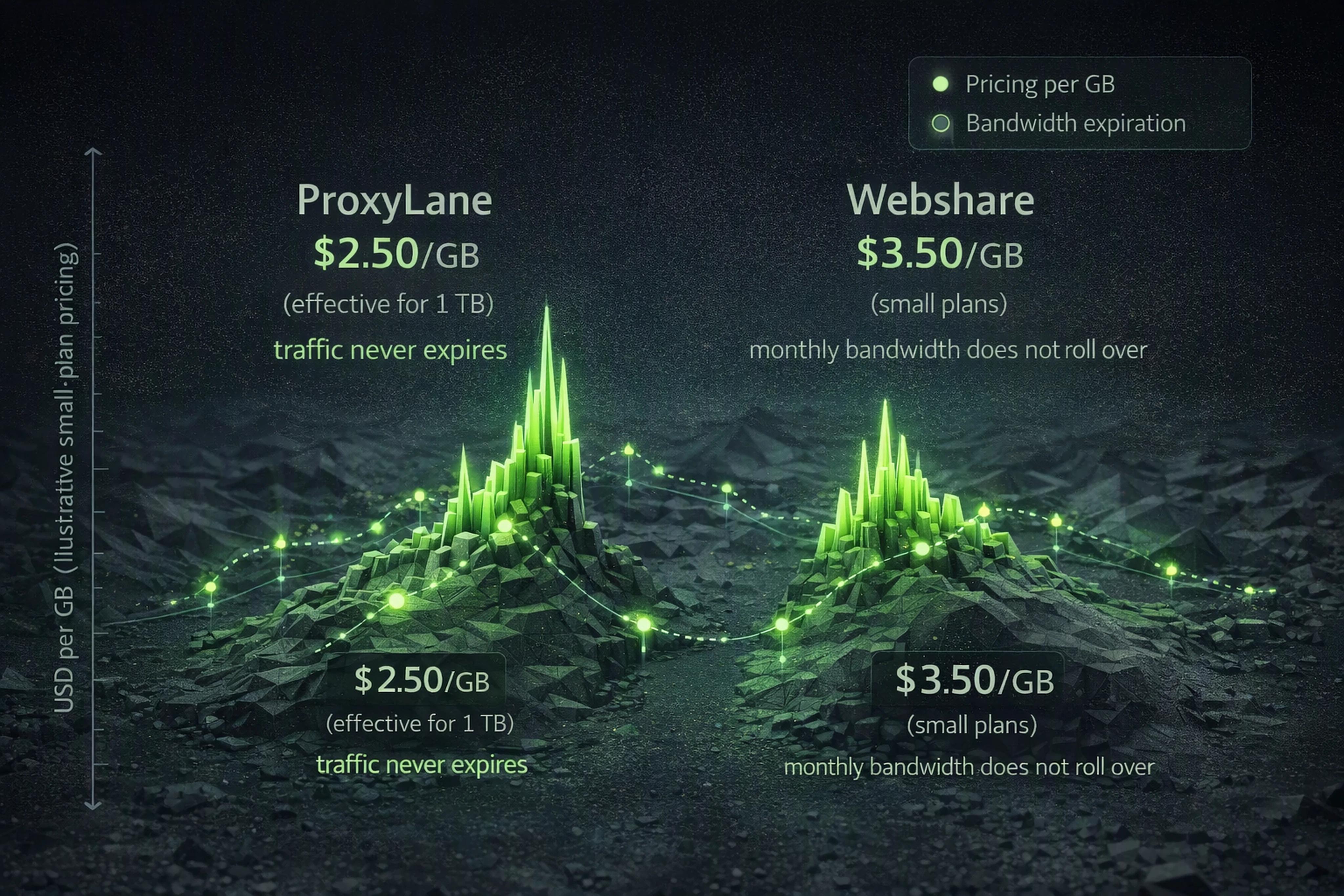
For steady, high-volume usage with well-defined monthly quotas, Webshare can be cost-effective at scale (down to $1.40/GB at 3,000 GB/month).
For bursty or irregular usage, ProxyLane’s combination of competitive per-GB pricing and non-expiring bandwidth is better aligned with real SMB behavior.
If your pattern looks like “big push, then quiet,” ProxyLane will almost always make budget conversations easier.
“Day-two reliability” is everything that happens after the first successful test:
Webshare supports:
This catalog breadth is a clear Webshare advantage if you run heterogeneous workflows like:
ProxyLane supports:
ProxyLane’s documentation is explicit about session continuity limits and how they map to real workflows — especially important for AI retrieval agents or browser automation tools like Playwright.
On the budget side, the difference is stark:
For SMB teams, this means:
In practice, many SMB data teams discover that:
Non-expiring traffic is effectively a risk hedge against this reality.
Instead of a single “winner,” it’s more useful to map Webshare and ProxyLane to specific SMB scenarios.
If your team runs:
Then ProxyLane is usually the better fit:
If your workloads look like:
You have two viable patterns:
For most SMB teams that aren’t yet operating at multi-terabyte monthly scales, ProxyLane’s model will feel simpler and safer.
If your requirement is:
Then Webshare is the clear winner:
ProxyLane deliberately focuses on premium residential proxies only. That specialization is an advantage if you want a residential-first partner, but it will not replace a full mixed-fleet provider.
Both providers operate residential networks, but ProxyLane is particularly vocal about:
If your team works under stricter compliance or brand-risk constraints, ProxyLane’s stance on ethical residential networks and its open-source skills for validating proxies can be reassuring.
Webshare and ProxyLane are not the only options. Depending on your requirements, you might also evaluate:
If you want a deeper methodological overview of how to evaluate these providers, see our in-depth guide: how to choose residential proxies for real-world data workflows.
For most SMB teams, cost per successful result is the more useful metric. A provider with cheaper per-GB pricing but lower success rates or more blocked requests can end up more expensive once you factor in retries and incomplete data.
ProxyLane explicitly frames buying decisions around cost per valid result, backed by independent tests showing 99.8% success on 3,000 requests.
Choose non-expiring traffic when:
ProxyLane’s non-expiring residential traffic is built for this pattern. Monthly plans like Webshare’s work best when you can confidently predict and consume your allowance.
You need city/ZIP-level targeting when:
Both Webshare and ProxyLane support city and ZIP targeting. ProxyLane adds a strong emphasis on verifying what the target site sees, which is important when your tests affect customer-facing outcomes.
Webshare and ProxyLane both provide rotating and sticky modes. ProxyLane documents sticky sessions up to 72 hours, which helps when designing multi-step automations.
Yes. Both Webshare and ProxyLane support standard HTTP and SOCKS5 protocols, which work with:
ProxyLane emphasizes a developer-first, SDK-less integration approach, publishing open-source skills that show AI agents how to configure proxies with plain Python or cURL.
Bottom line for SMB data teams:
ProxyLane’s focus on premium residential proxies and budget continuity makes it a strong default choice for SMBs who want their next request to work — not just more gigabytes.
 ProxyLaneTraffic never expires
Scale your workflows with the tools you already use. Rotating or sticky sessions up to 72 hours.
Compare seller APIs, licensed Amazon product data and proxy page checks by record, access scope and reuse rights.
Read guideChoose the right anti-detect browser proxy guide, map the shared verification steps, and keep account access separate from the network route.
Read guideOur picks for market research: ProxyLane for small, intermittent projects, plus options for regional tracking, monthly collection and managed extraction.
Read guide