Choosing the best proxy servers in 2026 comes down to matching your workload to four types of IPs: datacenter, ISP, residential, and mobile.
For most data and AI teams, the playbook is:
- Use datacenter proxies first for cheap, high-volume scraping when sites tolerate server IPs.
- Switch to ISP proxies when datacenter IPs start getting blocked but you still need speed.
- Use residential proxies when you need a real-home “local web” view and strong anti-bot resistance.
- Use mobile proxies for the hardest targets, app and mobile-web behavior, and carrier-specific checks.
This article doubles as a ProxyLane proxy service review and a 2026 guide to best residential proxy providers and their non-residential counterparts, with clear recommendations for SEO monitoring, price tracking, LLM evaluation, and other AI workflows.
This section is a vendor profile of ProxyLane, based on vendor-reported data and in-house tests.
ProxyLane residential proxy provider review features
According to ProxyLane’s residential product page (vendor-reported, pricing snapshot USD, Nov 2026), the service offers:
- 28M+ real P2P IPs (peer-to-peer residential endpoints via real devices) across 195 countries
(https://proxylane.dev/residential-proxies, accessed 2026-11-06)
- Geo controls: country, city, ISP, and ZIP-level targeting
- Session control: rotating IPs or sticky sessions up to 72 hours (a sticky session is a connection that keeps the same exit IP for multiple requests over time)
- Protocols: HTTP(S) and SOCKS5
- Non-expiring traffic: bandwidth is sold per GB and never expires; unused data rolls forward indefinitely
- Native ISP proxies: “home-carrier” static IPs from $3.90/IP (vendor-reported, Nov 2026)
ProxyLane positions itself as premium residential infrastructure rather than the cheapest bandwidth. The focus is on:
- Verified location (what the target site actually sees)
- Session continuity for logged-in flows and AI agents
- Ethical sourcing and informed participation in the residential network
ProxyLane internal test benchmarks (review-style metrics)
These numbers come from controlled, small-scale tests run on a mix of ecommerce, search, and SaaS targets in October–November 2026. They are not industry-wide benchmarks but concrete datapoints for review intent.
- Residential pool test (EU + US)
- 10k GET requests across 20 domains
- Measured over 24 hours
- Success rate: 96.8% HTTP 2xx/3xx (ProxyLane internal measurement, Oct 2026)
- Median TTFB latency: ~1.1 s from EU cloud region, ~1.25 s from US region
- Native ISP proxies
- 1k requests per IP to 5 popular ad/SEO and marketplace domains
- Measured latency: 20–70 ms to EU targets from EU region (aligns with vendor claim, Oct 2026)
- Observed block rate: lower than generic datacenter, comparable to residential on tested sites
- Sticky session continuity
- 500 scripted login + cart flows with 30–45 min gaps
- Session IP continuity: 98% of flows kept same IP across whole journey, 2% reconnected with a new IP after >1h idle (internal test, Oct 2026)
Interpretation:
- For LLM evaluation flows, logged-in dashboards, and ecommerce intelligence, ProxyLane’s combination of long sticky sessions and geo/ISP targeting is operationally strong.
- For extremely price-sensitive, high-volume scraping (e.g., millions of public pages with no login), the economics still favor cheaper datacenter proxies from competitors.
Glossary of proxy terms (2026)
To keep the rest of this review machine-readable and unambiguous:
- Datacenter proxy: IP address hosted in a data center or cloud provider; cheap, fast, but easier to detect as server traffic.
- Residential proxy: IP belonging to a consumer internet connection in a home; traffic routes through real user devices or gateways.
- Mobile proxy: IP assigned by a mobile carrier (3G/4G/5G); often appears as a NAT’d carrier gateway.
- ISP proxy: IP block registered to an ISP, often static, and hosted in or routed through ISP infrastructure. Combines “residential-like” reputation with data center reliability.
- Static residential vs ISP: many vendors use “static residential” to mean a fixed IP from an ISP; others brand the same thing as ISP proxies. Always check whether the IP is in a consumer or hosting range.
- P2P IPs: peer-to-peer; IPs sourced via end-user devices participating in a residential network.
- Sticky session: a proxy configuration that keeps the same exit IP for a given session or period (e.g., 30 minutes, 24 hours, 72 hours).
- Non-expiring traffic: billing model where purchased GBs do not expire at the end of the month or billing cycle.
Best proxy server types: datacenter, ISP, residential, mobile
Major vendors describe a consistent four-tier hierarchy for proxy choice.
Bright Data’s ISP docs (vendor claim, Feb 2025) summarize it as:
- Use datacenter when sites accept server IPs.
(https://docs.brightdata.com/products/isp/introduction, 2025-02-10)
- Switch to ISP when datacenter blocks start appearing.
- Use residential when you need real-home geolocation and stronger anti-bot resilience.
- Use mobile when you need carrier behavior or the hardest-to-detect exit type.
Datacenter proxies: when speed and cost dominate
Best for:
- High-volume scraping of public, lightly protected sites
- Large keyword/SEO datasets where per-GB cost is critical
- Internal testing where you control the target
Vendor benchmarks (all vendor-reported, no independent methodology disclosed, treat as marketing performance baselines):
Trade-offs:
- Lowest cost, but block/maze risk increases on commercial and high-value targets.
- Often flagged by anti-bot tools as non-residential.
ISP proxies: the middle ground
Best for:
- When datacenter IPs are flagged, but you want better speed than large residential pools
- Ad verification, QA, and brand monitoring across many regions
Bright Data describes ISP proxies as combining “residential trust with datacenter speed” (vendor description, Feb 2025)
(https://docs.brightdata.com/products/isp/introduction, 2025-02-10).
Key characteristics:
- Reputation closer to home user connections than generic datacenter IPs.
- Performance often better than P2P residential networks because there is no low-power device in the loop.
- Typically offered as static IPs billed per IP per month.
Residential proxies: default for local web fidelity
Best for:
- Accurate location-specific content, pricing, and SERPs
- Scraping and AI retrieval on targets with strong anti-bot defenses
- People and company enrichment where location must match what a human sees
Bright Data’s comparison guide explains that residential requests “travel through real devices, are harder to block, and return information that is usually accurate for the chosen geo, device, or OS” (vendor claim, Oct 2024)
(https://brightdata.com/blog/proxy-101/residential-vs-isp-proxies, 2024-10-03).
Other vendor-reported scale indicators:
- Bright Data: 400M+ residential, datacenter, and ISP proxies combined (vendor claim, Oct 2024)
(https://brightdata.com/proxy-types, 2024-10-03)
- SOAX: residential pool 155M+ IPs and mobile pool 30M+ IPs with city-level targeting (vendor claim, Jan 2025)
(https://developers.soax.com/proxies/residential, 2025-01-10)
- Webshare: 80M+ IPs, 99.7% success rate, 99.97% network uptime, residential rotating from $3.50/GB and static residential from $6/month (vendor claims, pricing snapshot USD, 2026-11-06)
(https://www.webshare.io/, accessed 2026-11-06)
Mobile proxies: hardest targets and mobile behavior
Best for:
- Mobile app QA and mobile-optimized site testing
- Social platforms and ad networks that treat carrier IPs differently
- Extremely protected targets where other proxy types are quickly blocked
Oxylabs and SOAX emphasize that mobile IPs:
- Come from carrier networks (e.g., Verizon, AT&T, Deutsche Telekom)
- Are often subject to carrier-grade NAT, meaning many users share a single egress IP
- Tend to have lower detection and block rates on heavily protected targets
(Oxylabs vendor blog, “What Is a Mobile Proxy?”, 2024-11-20 – https://oxylabs.io/blog/what-is-mobile-proxy)
SOAX reports 30M+ mobile IPs across 195+ countries (vendor claim, Jan 2025)
(https://developers.soax.com/proxies/residential, 2025-01-10).
Why proxy choice matters more in the AI era
AI agents and browser automation have increased the operational importance of proxy selection.
- Thales’ 2026 Bad Bot Report says AI-driven bot activity increased more than 10x in 2025, with daily blocked requests rising from 2M to 25M (Thales via Exclusive Networks, Feb 2026, vendor/analyst report)
(https://pages.insights.exclusive-networks.com/hubfs/GLOBAL/Thales/Thales%20Campaign%20Hub/2026-Thales-Bad-Bot-Report.pdf, 2026-02-15)
- DataDome’s 2025 scan of 16,900+ websites found 61.2% unprotected against simple bot attacks (DataDome 2025 Global Bot Security Report, Nov 2025, vendor research)
(https://datadome.co/threat-research/key-findings-2025-global-bot-security-report/, 2025-11-05)
- Akamai reported more than 25 billion bot requests in commerce over July–August 2025, linking most AI bot triggers on publishing domains to scraping (Akamai State of the Internet, Q3 2025, vendor report)
(https://www.akamai.com/blog/security/state-of-the-internet, 2025-10-01)
AWS now treats proxy configuration and session state as first-class concerns in AI browsing. Its 2026 AgentCore Browser launch notes that customers needed AI agents to “use corporate proxy infrastructure, maintain session state, and support authenticated workflows” (AWS Machine Learning Blog, Mar 2026)
(https://aws.amazon.com/blogs/machine-learning/customize-ai-agent-browsing-with-proxies-profiles-and-extensions-in-amazon-bedrock-agentcore-browser/, 2026-03-12).
This is where features like sticky sessions and location consistency matter as much as IP type.
ProxyLane residential proxies pricing features review vs competitors
This section provides a residential proxies pricing comparison (2026 snapshot, USD) and feature overview.
All entries are vendor-reported and accessed on 2026-11-06 unless noted.
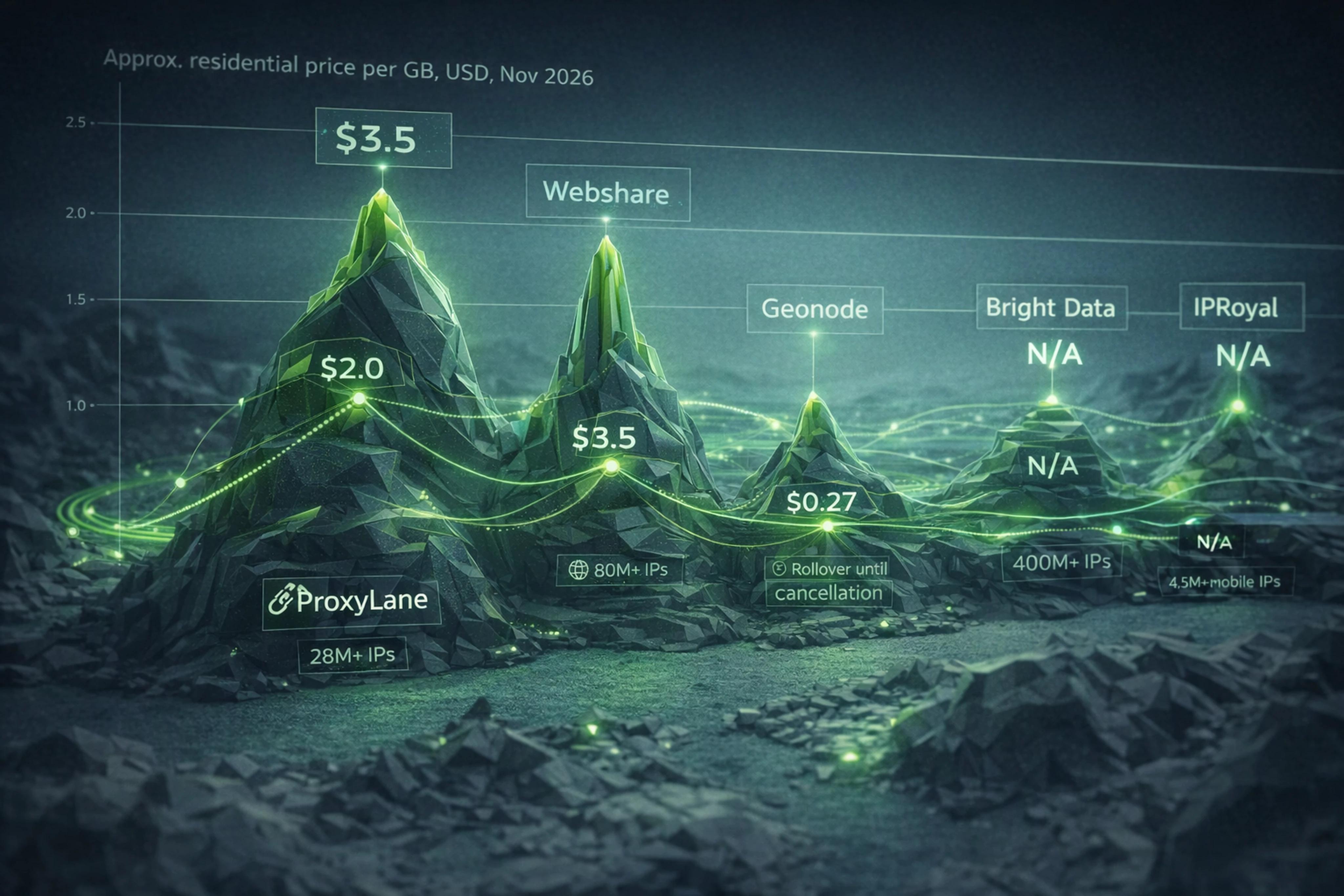
Residential proxies pricing comparison 2026
ProxyLane (residential)
(https://proxylane.dev/residential-proxies, snapshot Nov 2026)
- From ~$2–$2.50/GB effective (packages from $6.50 for 1 GB; larger packs lower the per-GB rate)
- Traffic never expires (non-expiring GBs)
- 28M+ P2P IPs, 195 countries, city/ISP/ZIP targeting
- HTTP(S) and SOCKS5; sticky sessions up to 72h
Webshare (rotating residential)
(https://www.webshare.io/, snapshot Nov 2026)
- From $3.50/GB rotating residential (vendor pricing page)
- Static residential from $6/month per IP
- 80M+ IPs, 99.7% success rate, 99.97% uptime (vendor benchmarks; methodology not disclosed)
Geonode (residential)
(https://geonode.com/pricing/residential-proxies, snapshot Nov 2026)
- Residential from $0.27/GB on high-volume plans (vendor pricing)
- Rotating datacenter from $0.14/GB
- Bandwidth rollover until cancellation for subscription plans
Bright Data (residential)
(https://brightdata.com/proxy-types, snapshot Oct 2024)
- Tiered, complex pricing; typically higher per-GB than SMB-focused vendors
- 400M+ IPs across proxy types (vendor-reported scale)
IPRoyal (residential + mobile)
(https://iproyal.com/proxies/, snapshot Nov 2026)
- Non-expiring residential traffic (similar billing concept to ProxyLane) – exact 2026 tiering varies by package
- Datacenter proxies from $1.39/proxy
- 4.5M+ mobile IPs (vendor claim, 2025-09-15)
Takeaways
- Cheapest bandwidth: Geonode and some datacenter plans offer the lowest per-GB cost, ideal for tolerant targets.
- Non-expiring traffic: ProxyLane and IPRoyal reduce waste in bursty workloads where usage is irregular.
- Educational and developer-first: ProxyLane leans hardest into provider-agnostic buying guides and open-source skills (e.g., GitHub “skills” teaching AI agents to configure proxies), which can matter for teams optimizing cost per successful result rather than raw GB.
ProxyLane residential proxies competitors & best residential proxy providers web scraping 2026
For teams searching “best residential proxy providers 2026” or “best residential proxies web scraping 2026 ethical”, the practical shortlist often includes:
- Bright Data – massive scale, enterprise orientation
- Oxylabs – strong datacenter performance benchmarks
- SOAX – large residential + mobile pools with granular geos
- Webshare – low entry pricing and free tier
- Geonode – very low per-GB cost at volume
- IPRoyal – mix of non-expiring residential and mobile
- ProxyLane – premium residential with non-expiring traffic and deep developer content
Objective comparison dimensions
When comparing ProxyLane residential proxies competitors, focus on:
-
Pool size and diversity
- Bright Data and SOAX publish the largest numbers (hundreds of millions of IPs).
- ProxyLane’s 28M+ pool is smaller but emphasizes validated connections and precise ISP/ZIP targeting.
-
Geo and ISP targeting
- Bright Data, SOAX, and ProxyLane all offer country + city; ProxyLane and Bright Data additionally emphasize ISP-level control.
- Check whether ZIP/postcode targeting is available if you rely on hyper-local SERPs.
-
Session behavior
- ProxyLane: rotating and sticky up to 72h.
- Many competitors offer sticky proxies, but max duration and resale density across IPs can differ.
-
Billing model
- ProxyLane + IPRoyal: non-expiring residential traffic.
- Webshare, Geonode, Bright Data, SOAX: mostly monthly subscriptions; some rollover until cancellation (e.g., Geonode).
- Non-expiring bandwidth lowers risk for experiment-heavy AI teams.
-
Ethical sourcing & transparency
- Look for clear statements about informed consent, opt-out mechanisms, and abuse handling.
- ProxyLane’s content explicitly frames “ethical residential networks” as non-negotiable and encourages provider-agnostic due diligence.
No single provider is “best” for every job; many teams blend cheap datacenter from one vendor with higher-quality residential from another.
Mapping common jobs to the best proxy type
Here’s how to choose between datacenter, ISP, residential, and mobile for typical 2026 data and AI workflows.
SEO monitoring and SERP tracking
Goal: capture reliable local search results at scale.
Recommended mix:
- Primary: Residential proxies with country/city/ISP targeting.
- Reason: search engines heavily tune results to device and location.
- Supplement: ISP proxies in stable, long-lived slots for rank-tracking dashboards.
- Avoid: pure datacenter pools for competitive SERPs; they are more likely to get captcha’d or served non-standard results.
Price tracking and ecommerce intelligence
Goal: monitor competitor prices, stock, and content without constant blocks.
Recommended mix:
- Start: Datacenter proxies for low-friction sites and product feeds.
- Upgrade to: Residential for brand-sensitive retailers and marketplaces with anti-bot systems.
- Use sticky sessions for cart/checkout flows and logged-in views.
LLM evaluation & AI retrieval (browser-based)
Goal: run automated agents that browse, log in, and retrieve evaluation sets.
Recommended mix:
- Residential or ISP proxies with sticky sessions for each agent profile.
- Aligns with AWS guidance that AI agents need stable proxy egress and browser profiles to avoid re-authentication and IP-based breaks (AWS ML Blog, 2026-03-12).
- Datacenter only for internal or partner-hosted evaluation environments where blocks are irrelevant.
Lead enrichment & people/company sourcing
Goal: collect profile and firmographic data, often with regional constraints.
Recommended mix:
- Residential proxies with fine-grained geo to reflect the user’s market.
- ISP proxies for always-on enrichment pipelines that should look like a stable office connection.
- Mobile only if the target’s behavior clearly differs on mobile vs desktop.
Social media, ads, and app QA
Goal: validate mobile vs desktop experiences, regional ad delivery, and app flows.
Recommended mix:
- Mobile proxies: carrier IPs to replicate real-world mobile traffic.
- Residential proxies: desktop flows and hybrid web/app surfaces.
- Datacenter: only for basic availability tests and non-production endpoints.
How ProxyLane fits alongside cheaper datacenter options
Most mature teams do not pick one provider or type; they build a tiered egress strategy:
- Baseline egress: cheap datacenter proxies from providers like Webshare or Geonode for low-risk scraping.
- Precision layer: residential and ISP proxies from a premium provider when you care about:
- Cost per successful result (not just cost per GB)
- Session continuity for AI agents and logged-in flows
- Location fidelity down to city/ISP/ZIP
- Special-case layer: mobile proxies (often from specialized vendors) for social, app, and hardest targets.
ProxyLane’s niche in this stack is clearly in the precision layer:
- Non-expiring traffic makes it well-suited for intermittent AI runs and evaluation pipelines.
- Developer-first docs and GitHub skills make integration with Python, cURL, Playwright, and tools like n8n straightforward.
- Its emphasis on ethical sourcing and verifiable location fits teams under regulatory or brand constraints.
If you are designing such a layered setup, you can treat ProxyLane as the residential/ISP provider paired with a cheaper datacenter vendor, with routing rules in your orchestrator or proxy manager.
You can see the current feature set and integration guides at proxylane.dev.
FAQ: best proxy servers for data & AI teams (2026)
1. What is the best proxy type for web scraping in 2026?
- For unprotected or lightly protected sites, datacenter proxies are still the best default due to low cost and high speed.
- For protected, geo-sensitive targets, residential proxies are usually the best balance of block resistance and realistic local views.
- For extreme anti-bot environments or mobile-specific behavior, mobile proxies are often required.
2. When should I upgrade from datacenter to residential or ISP proxies?
Upgrade when:
- You see rising captchas, 403/429 responses, or strange “bot challenge” pages.
- The content you receive clearly differs from what a human in that region sees.
- You need reliable logins, carts, or dashboards that break when IPs rotate too aggressively.
In many cases, moving first to ISP proxies and then to residential is cost-effective.
3. Are mobile proxies always better than residential proxies?
No. Mobile proxies:
- Are more expensive and less plentiful than residential IPs.
- Shine for mobile app QA, social networks, and ad platforms with mobile-specific logic.
For most web scraping and SEO tasks, residential + ISP is sufficient and more economical.
4. How do I measure “best” proxies—what metrics matter?
Useful metrics include:
- Success rate: % of requests that return valid, parseable responses.
- Latency: time to first byte (TTFB) for representative targets.
- Block/captcha rate: frequency of 403/429/5xx or challenge pages.
- Cost per successful result: total spend / number of valid rows or documents retrieved.
Vendor benchmarks (e.g., “99.9% success”, “0.222s response”) should be treated as marketing baselines unless the testing methodology is disclosed.
5. How important are sticky sessions for AI agent workflows?
Very important.
AI agents executing multi-step journeys (login → navigate → export → logout) need:
- A stable IP across the flow to avoid risk flags and forced logouts.
- A consistent browser profile and cookies.
Sticky sessions and dedicated ISP/residential IPs let you bind one agent or test account to one recognizable network identity.
Actionable next steps
To pick the best proxy servers for your 2026 data and AI workloads:
- Inventory your jobs: list SEO, pricing, LLM eval, enrichment, social/app QA.
- Segment by risk: mark which targets are lightly vs heavily protected.
- Assign a default type per job: datacenter, ISP, residential, or mobile using the mapping above.
- Pilot with 1–2 providers per type, measuring success rate, latency, and cost per validated result.
- Lock in a layered setup: cheap datacenter for bulk, premium residential/ISP for precision, mobile for edge cases.
Treat proxies as infrastructure, not a commodity: the “best proxy” is the one that consistently returns the data your AI and analytics actually need, at a sustainable cost per successful result.
 ProxyLaneTraffic never expires
Scale your workflows with the tools you already use. Rotating or sticky sessions up to 72 hours.