Real devices,
not datacenters
28M
Real-device IPs your scrapers blend in with


28M+ clean, human IPs from real P2P devices. Built to pass where others get blocked.
Connect with the tools you already use
28M
Real-device IPs your scrapers blend in with

195 countries
Country · Region · City · ZIP · ISP · ASN

GDPR & CCPA compliant
Average response time on QUIC
HTTP(S) · SOCKS5Unlimited
Concurrent connections
Volume discounts, no hidden fees
$2/GB
Traffic never expires98.7%
of 1,000 sampled IPs rated low risk by Scamalytics
Low risk: scores 0–19 on Scamalytics’ 0–100 scale. Aggregate sample result; individual countries vary.
≈0.35s average response time on our QUIC-powered network.
Actual response time varies by target, exit location and network conditions.
QUIC is designed for low-latency connection establishment. About the protocol
Go from a country down to one network. Check a regional price, a city's search results or a single carrier's view of a page.
 Germany
Example settings. Region, ZIP and ASN availability varies by location; the dashboard shows what each country supports.
Every request leaves from a different residential IP.
One IP stays with you while its device stays online.
One IP for exactly as long as you set, then a fresh one.
Give each flow its own session ID to run many sticky or timed sessions in parallel. A sticky IP is not a dedicated, permanent address.
ProxyLane offers premium residential IPs with ultra-low fraud scores, from ethically sourced, real devices.
Test your workload for $1.9598.7%
of 1,000 sampled IPs rated low risk by Scamalytics
Low risk: scores 0–19 on Scamalytics’ 0–100 scale. Aggregate sample result; individual countries vary.
Copy the proxy URL from the dashboard into PROXY_URL and run any example. HTTP(S) and SOCKS5 both work.
import os
import requests

proxy = os.environ["PROXY_URL"]

response = requests.get(
    "https://ipinfo.io/json",
    proxies={"http": proxy, "https": proxy},
    timeout=30,
)
print(response.json())
import { fetch, ProxyAgent } from "undici";
const dispatcher = new ProxyAgent(process.env.PROXY_URL);
const response = await fetch("https://ipinfo.io/json", { dispatcher });
console.log(await response.json());package main
import (
"fmt"
"io"
"net/http"
"net/url"
"os"
)
func main() {
proxy, _ := url.Parse(os.Getenv("PROXY_URL"))
client := &http.Client{Transport: &http.Transport{Proxy: http.ProxyURL(proxy)}}
resp, err := client.Get("https://ipinfo.io/json")
if err != nil {
panic(err)
}
defer resp.Body.Close()
body, _ := io.ReadAll(resp.Body)
fmt.Println(string(body))
}<?php
$ch = curl_init('https://ipinfo.io/json');
curl_setopt_array($ch, [
CURLOPT_PROXY => getenv('PROXY_URL'),
CURLOPT_RETURNTRANSFER => true,
CURLOPT_TIMEOUT => 30,
]);
echo curl_exec($ch);import java.net.*;
import java.net.http.*;
// Run with -Djdk.http.auth.tunneling.disabledSchemes=
public class Main {
public static void main(String[] args) throws Exception {
URI proxy = URI.create(System.getenv("PROXY_URL"));
String[] auth = proxy.getUserInfo().split(":", 2);
HttpClient client = HttpClient.newBuilder()
.proxy(ProxySelector.of(new InetSocketAddress(proxy.getHost(), proxy.getPort())))
.authenticator(new Authenticator() {
protected PasswordAuthentication getPasswordAuthentication() {
return new PasswordAuthentication(auth[0], auth[1].toCharArray());
}
})
.build();
HttpRequest request = HttpRequest.newBuilder(URI.create("https://ipinfo.io/json")).build();
System.out.println(client.send(request, HttpResponse.BodyHandlers.ofString()).body());
}
}using System.Net;
var proxy = new Uri(Environment.GetEnvironmentVariable("PROXY_URL")!);
var auth = Uri.UnescapeDataString(proxy.UserInfo).Split(':', 2);
var handler = new HttpClientHandler
{
Proxy = new WebProxy(proxy.GetLeftPart(UriPartial.Authority))
{
Credentials = new NetworkCredential(auth[0], auth[1]),
},
};
using var client = new HttpClient(handler);
Console.WriteLine(await client.GetStringAsync("https://ipinfo.io/json"));require "net/http"
require "uri"
proxy = URI(ENV.fetch("PROXY_URL"))
uri = URI("https://ipinfo.io/json")
Net::HTTP.start(uri.host, uri.port, proxy.host, proxy.port,
proxy.user, proxy.password, use_ssl: true) do |http|
puts http.get(uri.path).body
end# Check your exit IP and location
curl -x "$PROXY_URL" https://ipinfo.io/jsonSetup guides for Playwright, Puppeteer, Scrapy and antidetect browsers
Shorter round trips from wherever your scraper runs. Exit IPs still come from the country you target.
Generate endpoints in bulk, save up to 50 lists and export the shape your tool expects.
http://user:pass@host:10001host:10001:user:passuser:pass@host:10001host,port,username,password%protocol%://%ip%:%port%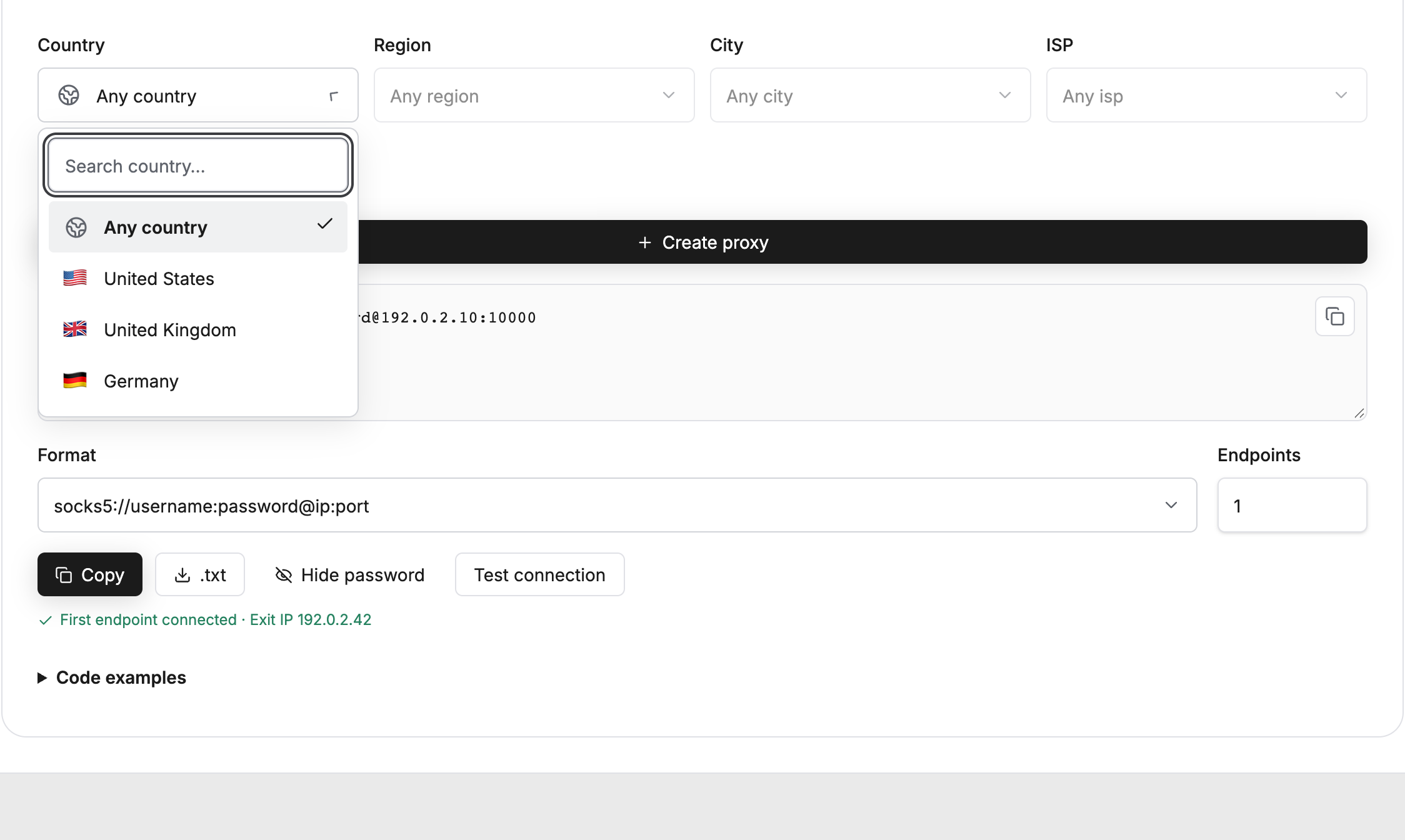
Build custom endpoints with your preferred region and rotation period. Save proxy lists for each project and reuse them later.
Check your real sites and browser setup first.
Your GB waits. Use it when the job is ready.
Pick your next package from trial usage.
From $2/GB. Buy the traffic you need, keep it until you use it.
Test our IP quality: 350 MB$1.95
For your first requests
per GB · Traffic never expires
For projects taking shape
per GB · Traffic never expires
For everyday workflows
per GB · Traffic never expires
For growing workloads
per GB · Traffic never expires
For bigger operations
per GB · Traffic never expires
For high-volume data
per GB · Traffic never expires
For your business, at your scale
Let's build your setup together




 25+ crypto
You get more than IPs. Real people help you set up, pick the right location and fix a failing session, day and night.


My Playwright flow loses the session after sign in
Switch it to a sticky session. Which country do you target?
Germany, Berlin
Set country and city in the dashboard and rerun. We're here if it happens again
Three. Rotating gives each request a new residential IP. Sticky keeps one IP while its device stays online. Timed keeps one IP for the duration you set, from 1 second to 72 hours. Use session IDs to run many sessions in parallel.
Six levels: country, region, city, ZIP, ISP and ASN. Region, ZIP and ASN availability varies by location; the dashboard shows what each country supports.
HTTP(S) and SOCKS5. Any client that accepts a proxy URL works, including cURL, Python, Playwright, Puppeteer, Scrapy and antidetect browsers.
No. Purchased residential traffic stays in your balance until you use it.
Yes, for cards and crypto: unused packages within 72 hours, duplicate payments, and service issues unresolved after 24 hours. See our refund policy for conditions, including used traffic and trials.
Test the IPs on your own targets. Keep any unused traffic for later.
