

Amazon Scraper API vs Proxy: Choose a Product Data Source
Distinguish authorized Amazon APIs, licensed product data and proxy-based page checks by record quality and access rights.
Read guide
Python engineers and AI teams searching for the best proxies for Python scraping and AI data pipelines increasingly treat proxy choice as infrastructure, not a…

Python engineers and AI teams searching for the best proxies for Python scraping and AI data pipelines increasingly treat proxy choice as infrastructure, not a bolt-on.
If you need residential proxies that work smoothly with requests, Playwright, and asyncio stacks, ProxyLane stands out in 2026 for non-expiring traffic, fine-grained geo-targeting, and developer-first integration — with a few trade-offs you should understand before standardizing.
This review breaks down ProxyLane’s pricing, features, and performance, compares it to major competitors, and shows how to wire residential proxies into ban-resistant Python workflows.
Meta description: ProxyLane proxy service review: residential proxies for Python scraping & AI pipelines — pricing, non-expiring traffic, geo targeting, and performance.
Verdict (2026): 4.3/5 — strong fit for Python-based scraping and AI pipelines.
Best for:
Score breakdown:
As of October 2026, ProxyLane’s pricing page lists: proxylane.dev/pricing
This non-expiring model is unusually friendly for:
ProxyLane positions itself as premium residential proxy infrastructure rather than generic bandwidth:
Note on response time: ProxyLane’s ~0.35s figure is a vendor-provided benchmark, likely measured as median latency from typical client regions (e.g., Western Europe / North America) to common targets. It is not a hard guarantee; your actual latency will vary by target site, path, and concurrency.
Why does any of this matter in 2026?
In this environment, bans and throttling are common.
ProxyLane’s value is its combination of:
Searchers often want “ProxyLane residential proxies pricing features review” alongside competitor numbers. Here’s a concise comparison as of October 2026, based on public vendor statements.
All metrics below are vendor-reported on official websites and verified 2026-10-11. Always check current pricing and terms.
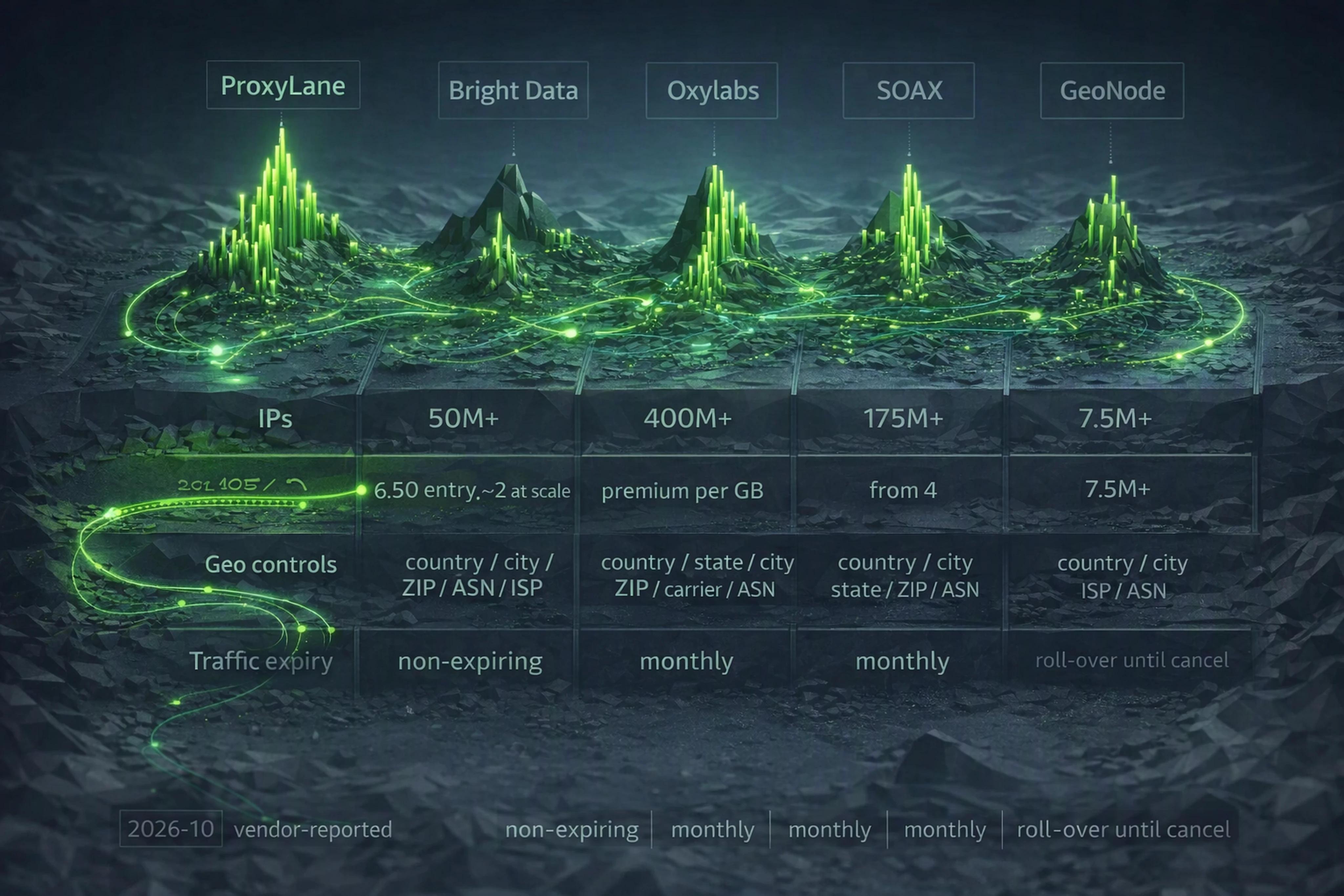
| Provider | Residential IPs (approx.) | Countries (approx.) | Pricing model (entry) | Geo controls (examples) | Non-expiring traffic? |
|---|---|---|---|---|---|
| ProxyLane | 50M+ (vendor estimate) | 195+ (vendor) | 1 GB for $6.50; down to ~$2/GB | Country, city, ZIP, ASN, ISP (vendor) | Yes (vendor) |
| Bright Data | 400M+ monthly IPs | 195 countries | Per GB; figures vary, ~premium | Country, state, city, ZIP, carrier, ASN brightdata.com, 2026-10-11 | No (standard monthly) |
| Oxylabs | 175M+ IPs | 190+ countries | From $4/GB oxylabs.io, 2026-10-11 | Country, city, state, ZIP, ASN | No (monthly packages) |
| SOAX | 155M+ IPs | 195+ countries | GB-bundled, exact tiers vary | Country, city, ISP, ASN developers.soax.com, 2026-10-11 | No (monthly) |
| GeoNode | 7.5M+ active IPs | 150+ countries | From $0.27/GB geonode.com, 2026-10-11 | Country, some city-level | Roll-over until cancel |
Highlights:
For Python teams, these trade-offs often resolve to:
For “best residential proxies for Python scraping”, the criteria are practical:
ProxyLane aligns well when you:
Session-level controlaiohttp or httpxBelow are concrete patterns you can use.
For many teams, the baseline scraping stack is Python Requests + sessions.
import requests

PROXY_HOST = "proxy.proxylane.dev"  # Example host; check actual hostname
PROXY_PORT = 8000                    # Example port
PROXY_USER = "your_username"
PROXY_PASS = "your_password"

proxies = {
    "http": f"http://{PROXY_USER}:{PROXY_PASS}@{PROXY_HOST}:{PROXY_PORT}",
    "https": f"http://{PROXY_USER}:{PROXY_PASS}@{PROXY_HOST}:{PROXY_PORT}",
}

session = requests.Session()
session.proxies.update(proxies)

resp = session.get("https://httpbin.org/ip", timeout=15)
print(resp.json())
Key points:
Session to reuse TCP connections and cookies — Requests’ docs explicitly recommend connection pooling and session reuse for reliability and performance (docs.python-requests.org, 2024).Use:
Rotating residential proxies for:
Sticky sessions for:
Example: two sessions, each with its own credentials or endpoint:
rotating_session = requests.Session()
rotating_session.proxies.update({
    "http": "http://rot-user:rot-pass@rotating.proxylane.dev:8000",
    "https": "http://rot-user:rot-pass@rotating.proxylane.dev:8000",
})

sticky_session = requests.Session()
sticky_session.proxies.update({
    "http": "http://stick-user:stick-pass@sticky.proxylane.dev:8000",
    "https": "http://stick-user:stick-pass@sticky.proxylane.dev:8000",
})
ProxyLane itself recommends rotating for independent requests and sticky when related steps must share an IP, while noting a sticky IP can still change if the residential exit goes offline (proxylane.dev, guidance verified 2026-10-11).
For “residential proxies for Playwright”, ProxyLane fits well because Playwright supports global or per-context proxies for HTTP(S) and SOCKS.
import asyncio
from playwright.async_api import async_playwright

PROXY_URL = "http://user:pass@proxy.proxylane.dev:8000"  # HTTP proxy

async def main():
    async with async_playwright() as p:
        browser = await p.chromium.launch(proxy={"server": PROXY_URL})
        context = await browser.new_context()
        page = await context.new_page()
        await page.goto("https://httpbin.org/ip")
        print(await page.text_content("pre"))
        await browser.close()

asyncio.run(main())
Tips for ban resistance with Playwright + residential proxies:
When using ProxyLane, you can:
For high-throughput AI data pipelines and concurrent scrapers, asyncio stacks like aiohttp or httpx are common.
import asyncio
import aiohttp

ROTATING_PROXY = "http://user:pass@rotating.proxylane.dev:8000"

async def fetch(session, url):
    async with session.get(url, proxy=ROTATING_PROXY, timeout=15) as resp:
        return await resp.text()

async def main(urls):
    async with aiohttp.ClientSession() as session:
        tasks = [fetch(session, url) for url in urls]
        results = await asyncio.gather(*tasks, return_exceptions=True)
        for r in results:
            print(type(r), str(r)[:80])

urls = ["https://example.com"] * 50
asyncio.run(main(urls))
Practices for robust pipelines:
ProxyLane’s non-expiring traffic lets you run such experiments without worrying about monthly resets, which is useful for AI teams testing new retrieval strategies in bursts.
AI and alternative data are converging.
Lowenstein Sandler’s 2024 alternative-data survey reported:
This means scripts are becoming full AI data pipelines.
ProxyLane’s residential proxies support AI workflows by:
Common pipeline stages where residential proxies matter:
A critical theme in ProxyLane’s ecosystem is “evidence-based buying” — verify what the target sees before scaling.
curlcurl -x http://user:pass@proxy.proxylane.dev:8000 \
https://ipinfo.io/json
Look for:
ip — the exit IPcity, region, countryorg — often includes ISP or ASNRepeat for multiple requests to confirm:
import requests

proxies = {
    "http": "http://user:pass@proxy.proxylane.dev:8000",
    "https": "http://user:pass@proxy.proxylane.dev:8000",
}

session = requests.Session()
session.proxies.update(proxies)

resp = session.get("https://ipinfo.io/json", timeout=15)
print(resp.json())
You can swap ipinfo.io with other GeoIP APIs or self-hosted MaxMind/DB-IP services for stricter control.
For a sticky residential proxy:
for i in range(5):
    r = session.get("https://httpbin.org/ip", timeout=15)
    print(i, r.json())
If the IP remains constant across requests, the session is sticky.
Note: even sticky residential IPs can change unexpectedly if the underlying device disconnects. ProxyLane explicitly flags this in its guidance.
org/ASN fields for expected ISPs.This evidence lets you compare providers by cost per validated result — ProxyLane’s preferred metric — instead of headline GB price.
Any review of “best residential proxies web scraping 2026 ethical” must address compliance.
Before scraping or using residential proxies, you should:
Always consult legal counsel for high-stakes or ambiguous targets.
Residential networks route through real home connections.
When evaluating a provider (including ProxyLane), use an ethical checklist:
ProxyLane’s site emphasizes informed participation, withdrawal controls, and abuse-response processes as core evaluation criteria (proxylane.dev, 2026-10-11), and encourages customers to demand evidence of ethical sourcing from any residential provider.
ProxyLane is a strong choice if you:
If you need the largest possible IP footprint or ultra-low headline $/GB, some alternatives may be better. But for measurable, ban-resistant Python workflows, ProxyLane is a compelling option.
Residential proxies route through real consumer ISPs, making them harder for sites to classify as bots compared to datacenter IPs.
They’re especially useful for:
Datacenter proxies can be cheaper and faster but are more easily blocked.
You configure a Session with ProxyLane’s HTTP/SOCKS endpoint and credentials:
session.proxies with http://user:pass@host:port.The examples earlier in this article show a ready-to-run pattern.
Yes.
Playwright supports global proxies when launching a browser and per-context proxies.
You can:
playwright.async_api) with a proxy={"server": PROXY_URL} configurationThis is useful for more complex sites where JavaScript and full browser behavior matter.
Use an async HTTP client (aiohttp, httpx) and pass the proxy URL per request or per session.
For rotation:
Implement retries, backoff, and error monitoring to maintain ban-resistant behavior.
Legality depends on:
Always:
Residential proxies don’t make an otherwise unlawful activity lawful; they’re infrastructure, not a legal shield.
Actionable next steps:
That approach gives your next working request the best chance of success — and keeps your AI and data pipelines both cost-aware and resilient.
 ProxyLaneTraffic never expires
Scale your workflows with the tools you already use. Rotating or sticky sessions up to 72 hours.
Distinguish authorized Amazon APIs, licensed product data and proxy-based page checks by record quality and access rights.
Read guideChoose the right anti-detect browser proxy guide, map the shared verification steps, and keep account access separate from the network route.
Read guideSeparate Australian egress from en-AU content, AUD pricing, GST display, postcode validation and the state delivery context.
Read guide