If you’re weighing SOAX vs ProxyLane for residential proxies, the real trade-off is control vs. carryover:
- Choose SOAX when you need maximum control over routing and error handling (fine-grained geo, ASN/ZIP filters, multiple rotation modes, published benchmarks).
- Choose ProxyLane when you care more about lower $/GB, non‑expiring traffic, and simple, developer-first integration for growth and scraping workflows.
This guide breaks down SOAX and ProxyLane on four criteria that actually decide the choice:
- IP quality and reliability
- Geo-targeting controls
- Rotation and session options
- Total cost per successful request
We’ll close with clear use‑case recommendations and name other serious alternatives, so you can decide what fits your growth or data pipeline.
At a glance: SOAX vs ProxyLane comparison
- Residential IP pool size — SOAX: 155M+ IPs in 195+ countries; ProxyLane: 50M+ IPs globally
- Published quality metrics — SOAX: Claims 99.95% success , 0.55s response time; ProxyLane: Emphasizes validation and results; no public % benchmark
- Geo-targeting granularity — SOAX: Country, region, city, ISP, ASN, ZIP; ProxyLane: Country, city, ISP
- Rotation & sessions — SOAX: Per-request, sticky, timed, request-count, error modes; ProxyLane: Rotating or sticky sessions
- Protocol support — SOAX: HTTP(S), SOCKS5 (per docs); ProxyLane: HTTP and SOCKS5
- Pricing (headline, residential) — SOAX: Tier 1: $5.00/GB ; Tier 2: $3.75/GB; ProxyLane: From $2.50/GB ; 1 GB entry at $6.50
- Traffic expiry / rollover — SOAX: Credits roll over 60 days; ProxyLane: Unused traffic never expires
- Entry test offer — SOAX: $1.99 / 400MB for 3 days (~$4.98/GB); ProxyLane: 1 GB / $6.50 starter package
- Session behavior focus — SOAX: Multiple rotation & error behaviors; ProxyLane: Clear choice: rotating vs sticky as first-class concept
- Evidence of control plane maturity — SOAX: Deep filters + rotation modes + error handling; ProxyLane: Simpler interface, strong focus on validation workflows
- Ethics & sourcing posture — SOAX: Emphasizes informed users, KYC, 24/7 monitoring; ProxyLane: Pushes evidence-based, ethical residential sourcing
Criterion 1: IP quality and reliability
For growth and scraping projects, usable IPs matter more than headline pool size.
SOAX on IP quality
Publicly available data paints SOAX as a benchmarked, control-first provider:
- Claims 99.95% success rate and 0.55-second proxy response time on residential proxies.
- Proxyway’s 2026 review reports few errors or downtime over a three-week test and notes strong infrastructure and advanced filtering.
- Residential pool: 155M+ IPs across 195+ countries.
This makes SOAX appealing when you need predictable performance at scale and are willing to pay for it.
ProxyLane on IP quality
ProxyLane takes a more “utility and verification” stance than a marketing-claims stance:
- Publicly lists a 50M+ residential IP pool.
- Does not publish a headline success-rate percentage but repeatedly stresses:
- Verifying what the target actually returns.
- Checking session continuity for logged-in flows.
- Measuring cost per successful result, not cost per GB alone.
- Maintains open-source skills on GitHub that show you how to test and validate residential proxies (including non-ProxyLane providers) via Python, cURL, etc.
In other words: ProxyLane’s message is “measure it yourself in your workflow”, rather than “trust our single global number.”
How to decide on IP quality
Choose SOAX if:
- You want published, aggressive benchmarks (99.95% success, 0.55s response time).
- You are running high-volume, time-sensitive scraping where performance SLAs matter.
Choose ProxyLane if:
- You’re comfortable running your own validation and care more about economics and carryover than one headline stat.
- You want a provider that encourages evidence-based buying and testing in your own stack.
Criterion 2: Geo-targeting controls
For localized testing, pricing intelligence, or market-specific campaigns, geo and ISP precision can make or break your data.
SOAX geo-targeting
SOAX exposes one of the most granular public geo stacks on the market:
- Country
- Region
- City
- ISP
- ASN
- ZIP code
Its docs note that unsupported combinations return errors, which is actually a plus: your scripts can detect and handle impossible targeting rather than silently misrouting.
This plays well for:
- Multi-country, multi-city pricing and availability checks for ecommerce.
- Ad verification where ASN/ZIP accuracy matters.
- Compliance-sensitive flows where you must narrow traffic to specific networks.
ProxyLane geo-targeting
ProxyLane focuses on the set of controls that covers most growth and scraping use cases without over-complication:
- Country-level targeting
- City-level targeting
- ISP targeting
The goal is to give you access to the “local web” you need, without requiring you to define ASN or ZIP for typical jobs like:
- Country- and city-based SERP and marketplace monitoring.
- Local competitor pricing and catalog checks.
- Lead qualification (e.g., only see forms as if you’re in a specific metro area).
How to decide on geo controls
Choose SOAX if:
- You truly need ASN or ZIP-level targeting, or you have regulatory requirements that depend on specific networks.
- You maintain per-market routing rules and want your proxy provider to match that granularity.
Choose ProxyLane if:
- Country/city/ISP is enough for your campaigns, and you prefer a simpler configuration surface.
- You’re optimizing more for cost per successful result than for ultra-granular routing.
Criterion 3: Rotation options and session control
Rotation and session behavior are where the day-to-day scraping ergonomics live. The right setup depends on whether you run single-shot or multi-step flows.
SOAX rotation and session behavior
SOAX is a rotation power-user’s toolkit. Based on public docs, it supports:
- Rotating IP every request – ideal for large-scale scraping with minimal session state.
- Sticky sessions – re-use the same IP over many requests.
- Timed rotation – change IP after a certain time interval.
- Request-count-based rotation – rotate after N requests.
- Error behavior controls – on error, you can configure retry, replacement, or failure.
- Ephemeral sessions that expire after 60 seconds of inactivity.
This is excellent for:
- Complex scraping pipelines where IP rotation logic is tightly coupled with retry policies.
- Multi-tenant systems where each tenant needs its own session profile.
ProxyLane rotation and session behavior
ProxyLane’s philosophy is to make session policy a first-class, but simple, decision.
It offers two clear modes:
- Rotating proxies – independent requests each exit through a different residential IP.
- Sticky sessions – a single residential IP is kept for a period, supporting:
- Logged-in flows.
- Cart/checkout simulations.
- Multi-step forms and multi-page scrapers.
ProxyLane’s content focuses less on exotic rotation knobs and more on matching session type to your workflow and validating:
- That session continuity holds across steps.
- How the target website behaves during retries and redirects.
How to decide on rotation options
Choose SOAX if:
- You want a fine-tuned rotation engine with timers, request-count triggers, and detailed error behaviors.
- Your scraping system already models complex IP and retry strategies and you need your proxy provider to plug into that.
Choose ProxyLane if:
- Your main need is to choose between “one IP per request” vs “same IP per flow” without more knobs.
- You prioritize developer simplicity and want proxies that work cleanly with tools like Playwright, Python, cURL, and n8n—no proprietary SDK required.
Criterion 4: Total cost of successful requests
For serious growth and scraping teams, the unit that matters is cost per successful, validated request, not raw cost per GB.
Both SOAX proxy pricing and ProxyLane residential proxies pricing start from bandwidth, but the economics diverge.
SOAX pricing and traffic expiry
From its current public pricing:
- Tier 1: $5.00/GB.
- Tier 2: $3.75/GB.
- Credits roll over for 60 days; after that, they expire.
- Help center lists a $1.99 test package with 400MB for 3 days, an effective rate of about $4.98/GB (before considering retries/waste).
SOAX’s strength is predictable, benchmarked quality; you pay a premium, and you’re expected to use your credits within a relatively short window.
ProxyLane pricing and never-expiring traffic
ProxyLane’s model is built around non-expiring bandwidth:
- Pricing from $2.50/GB (headline rate).
- 1 GB entry package at $6.50.
- Unused traffic never expires — you can buy for a specific batch and keep the rest for future jobs.
This is a strong fit for:
- Teams that run intermittent campaigns (e.g., quarterly price checks, occasional enrichment runs).
- Data and AI teams doing experiments where traffic usage is bursty and unpredictable.
Modeled cost per successful GB
Using public claims and a simple model:
- If SOAX truly delivers 99.95% success at $5/GB, then on a cost per successful GB basis:
- ProxyLane would need to fall below about 49.975% success rate to be more expensive than SOAX Tier 1.
- Versus SOAX Tier 2 at $3.75/GB, the modeled break-even is about 66.63% success.
This is a model, not a measurement of ProxyLane’s actual success rate. But it highlights a key point: even with a strong quality claim from SOAX, ProxyLane’s lower $/GB + non-expiring traffic gives it a lot of room to be competitive on cost per successful result.
Here’s how the headline economics line up for buyers focused on bandwidth and expiry.
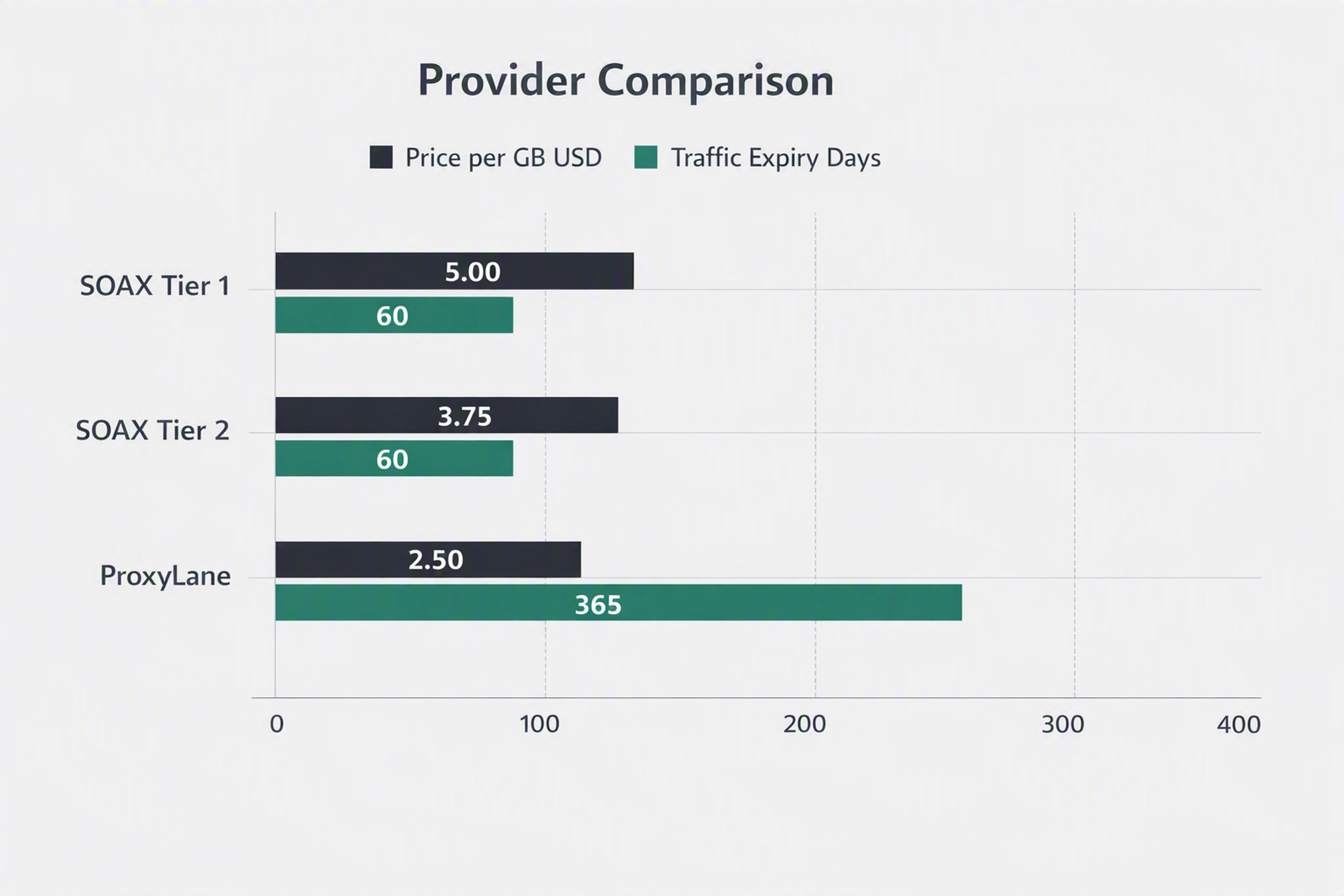
Headline pricing and rollover: SOAX charges more per GB with 60-day credits, while ProxyLane offers lower per-GB rates and traffic that never expires.
When SOAX makes more sense for growth and scraping
SOAX is a strong choice when you need a control-oriented, benchmarked platform and are comfortable paying more for that control.
Ideal SOAX use cases
- Enterprise-scale scraping across many markets where:
- You want city + ISP + ASN + ZIP controls.
- You design detailed rotation and retry strategies in-house.
- You value published metrics (99.95% success, 0.55s) to justify your vendor internally.
- Ad verification and brand safety:
- Verifying creatives and placements as seen from specific ISPs, ASNs, or ZIPs.
- Checking regional compliance where small geo mismatches matter.
- Heavily regulated or risk-averse environments that want:
- Established vendor reputation.
- 24/7 monitored pool and explicit ethical sourcing docs.
SOAX’s SOAX residential proxies review on Proxyway reinforces this: strong infrastructure and control plane, slightly weaker in support after platform changes, but overall premium positioning.
When ProxyLane makes more sense for growth and scraping
ProxyLane is designed for teams that want reliable residential access with better bandwidth economics and minimal friction.
Ideal ProxyLane use cases
- Growth and marketing teams running:
- Regular but not daily campaign checks (SERPs, ecommerce, review monitoring).
- Localized landing-page testing in specific cities or ISPs.
- Lead and company enrichment where volume spikes around campaigns.
- Data and AI workflows that:
- Use residential proxies for retrieval, validation, or enrichment as part of a pipeline.
- Need simple integration via Python, Playwright, cURL, or n8n without an SDK.
- Want to drive AI agents through open-source skills that test and verify connections.
- Teams optimizing for cost per successful result by:
- Buying traffic in 1 GB+ chunks for a project.
- Using what they need today and keeping unused GB forever.
ProxyLane’s brand emphasizes:
- Quality before volume – bigger pools only matter if sessions are stable and responses are valid.
- Evidence-based buying – you should verify IP geography and behavior before scaling.
- Ethical residential networks – informed participation and abuse response as non-negotiables.
If that mindset aligns with how you already think about data infrastructure, ProxyLane is likely a strong fit.
How ProxyLane compares beyond SOAX
If you’re benchmarking broadly, you’re likely also looking at Oxylabs, Bright Data, or Smartproxy.
- Oxylabs – large pool, strong tooling, deep enterprise focus. If you’re thinking about Oxylabs specifically, see our related guide: Oxylabs alternatives for web scraping: how ProxyLane compares.
- Bright Data – massive feature set, many proxy types, strong data collection platform; often overkill and pricier for smaller teams.
- Smartproxy – more SMB-friendly, simple dashboards and good documentation.
In that landscape, ProxyLane anchors itself as:
- Premium residential proxies for your next working request, not a generic bandwidth bucket.
- A provider that’s comfortable teaching you how to validate any residential proxy, even if it’s not theirs.
SOAX, by contrast, leans further toward the control-plane and benchmark side of the market.
Practical buying checklist
Use this checklist to decide between SOAX and ProxyLane for a new growth or scraping project.
1. How often will you run jobs?
- Daily/high-volume: SOAX or ProxyLane both work; SOAX’s benchmarks may matter more at scale.
- Intermittent/bursty: ProxyLane’s non-expiring traffic is a clear financial advantage.
2. What geo precision do you actually need?
- Need ASN/ZIP-level control? SOAX.
- Country/city/ISP is enough? ProxyLane is simpler and cheaper.
3. How complex is your rotation logic?
- Custom rotation per tenant / error mode tuning? SOAX.
- Just need rotating vs sticky sessions that work reliably? ProxyLane.
4. What are you measured on internally?
- Infrastructure SLAs (latency, success rate) → SOAX’s public metrics are helpful.
- Cost per valid row / lead / enriched record → ProxyLane’s pricing and traffic model can be easier to optimize.
FAQ: SOAX vs ProxyLane for residential proxies
1. Which is cheaper for residential proxies, SOAX or ProxyLane?
On headline pricing, ProxyLane is cheaper per GB. ProxyLane starts at $2.50/GB with a 1 GB / $6.50 entry package and traffic that never expires. SOAX lists residential pricing at $5.00/GB (Tier 1) and $3.75/GB (Tier 2) with credits that roll over for 60 days.
However, the real metric is cost per successful request. SOAX’s claimed 99.95% success and 0.55s response time may justify the higher price if your workloads are highly sensitive to performance. ProxyLane relies on you validating quality in your own pipeline, but its lower $/GB and non-expiring traffic can make it more cost-effective, especially for intermittent jobs.
2. Who has better geo-targeting: SOAX or ProxyLane?
SOAX offers more granular geo controls: country, region, city, ISP, ASN, and ZIP. That’s valuable when you need very specific network or postal-level targeting.
ProxyLane offers country, city, and ISP targeting, which covers most growth, scraping, and testing scenarios (e.g., local SERPs, ecommerce, landing pages) without over-complication. If you don’t explicitly need ASN/ZIP, ProxyLane’s simpler targeting is usually enough.
3. Which is better for sticky vs rotating sessions?
Both support rotating and sticky residential sessions.
- SOAX goes further with timed rotation, request-count rotation, and error behaviors. Choose it if you want precise control over when and how IPs rotate and how retries behave.
- ProxyLane focuses on a clear choice between rotating vs sticky sessions and aligns guidance around workflow design (single request vs multi-step flows). Choose it if your needs are straightforward and you want less configuration overhead.
4. Which provider integrates more easily with developer tools?
Both work with standard HTTP/SOCKS5 clients, but ProxyLane is explicitly developer-first and provider-agnostic:
- Works out of the box with Playwright, Python, cURL, and n8n, no proprietary SDK.
- Publishes open-source skills that teach AI agents and developers how to set up and verify residential proxies, not just ProxyLane’s.
SOAX also supports popular languages and tools, but ProxyLane’s documentation and GitHub skills lean harder into “use the stack you already have” and validation-first setups.
5. Is ProxyLane a good alternative to SOAX for smaller teams?
Yes. For small and mid-size teams with limited but important scraping workloads, ProxyLane is a strong SOAX alternative because:
- You can start at 1 GB / $6.50 with no expiry.
- You get country/city/ISP targeting and simple session control.
- You can integrate with existing tools without restructuring your stack.
If your workloads later demand ultra-granular geo routing or complex rotation rules, you can still add a provider like SOAX alongside ProxyLane and compare actual cost per successful result between them.
Bottom line
- Pick SOAX when you want maximum control, benchmarked performance, and deep geo filters and you’re okay with paying more for those capabilities on a 60-day credit cycle.
- Pick ProxyLane when you want premium residential proxies with better bandwidth economics, non-expiring traffic, and straightforward integration for growth and data workflows.
In many mature teams, the most robust approach is to test both on the same workflow, track cost per validated record, and scale traffic toward the provider that delivers the best total cost of successful requests.