
Amazon Scraper API vs Proxy: Choose a Product Data Source
Compare seller APIs, licensed Amazon product data and proxy page checks by record, access scope and reuse rights.
Read guide
Python BeautifulSoup scraping still starts with requests + bs4, but durable, logged‑in workflows now live or die on the proxy layer. This guide shows how to…

Python BeautifulSoup scraping still starts with requests + bs4, but durable, logged‑in workflows now live or die on the proxy layer. This guide shows how to install and use BeautifulSoup, then pairs those patterns with rotating residential proxies in a ProxyLane‑style stack so your selectors survive localization, A/B tests, and anti‑bot tweaks.
We’ll cover practical BeautifulSoup patterns, then a ProxyLane proxy service review: pricing, features, competitors, and when their residential proxies make sense for modern web scraping.
beautifulsoup4 is a Python library that parses HTML/XML into a navigable tree.
You can:
find, find_all, CSS selectors via Soup Sieve)Despite newer browser‑based tools, BeautifulSoup remains a mainstream primitive in 2026 for:
beautifulsoup pip basicsBeautifulSoup itself is parser‑agnostic; you install it plus one or more HTML parsers.
pip install beautifulsoup4 lxml html5lib requests
beautifulsoup4 – the core librarylxml – fast, robust parser (recommended for most scraping)html5lib – browser‑like parsing; slower but more forgivingrequests – the HTTP client we’ll pair with proxiesBeautifulSoup’s docs note that invalid HTML can produce different trees in different parsers, so choose intentionally:
lxml when you care about speed and the HTML is moderately cleanhtml5lib when sites are extremely messy or you need browser‑like behaviorBasic import pattern:
import requests
from bs4 import BeautifulSoup

html = """<html><body><p>Hello world</p></body></html>"""
soup = BeautifulSoup(html, "lxml")  # or "html5lib" or "html.parser"
print(soup.p.text)
Key points:
"lxml", "html5lib", or "html.parser"Most logged‑in scraping workflows rely on a small set of BeautifulSoup primitives.
find and find_all: structural selection that ages wellText changes often; structure less so. Use attributes and hierarchy rather than visible copy.
product = soup.find("div", class_="product-card")
price = product.find("span", attrs={"data-test": "price"}).text.strip()

products = soup.find_all("div", class_="product-card")
for p in products:
    name = p.find("h2").get_text(strip=True)
    print(name)
Patterns that pair well with residential proxies:
data-* and testing hooks that survive localizationWhen A/B tests shuffle components, you often need relative traversal.
card = soup.find("div", class_="product-card")

# Parent containers
section = card.parent

# Children
image = card.find("img")

# Siblings
next_card = card.find_next_sibling("div", class_="product-card")
Useful traversal attributes/methods:
.parent, .parents – climb up the tree.children, .descendants – walk down.next_sibling, .previous_sibling – lateral movement within a list/gridThese structural relations tend to survive:
BeautifulSoup’s select now uses Soup Sieve, which supports modern CSS selectors:
# Products that are on sale
sale_cards = soup.select("div.product-card:has(span.badge[data-type='sale'])")

# Links in a specific section
links = soup.select("section#recommended a[href]:not([rel='nofollow'])")
Soup Sieve supports:
[data-test='price'], [href^='/product']section > div, ul li + li:not(), :is(), :has() (draft‑level CSS4 semantics)If you build a scraping API where users submit CSS selectors, treat them as untrusted input.
GitHub security advisories report that Soup Sieve ≤ 2.8.3 was vulnerable to Regular Expression Denial of Service (ReDoS) and memory exhaustion from crafted selectors. The advisory (GHSA‑836r‑79rf‑4m37) recommends upgrading to Soup Sieve ≥ 2.8.4.
Practical safeguards:
Residential proxies are most useful when you need logged‑in continuity. Requests’ Session object is the right abstraction.
import requests
from bs4 import BeautifulSoup

session = requests.Session()
session.headers.update({
    "User-Agent": "Mozilla/5.0 (compatible; bs4-agent/1.0)",
    "Accept-Language": "en-US,en;q=0.9",
})

resp = session.get("https://example.com/login")
# ... post credentials, keep cookies on `session`

resp = session.get("https://example.com/account")
soup = BeautifulSoup(resp.text, "lxml")
Why Session matters:
This is the bridge between a “logged‑in browser workflow” and a repeatable scraping script.
Even a perfect selector fails if the page never loads or shows the wrong variant.
Residential proxies affect what you see and whether you get blocked:
MDN documents that headers like Accept-Language and cache Vary rules drive content negotiation, meaning:
For BeautifulSoup workflows, that means you need:
ProxyLane is a residential proxy provider built for AI agents and authenticated browser workflows.
According to ProxyLane’s published metrics, they focus on clean residential IPs, high success rates, and session control rather than raw pool size. They emphasize that fewer blocked requests reduce the GB you pay per finished page.
ProxyLane runs four main products relevant to BeautifulSoup Python scraping:
ProxyLane pricing (2026, as publicly listed):
They expose HTTP(S) and SOCKS5 gateways, support rotating and sticky sessions from 1 second up to 72 hours, and allow unlimited concurrent connections. Exact gateway URLs, authentication formats, and targeting parameters are documented in their dashboards and API docs; always check your provider’s current documentation.
Here’s how ProxyLane’s residential proxies compare to other residential proxy providers for web scraping in 2026.
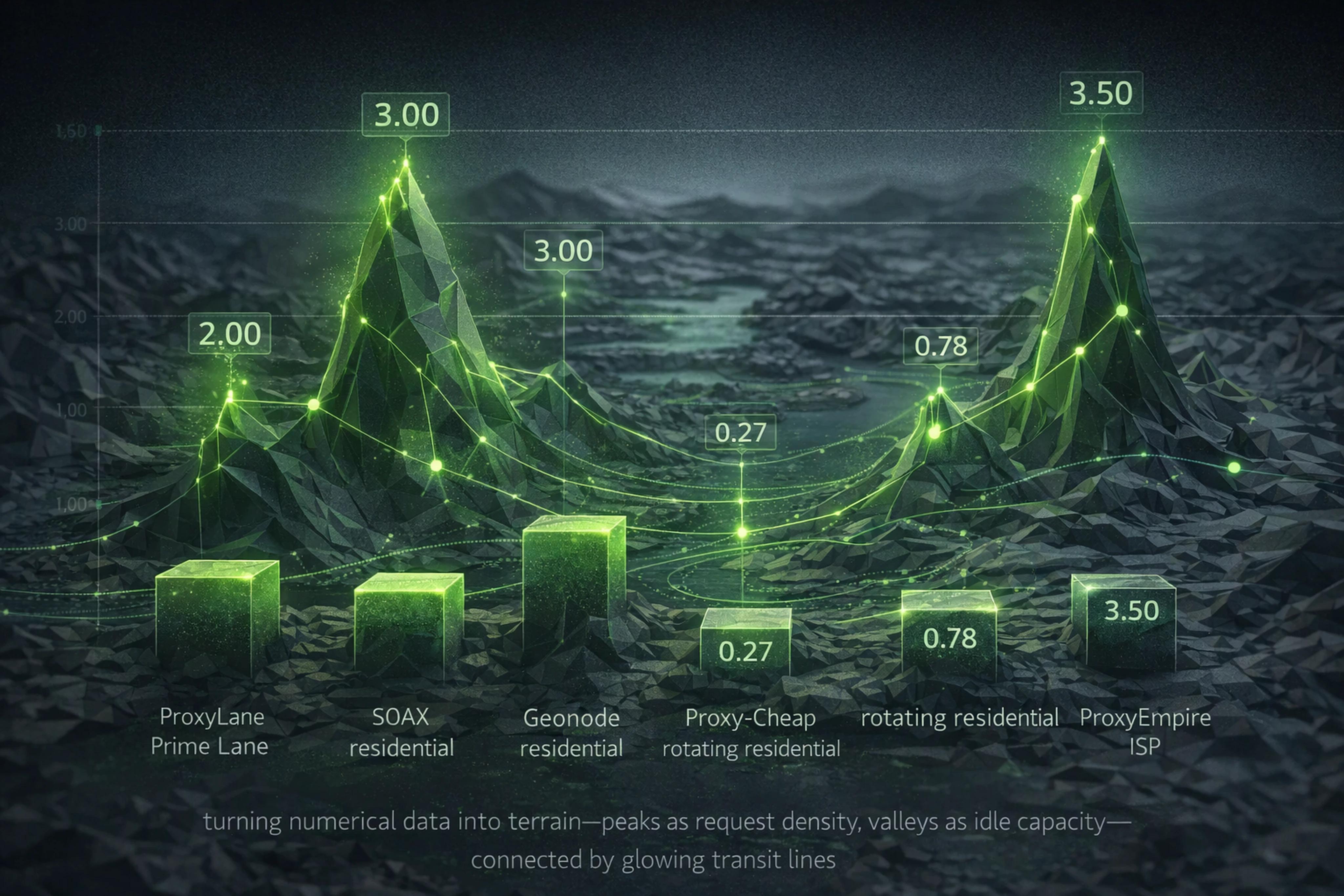
Key reference points from public marketing pages:
Interpretation for BeautifulSoup workflows:
Strengths compared to other residential proxy providers for web scraping review:
Consider competitors when:
Designing selectors is only half the problem; the other half is keeping IP, locale, and sessions aligned.
Session + proxy rotation tied to workflow stepsExample: scraping paginated product listings behind a login.
import requests
from bs4 import BeautifulSoup

BASE_URL = "https://example.com"
PROXY = "http://user:pass@gw.proxylane.example:12345"  # example format; consult your provider docs

session = requests.Session()
session.headers.update({
    "User-Agent": "Mozilla/5.0 (compatible; bs4-residential/1.0)",
    "Accept-Language": "en-US,en;q=0.9",
})
session.proxies.update({
    "http": PROXY,
    "https": PROXY,
})

# 1. Log in
resp = session.post(f"{BASE_URL}/login", data={"email": "...", "password": "..."})
resp.raise_for_status()

# 2. Scrape multiple pages with the same IP/session
for page in range(1, 6):
    resp = session.get(f"{BASE_URL}/account/orders?page={page}")
    resp.raise_for_status()
    soup = BeautifulSoup(resp.text, "lxml")
    for row in soup.select("table.orders tr.order-row"):
        order_id = row.select_one("td.id").get_text(strip=True)
        print(order_id)
Proxy rotation strategies:
ProxyLane and similar providers expose rotation and sticky session controls; use them to mirror how a human would browse.
Residential IPs are only part of geolocation; headers matter too.
MDN’s docs explain that Accept-Language influences server responses and caching. For durable selectors:
Accept-Language to the country of your proxy exitExample:
session.headers["Accept-Language"] = "de-DE,de;q=0.9" # when using a German residential exit
On modern e‑commerce sites, copy changes constantly. Keep BeautifulSoup selectors resilient:
data-* attributes, test IDs, and stable classes:has() and :not() to express relationships rather than words.find(text="Buy now"); use .find("button", attrs={"data-role": "purchase"})Residential proxies help because they:
parse_only for performanceWhen pages are large, BeautifulSoup can parse only what you need.
from bs4 import BeautifulSoup, SoupStrainer

only_products = SoupStrainer("div", class_="product-card")
soup = BeautifulSoup(html, "lxml", parse_only=only_products)
Notes:
html5lib, per BeautifulSoup docsPaired with residential proxies, this saves bandwidth and CPU:
Residential proxy providers raise distinct compliance questions.
Best practices for ethical BeautifulSoup Python scraping with residential proxies:
Residential proxies can increase risk because traffic looks like that of real end‑users:
Always consult legal counsel and your organization’s policies when designing scraping systems, especially for authenticated, localized content.
For teams asking “best residential proxies web scraping 2026 ethical” and specifically “ProxyLane residential proxies pricing features review,” here’s a concise verdict.
If you’re building agents or scrapers that act for users in one country and need residential IPs plus sticky sessions, ProxyLane’s design philosophy aligns well with BeautifulSoup‑centric workflows. You can learn more and test these patterns against real endpoints at proxylane.dev.
Install BeautifulSoup, a parser, and Requests:
pip install beautifulsoup4 lxml requests
Then:
import requests
from bs4 import BeautifulSoup

resp = requests.get("https://example.com")
soup = BeautifulSoup(resp.text, "lxml")
for link in soup.find_all("a"):
    print(link.get("href"))
Use:
"lxml" for speed and robustness on typical sites"html5lib" when dealing with extremely broken HTML and you need browser‑like parsingParser choice affects how unstable markup is interpreted, so test against your target site.
In Requests:
session = requests.Session()
session.proxies.update({
    "http": "http://user:pass@gw.provider.example:port",
    "https": "http://user:pass@gw.provider.example:port",
})
resp = session.get("https://example.com")
soup = BeautifulSoup(resp.text, "lxml")
Consult your proxy provider docs for exact gateway URLs, authentication formats, and targeting options.
Legality depends on jurisdiction, target site terms, and how you use them. In general:
Seek legal counsel for sensitive or large‑scale projects.
ProxyLane is strong when you need:
Other providers may be better if your priority is the lowest possible price/GB. Evaluate based on cost per successful result, not just advertised pool size or headline price.
 ProxyLaneTraffic never expires
Scale your workflows with the tools you already use. Rotating or sticky sessions up to 72 hours.
Compare seller APIs, licensed Amazon product data and proxy page checks by record, access scope and reuse rights.
Read guideChoose the right anti-detect browser proxy guide, map the shared verification steps, and keep account access separate from the network route.
Read guideOur picks for market research: ProxyLane for small, intermittent projects, plus options for regional tracking, monthly collection and managed extraction.
Read guide